Loading..

GET 10% OFF BY USING CODE TBS10

Where to Buy Authentic Banarasi Sarees in Varanasi: A Local’s Guide

The best markets, weaving areas, buying tips and authenticity checks before you take a Banarasi saree home

There is something special about buying a Banarasi saree in Varanasi itself.

You are not simply entering a shop and choosing a piece of clothing. You are entering a city whose textile identity is deeply connected with silk, zari, jacquard weaving and generations of artisan knowledge.

But there is one problem.

How do you know which Banarasi saree is actually worth buying?

Varanasi has everything from traditional market lanes and wholesale traders to family-run stores, weaving communities, showrooms and craft institutions. Prices can vary dramatically, and a saree described as “pure,” “handloom” or “original Banarasi” should not be accepted on the label alone.

This guide explains where to shop for Banarasi sarees in Varanasi, what each area is best for, how to identify a genuine product and how to avoid common buying mistakes.


First: What Does “Authentic Banarasi” Actually Mean?

Before discussing markets, it is important to understand what you are buying.

Banaras Brocades and Sarees is a registered Geographical Indication (GI) product associated with Uttar Pradesh. The official GI description identifies finely woven silk, intricate zari ornamentation, compact weaving and characteristic Banarasi motifs including floral and foliate designs, kalga, bel, jali and meena work.

The word Banarasi, however, does not automatically mean:

  • 100% pure silk
  • Handwoven
  • Handmade zari
  • One specific fabric
  • One specific price range

A Banarasi product can have different fabric compositions and production methods, so a buyer needs to ask questions.

And this is especially important when shopping in a tourist-heavy market.


Where Should You Shop for Banarasi Sarees in Varanasi?

Rather than looking for one “best shop,” think of Varanasi’s saree shopping landscape in five broad categories:

  1. Chowk and Thatheri Bazaar — traditional market experience and wide variety
  2. Vishwanath Gali / Godowlia area — convenient for visitors and first-time browsing
  3. Weaving neighbourhoods — closer to the production side of the craft
  4. Organised handloom/craft institutions — useful when you prioritise documentation and learning
  5. Established saree showrooms — convenient for comparing collections and receiving guided assistance

Each serves a different type of buyer.


1. Chowk & Thatheri Bazaar: For the Traditional Market Experience

If you want to experience old Banaras saree shopping, start around the traditional commercial areas of Chowk and Thatheri Bazaar.

These areas are associated with the city’s established textile trade and offer access to multiple sellers rather than one single showroom.

That makes them useful for comparison shopping.

You can look at several sarees side by side, compare:

fabric + zari + motifs + weaving + price

before making a decision.

Recent local shopping guides continue to identify Chowk and Thatheri Bazaar among the key areas for Banarasi shopping.

Best for:

  • Experienced saree buyers
  • Wholesale-style shopping
  • Comparing multiple designs
  • Traditional Banarasi patterns
  • Buyers comfortable negotiating

One important warning

A busy market does not automatically mean every seller is selling handwoven silk.

Ask specifically:

“Is this handloom or powerloom?”

“What is the fabric composition?”

“Where was it woven?”

“Can you show the product or certification details?”


2. Vishwanath Gali & Godowlia: Convenient for First-Time Visitors

The areas around Vishwanath Gali and Godowlia are convenient if you are already exploring central Varanasi.

They offer a large concentration of saree shops and make it easy to compare products without travelling deep into the weaving areas.

Recent 2026 local shopping guides identify Vishwanath Gali, Godowlia, Chowk and Thatheri Bazaar as important areas in Varanasi’s saree-shopping landscape.

Best for:

  • First-time visitors
  • Tourists
  • Quick shopping
  • Large variety
  • Ready-to-browse collections

The downside

These are convenient shopping areas, so you should be particularly careful about tourist pricing and product claims.

Don’t buy the first saree you see.

Walk into several stores.

Ask the same questions.

Compare similar-looking products.

You will quickly learn how widely prices can vary.


3. Weaver Neighbourhoods: Go Closer to the Loom

For buyers who want to understand where Banarasi textiles are actually produced, the most interesting experience can be moving beyond the retail streets and into weaving communities.

Government documentation of the Banaras weaving ecosystem describes a network of weaving communities, workshops and specialised production activities. Historical documentation refers to weavers as karigars and describes karkhanas and different roles within the production chain.

Current local guides commonly point buyers toward areas such as Madanpura, Pilikothi and other weaving clusters, where the relationship between household/workshop and textile production can be much more direct.

Why this experience is different

You may get the opportunity to understand:

  • How the loom works
  • How patterns are developed
  • What different fabrics feel like
  • How zari is incorporated
  • How long certain designs can take
  • The difference between retail and production environments

Important

Not every weaving household is a walk-in retail store.

It is better to arrange an introduction or visit through a reputable local contact rather than arriving unannounced at private homes.


4. Deendayal Hastkala Sankul: Learn Before You Buy

One of the most useful places for someone who wants to understand Banarasi craftsmanship before shopping is the Deendayal Hastkala Sankul (Trade Facilitation Center & Crafts Museum).

The Government of Uttar Pradesh says its textile gallery displays a wide range of Banarasi sarees, dupattas and stitched garments, while also explaining the complete weaving process, including techniques, materials and tools. Its GI gallery displays GI products with their associated details.

This is valuable because the best Banarasi buyer is not necessarily the one who knows the cheapest market.

It is the buyer who knows what they are looking at.

Best for:

  • First-time buyers
  • Brides
  • Textile enthusiasts
  • International visitors
  • Buyers who want to learn about Banarasi craftsmanship
  • Anyone confused by different weaving terms

Shopping advantage

Even when you don’t purchase your saree here, understanding the textile first can make your later market shopping much more informed.


5. Organised Handloom Institutions & Weaver Support Network

Varanasi is also home to the Government of India’s Weavers’ Service Centre, part of the national handloom support network. The Development Commissioner (Handlooms) lists Varanasi among its Weavers’ Service Centres and describes the broader role of these centres in technical assistance, skill development and design support.

This is less about finding a tourist shopping street and more about understanding the institutional side of the handloom ecosystem.

The Varanasi Design Resource Centre has also been established as part of the Weavers’ Service Centre network, with design resources intended for weavers, manufacturers, designers and other textile stakeholders.

For serious textile buyers, researchers and designers, this side of Banaras is worth knowing about.


Should You Buy from a Market or a Showroom?

This is one of the most common questions.

The answer depends on what you value.

Local Market

Advantages

More variety

More opportunity to compare prices

Traditional shopping atmosphere

Potentially more room for negotiation

Disadvantages

Quality varies

More product knowledge required

Greater need to verify fabric and weaving claims


Established Showroom

Advantages

More organised experience

Easier comparison

Better product presentation

Often more convenient for out-of-town buyers

Disadvantages

Prices may be higher

Less bargaining flexibility

A premium showroom does not automatically prove handloom authenticity

The correct question isn’t:

“Market or showroom?”

It is:

“Can this seller clearly explain what this saree is and where it came from?”


How to Identify an Authentic Banarasi Saree

This is the most important section of the entire guide.

1. Ask About the Fibre

Never assume:

Banarasi = pure silk

Ask:

“Is this 100% silk?”

“What is the exact fibre composition?”

For pure silk products, the Silk Mark system is one useful certification mechanism. The Silk Mark Organisation of India states that its label is used on products made from 100% pure silk by authorised users.


2. Ask Whether It Is Handloom or Powerloom

Do not accept:

“Original Banarasi.”

as the only answer.

Ask:

“Handloom hai ya powerloom?”

This distinction matters because Varanasi has both traditional handloom production and mechanised production.

Research on Varanasi’s handloom sector has specifically identified competition from powerloom production as a significant challenge for traditional weavers.


3. Ask Where It Was Woven

This is particularly important when purchasing an expensive saree.

Ask:

“Ye saree kahan weave hui hai?”

A seller who knows their supply chain should be able to give you meaningful information.

You don’t necessarily need the exact address of a weaver, but you should understand the production origin and fabric category.


4. Look at the Reverse Side

Turn the saree over.

Look closely at:

  • Weave consistency
  • Zari integration
  • Loose threads
  • Motif construction
  • Selvage
  • Back-side finishing

A close-up of the reverse can sometimes tell you much more than a heavily edited front photograph.


5. Study the Zari

Don’t assume:

shiny = good zari

Ask what type of zari is used.

Also remember:

Silk certification and zari quality are separate matters.

The Silk Mark Organisation of India specifically states that Silk Mark does not guarantee zari purity or quality.

So for an expensive saree, ask separately about:

silk + zari


6. Don’t Judge Authenticity by Price Alone

A ₹5,000 saree is not automatically fake.

A ₹50,000 saree is not automatically authentic.

Price can vary because of:

  • Silk quality
  • Fabric construction
  • Zari
  • Weaving technique
  • Motif density
  • Design complexity
  • Labour
  • Brand positioning
  • Retail margin

The smarter approach is to understand what you’re paying for.


7. Don’t Expect a Burn Test to Be the Only Answer

You may hear advice online telling buyers to perform a burn test.

Don’t experiment casually with a valuable saree.

Instead, rely on:

product documentation + certification where applicable + seller transparency + professional testing when necessary

A premium saree is not the place for risky DIY experiments.


What Should a Good Banarasi Seller Be Able to Explain?

Before buying, see whether the seller can answer these questions clearly:

Fabric

What is the fibre?

Weave

What type of Banarasi is this?

Production

Handloom or powerloom?

Origin

Where was it woven?

Zari

What type of zari is used?

Design

Is the motif woven or embroidered?

Care

How should it be cleaned and stored?

Certification

Is there Silk Mark or other relevant documentation?

A confident seller does not need to make exaggerated promises.

They should be able to explain the product.


How to Compare Prices Without Getting Confused

Imagine three stores show you sarees that look almost identical.

Store A:

₹8,000

Store B:

₹15,000

Store C:

₹28,000

Don’t immediately conclude that A is the bargain and C is overpriced.

Ask each seller:

Pure silk?

What weave?

Handloom?

What zari?

How intricate is the design?

Who made it?

What certification is available?

What is the saree’s actual length and width?

Once you ask these questions, the price difference often becomes easier to understand.


When Is the Best Time to Shop for a Banarasi Saree?

If you are visiting Varanasi specifically to buy a wedding saree, don’t leave it until your final day in the city.

Give yourself time to:

Compare

Think

Revisit

Negotiate

Verify

Decide

For a bridal purchase, spending several hours—or even multiple shopping sessions—can be much wiser than making a rushed decision.


How Many Shops Should You Visit?

For an ordinary festive saree:

3–5 stores can give you a good comparison.

For an expensive bridal Banarasi:

Visit several sellers and compare equivalent categories.

Don’t compare:

lightweight Georgette

with

heavy Katan brocade

and conclude one shop is cheaper.

Compare like with like.


How to Bargain in Varanasi’s Saree Markets

Bargaining may be possible in traditional markets, but don’t make the lowest possible price your only objective.

Instead:

First

Understand the product.

Second

Compare similar sarees from multiple shops.

Third

Ask for the best final price.

Fourth

Consider the seller’s transparency and after-sales support.

A ₹500 saving is not necessarily worthwhile if you lose confidence in what you have purchased.


A Local-Style Shopping Strategy

Here’s a simple approach for a first-time visitor.

Morning: Learn

Visit a craft or textile institution such as Deendayal Hastkala Sankul and understand the basic vocabulary and weaving process.

Afternoon: Compare

Explore Chowk and Thatheri Bazaar and compare several sellers.

Later: Go Deeper

If buying a high-value handloom piece, seek access to a genuine weaving network or workshop rather than relying entirely on tourist-facing retail.

Final Stage: Verify

Before paying, recheck:

fabric + handloom/powerloom + zari + origin + certification + price

This is far safer than choosing purely by appearance.


Examples of Local Places Buyers May Encounter

Varanasi has a large number of saree sellers and weaving businesses, and availability, inventory and business status can change. Rather than declaring any individual shop “authentic” solely from online listings, treat these as places to research and compare, and independently verify the product’s handloom, silk and provenance claims.

One example is Shades Of Banaras in the Govindpura area, which is listed as a saree shop/silk store. Another is Madhu Handloom (Banarasi Silk Brocades Manufacturer and Wholesale Supplier) near Chaukhambha.

For a more production-oriented option, Banarasi Sarees Manufacturer in Varanasi India is listed in Madanpura as a textile/clothing manufacturer and wholesaler, while Adarsh Silk Bunkar Co-op Ltd: Banarasi Handloom Wholesale Outlet is listed as a handicrafts wholesaler in the Ramnagar area. These listings are useful starting points, but a directory listing is not itself proof that every product sold there meets a particular handloom or purity standard. Verify each saree individually before purchasing.


The Best Areas for Different Types of Buyers

Your PriorityWhere to Start
Traditional market experienceChowk / Thatheri Bazaar
Convenient tourist shoppingVishwanath Gali / Godowlia
Comparing many designsChowk / central market areas
Understanding weavingDeendayal Hastkala Sankul
Looking closer to weaving communitiesMadanpura / other weaving clusters
Serious textile researchWeavers’ Service Centre / craft institutions
Wholesale-style buyingTraditional textile trade areas
First Banarasi purchaseOrganised seller + market comparison

How Much Should You Budget?

There is no single authentic Banarasi price.

Depending on fabric, zari, design, weaving method, craftsmanship and brand, prices can range from relatively accessible festive pieces to very expensive bridal and collector-grade textiles.

Instead of starting with:

“I have ₹10,000. What Banarasi can I buy?”

start with:

“What type of Banarasi do I want?”

For example:

Lightweight festive saree

Look at lighter fabrics and simpler zari.

Traditional Katan

Expect a different price bracket depending on silk, design and zari.

Intricate bridal brocade

Budget significantly more.

Heirloom-quality handloom

Focus on provenance and craftsmanship rather than simply price.


Common Mistakes Tourists Make

Mistake 1: Buying the First Saree They Like

Wait.

Compare.


Mistake 2: Assuming “Pure Banarasi” Means Pure Silk

It doesn’t.

Ask for the fibre composition.


Mistake 3: Assuming Every Banarasi Is Handloom

Ask directly.


Mistake 4: Shopping Only by Price

Cheap isn’t automatically good.

Expensive isn’t automatically authentic.


Mistake 5: Ignoring the Reverse Side

Always inspect the weave.


Mistake 6: Not Asking About Zari

Ask what you’re actually getting.


Mistake 7: Buying a Bridal Saree in a Hurry

Take your time.

A bridal saree may be worn for decades.


Mistake 8: Forgetting to Get the Invoice

For an expensive saree, retain the invoice and product details.

This is particularly useful if you later need care, alteration, exchange or provenance information.


What to Carry While Saree Shopping

Keep your shopping practical.

Carry:

Phone calculator

Measuring tape if you’re buying fabric

Shopping bag

Payment method

A note with your budget

Reference photos of the style you want

For bridal shopping, also bring:

Blouse reference

Jewellery reference

Wedding colour palette

This helps the seller recommend something that genuinely fits your wardrobe.


A Simple 10-Point Authenticity Checklist

Before you pay, ask yourself:

☐ Is the fibre clearly identified?

☐ Is it handloom or powerloom?

☐ Does the seller explain where it was woven?

☐ Have I inspected the reverse side?

☐ Do I understand the zari?

☐ Does the price make sense for the craftsmanship?

☐ Have I compared similar sarees?

☐ Is certification available where applicable?

☐ Do I have the invoice?

☐ Am I buying because I love the saree—or because the seller is pressuring me?

If you can answer all ten comfortably, you’re in a much stronger position.


Why Buying in Varanasi Is Still Special

Online shopping can offer convenience.

But buying a Banarasi saree in Varanasi gives you something an online photograph cannot.

You get to:

Touch the fabric.

See the zari in natural light.

Compare textures.

Speak with sellers.

Ask about weaving.

Visit textile institutions.

And, when arranged appropriately, experience the connection between the finished product and the weaving communities behind it.

That connection is part of what makes buying a Banarasi in Banaras so memorable.


The Banarasi Style: Buy the Story, Not Just the Saree

At The Banarasi Style, we believe that choosing a Banarasi saree should begin with understanding what makes the textile special.

The beauty is in:

the silk

the zari

the weave

the motif

the craftsmanship

and the hands behind the fabric

Varanasi’s Banarasi tradition has a recognised GI identity and remains supported by a wider handloom ecosystem that includes weaving communities, government programmes, design resources and craft institutions.

That is why the best Banarasi purchase isn’t necessarily the most expensive one.

It is the one whose quality, craftsmanship, provenance and price you understand.


Final Verdict: Where Should You Buy Your Banarasi Saree in Varanasi?

There isn’t one magic shop or one street that guarantees authenticity.

For the traditional market experience, explore:

Chowk and Thatheri Bazaar.

For convenient tourist shopping, look around:

Vishwanath Gali and Godowlia.

For a deeper connection with the craft, explore:

weaving communities and reputable weaver networks.

For learning about the textile before spending money, visit:

Deendayal Hastkala Sankul.

And throughout the process, remember the golden rule:

Don’t buy the label. Buy the product you have verified.

Ask about the silk.

Ask about the weave.

Ask about the zari.

Ask where it was made.

Ask whether it is handloom.

Ask for documentation where appropriate.

Then make your decision.

Because when you take a Banarasi saree home from Varanasi, you’re not just bringing back a beautiful garment.

You’re bringing back a piece of the city’s living textile heritage.

The Banarasi Style

Timeless Elegance Woven in Varanasi.


Frequently Asked Questions

Where is the best place to buy Banarasi sarees in Varanasi?

For traditional market shopping, Chowk and Thatheri Bazaar are useful starting points. Vishwanath Gali and Godowlia are convenient for visitors. Buyers seeking deeper craft connections can explore weaving communities and established weaver networks.

Is Chowk good for Banarasi saree shopping?

Yes. Chowk is part of Varanasi’s established textile-trade areas and is useful for comparing multiple sellers and designs. But you should verify each product rather than assuming every seller offers handwoven or pure-silk Banarasis.

Is Godowlia good for Banarasi sarees?

Godowlia is convenient because of its concentration of retail stores and its accessibility for visitors. As with any busy market, compare prices and verify fabric and production claims before purchasing.

Can I buy Banarasi sarees directly from weavers?

Yes, but direct buying usually requires some local knowledge or an introduction because many weaving households are production spaces rather than conventional retail shops.

Are Banarasi sarees from Varanasi always pure silk?

No. Always check the fibre composition. The term Banarasi does not itself guarantee 100% pure silk.

How can I verify pure silk?

Where applicable, look for a Silk Mark label from an authorised user. The Silk Mark Organisation of India says the label is used for products made from 100% pure silk.

Does Silk Mark prove that the zari is pure?

No. Silk Mark concerns silk purity and does not certify zari quality or purity.

How do I know whether a Banarasi saree is handloom?

Ask the seller directly and request clear product information. Do not infer handloom status merely from the saree’s appearance.

How much should I pay for an authentic Banarasi saree?

There is no universal price. Compare sarees with similar fabric, weaving method, zari, design complexity and craftsmanship.

Should I bargain when buying Banarasi sarees in Varanasi?

Bargaining may be possible in traditional markets, but first understand the product and compare similar sarees. The lowest price should not be your only criterion.
Meet the Weavers of Varanasi: The Hands Behind Every Banarasi Saree

The hands, heritage and human stories behind one of India’s most treasured textiles

When you see a Banarasi saree, the first things you may notice are the silk, the zari, the intricate border, the pallu and the unmistakable richness of the design.

But there is something much more important behind every finished saree:

a pair of hands.

Hands that prepare threads.
Hands that read patterns.
Hands that operate the loom.
Hands that correct tiny imperfections.
Hands that may have learned the craft inside a family workshop and spent decades refining it.

The Banarasi saree is often described as a symbol of Indian luxury, bridal tradition and heritage. Yet the textile’s history cannot be separated from the people who make it.

In Varanasi, weaving remains one of the city’s best-known craft traditions. The Government of Uttar Pradesh describes silk weaving and Banarasi sarees as among Varanasi’s most renowned handicrafts, while Banaras Brocades and Sarees has registered Geographical Indication status. The official GI description highlights finely woven silk, intricate zari ornamentation, compact weaving and characteristic motifs and techniques associated with Banaras.

This is the story behind the saree you see in a shop window or on an online product page.

It is the story of the weavers of Varanasi.


Who Are the People Behind a Banarasi Saree?

A Banarasi saree does not emerge from one simple step.

Its creation can involve several stages of specialised work, from yarn preparation and design development to setting the loom and weaving the final fabric.

In traditional weaving communities, skills have often been passed through families and generations. A 2024 study of Varanasi handloom weavers found that 92% of respondents identified weaving as a family occupation, illustrating how strongly inherited knowledge continues to shape the sector. The same study also found that many respondents had decades of weaving experience.

This is important because weaving knowledge is not only written in manuals.

Much of it is learned through practice.

A young person growing up around a loom may first observe. Then assist. Later, they may learn individual processes before eventually taking responsibility for a complete section of weaving.

Over years, the movement of the hand becomes almost instinctive.

The weaver learns to understand tension, alignment, rhythm, pattern, thread behaviour and the subtle differences that can influence the finished cloth.

That experience is part of what gives handmade textiles their character.


Varanasi: A City Where Weaving Is Part of Everyday Life

Banarasi weaving is not confined to a museum or a historical display.

It has developed within neighbourhoods, homes, workshops and weaving clusters across the Varanasi region.

Government handloom documentation identifies Varanasi as a major handloom cluster. The Varanasi Mega Handloom Cluster, announced in 2008–09, covers the entire Varanasi district and has received interventions involving loom upgradation, raw-material supply, credit support, training, marketing and common facilities.

This cluster-level approach reflects an important reality:

The Banarasi saree is part of an ecosystem, not just an individual artisan’s product.

Within that ecosystem are weavers, designers, yarn suppliers, dyers, traders, master weavers, cooperatives, exporters, retailers and institutions that provide technical or financial support.

A saree may ultimately reach a customer thousands of kilometres away, but its production can begin inside a modest weaving room in Varanasi.


What Does a Banarasi Weaver Actually Do?

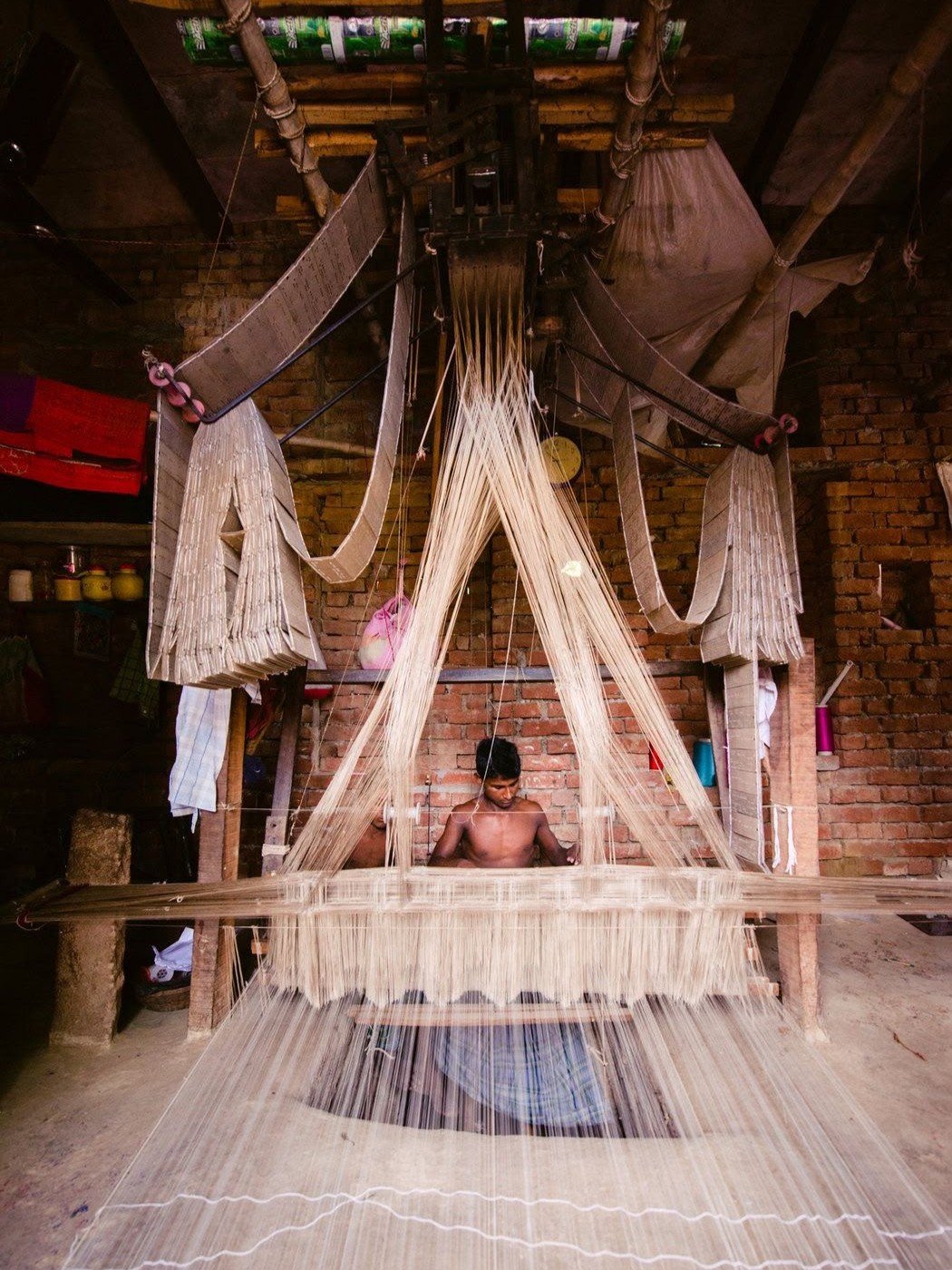
A traditional Banarasi loom may look complicated to a visitor seeing it for the first time.

For the weaver, however, every component has a purpose.

The official GI description of Banaras brocades and sarees notes the use of conventional Banaras handloom jacquard systems and traditional attachments such as jala, pagia and naka for creating motifs.

Historically documented Banaras weaving also includes techniques such as Kadhua, Cutwork and Fekwa, along with products such as Butidar, Tanchoi and Jangla styles. Government handloom literature describing the Cholapur cluster in Varanasi records pit looms fitted with jacquard systems and identifies several of these techniques among the area’s weaving practices.

The technical process can therefore involve much more than simply “putting thread through a loom.”

A skilled weaver must coordinate:

warp and weft + pattern + tension + timing + zari + fabric structure

and maintain consistency across the length of the saree.

That is why the finished design can look so effortless even though the process behind it is highly demanding.


The Art of Reading a Design

One of the most fascinating aspects of Banarasi weaving is the relationship between design and weaving.

The motifs seen on a saree do not simply appear after the fabric has been made.

They must be planned and translated into a form the loom can execute.

Traditional Banarasi designs can include floral and foliate patterns, kalga, bel, jali structures, meena work, paisleys and other decorative elements. The Varanasi district’s official GI description specifically highlights these characteristics.

For the weaver, this means the finished saree is simultaneously:

textile + geometry + craftsmanship + timing

A small error in the pattern can affect the visual continuity of the design.

The weaver therefore needs concentration for long periods.

This is one reason the word “craftsmanship” is so important when talking about Banarasi sarees.

The craft is not simply visible in the finished motif.

It is present in every decision made while that motif is being woven.


Why Banarasi Sarees Can Take So Much Time

Not every Banarasi saree takes the same amount of time to weave.

The duration depends on the fabric, design complexity, zari density, weaving technique, pattern repeat and other production factors.

A simple design and a highly intricate brocade are not equivalent projects.

The more complex the design, the greater the concentration and labour involved.

This is especially visible in intricate forms of weaving where decorative motifs must be integrated carefully into the fabric rather than simply printed onto its surface.

The result is one of the reasons Banarasi textiles have long been associated with ceremonial clothing and heirloom wardrobes.

When a customer sees a detailed Banarasi pallu, they are seeing the final expression of a much longer process.


The Loom Is More Than a Tool

For a weaving family, the loom may be both workplace and source of livelihood.

Government documentation on Varanasi’s handloom clusters notes substantial investment in loom upgradation and technical support. In the Varanasi Mega Handloom Cluster, more than 45,000 handloom parts were distributed, while a raw-material bank supplied 18.5 lakh kilograms of yarn worth about ₹307.62 crore through March 2023.

These figures demonstrate the scale of the handloom ecosystem, but they also reveal something else:

the loom cannot function independently of the larger supply chain around it.

Good yarn must be available.

Tools must work.

Designs must remain commercially relevant.

Weavers need access to finance.

And finished products must reach customers who understand their value.


The Skill You Cannot See in a Photograph

When we buy a saree online, we see an image.

We do not see:

  • How many hours the weaver sat at the loom.
  • How many times a thread had to be corrected.
  • How much concentration was required.
  • Who taught the weaver the technique.
  • How many generations of knowledge influenced the design.
  • How much of the final retail value actually reached the producer.

That gap between what the customer sees and what the maker experiences is one of the most important things to understand about handloom textiles.

The beauty of a Banarasi saree is visible immediately.

The labour behind it is not.


The Challenges Facing Varanasi’s Weavers

The story of Banarasi weaving should not be romanticised.

The craft has immense cultural value, but many weavers also face economic and occupational challenges.

A 2024 study focusing on Varanasi handloom weavers reported concerns including delayed payments, low income during off-seasons, difficulty obtaining credit, rising input costs and competition from powerloom production. In that study, 80% of respondents identified powerloom competition as a challenge. It also reported concerns related to long working hours and health problems associated with prolonged loom work.

Earlier studies have similarly identified financial pressure, raw-material costs, marketing difficulties, changing designs and irregular income among major concerns for Varanasi’s handloom community.

These challenges matter because a craft does not survive simply because consumers love the finished product.

It survives when the people making it can also build a sustainable livelihood from that craft.


Why Powerlooms Have Changed the Market

Technology has not simply entered the Banarasi industry from outside.

It has changed the competitive environment in which handloom weavers operate.

Powerloom production can offer speed, consistency and lower production costs for certain products.

For a handloom weaver, the comparison can be difficult.

A handmade saree may involve significantly more time and skilled labour, while a mechanically produced textile can imitate some of the visual elements of traditional designs at a different price point.

Research on Varanasi’s handloom sector has highlighted modernisation and mechanisation as important pressures on traditional weaving livelihoods.

This does not mean every machine-made textile is inferior in every respect.

It means that buyers need to understand what they are purchasing.

A handloom saree and a powerloom saree can belong to very different production systems even when photographs look surprisingly similar.


Why Young People Do Not Always Want to Become Weavers

A craft can be culturally prestigious while still being economically difficult.

This is one of the central challenges facing traditional weaving communities.

If younger generations see long working hours, uncertain earnings and limited opportunities for growth, they may understandably look toward other professions.

A 2024 study of Varanasi weavers found that most respondents had entered weaving through their family occupation, while the same research highlighted concerns regarding income, health, market access and opportunities.

This creates a difficult question:

How do you preserve a centuries-old skill when the next generation needs a financially viable future?

The answer cannot simply be “preserve tradition.”

Tradition must also evolve economically.


Government Support for Varanasi’s Weaving Community

There have been significant efforts to support the handloom sector.

The Varanasi Mega Handloom Cluster records interventions covering:

raw materials, loom parts, solar lighting, credit, marketing, design development, training and common facilities.

As of March 2023, the cluster report recorded:

  • 4,000 solar lighting units distributed
  • 45,253 handloom parts distributed
  • 18.5 lakh kg of yarn supplied through the raw-material bank
  • Loans sanctioned to 2,336 weavers under credit support
  • 220 new designs introduced through the market-development initiative
  • 31 training and 7 awareness programmes completed

These are cluster-level figures reported by the Development Commissioner (Handlooms), not a count of every weaver or every Banarasi saree produced in the city.

The Government of India’s Weavers’ Service Centre, Varanasi also identifies technical guidance, skill upgrading, product development, design, weaving, dyeing, printing and implementation support for handloom schemes among its functions.

The broader handloom support system also includes mechanisms such as the Weaver MUDRA / concessional credit framework.


Meet the Master Weavers

Varanasi’s weaving community includes artisans whose skills have been formally recognised through national and state-level awards.

The Development Commissioner (Handlooms) maintains official records of handloom awardees and weavers from Varanasi, including artisans recognised for specialist Banarasi skills such as Kaduwa Jangla.

The Ministry’s official weaver database also records individual Varanasi weavers working on specific Banarasi products and techniques. For example, the database lists Haji Rais Ahmad, associated with Satin Tanchoi and Banaras Brocade, and Reyazuddin Ansari, associated with Kaduwa Jangla and Butidar sarees, among other handloom products.

These names matter because they remind us that “the Banarasi weaver” is not an abstract character.

They are real people with highly specialised skills.

At the same time, it is important not to assume that every weaver has the same background, income, technique or working arrangement. Varanasi’s weaving community is diverse, and individual stories differ.


Weaving Is Often a Family Story

One of the most meaningful aspects of Banarasi weaving is its intergenerational nature.

A design may be modern.

A colour palette may change.

A buyer may discover the saree through Instagram.

But the knowledge of how to work the loom can still come from a parent, grandparent or another experienced artisan.

This is how craft knowledge survives.

Not necessarily through a single textbook, but through:

watching + practising + repeating + correcting + teaching

A saree made today can therefore contain knowledge that predates the person who is weaving it.

That is one reason handloom textiles carry a different emotional meaning from mass-produced fashion.


What Makes a Handwoven Banarasi Saree Special?

It is tempting to say that handloom means “perfect.”

But that is not quite right.

Handloom production can contain subtle irregularities that are natural to handmade textiles.

The stronger argument for handloom is not that every inch must be mechanically identical.

It is that the textile is produced through human skill and controlled manually at the loom.

The official Varanasi GI description connects Banaras Brocades and Sarees with conventional handlooms and specialised attachments used to create intricate motifs.

That human involvement can influence:

  • The rhythm of the weave
  • The handling of yarn
  • Pattern execution
  • Small variations
  • Fabric character
  • The overall tactile experience

For many collectors, these qualities are exactly what make a handwoven saree special.


How Buyers Can Support the Weaver

Supporting weavers does not require buying the most expensive saree in the store.

It begins with buying consciously.

Before purchasing a Banarasi saree, ask:

Is it handloom or powerloom?

Do not assume that every product using the word “Banarasi” is handmade.

What is the fabric?

Ask whether it is pure silk, a blend, or another fibre.

Where was it woven?

Understanding provenance is particularly important when buying a high-value textile.

What is the zari?

The Silk Mark system concerns silk purity, not the quality or purity of zari, so buyers should seek separate clarity about the zari used.

Who made it?

When the seller can provide meaningful information about the artisan, weaving cluster or production process, it creates a stronger connection between the buyer and the craft.

Is the price realistic for the claimed craftsmanship?

A very low price for a supposedly highly intricate handwoven silk saree should encourage questions rather than automatic excitement.


Why the Story of the Weaver Matters

Imagine wearing a Banarasi saree at a wedding.

People notice the colour.

They notice the zari.

They compliment the border.

Someone asks where you bought it.

But the most important story is rarely visible.

Somewhere in Varanasi, a skilled artisan may have spent long hours transforming threads into the cloth you are now wearing.

That person may have inherited the skill.

They may work in a family workshop.

They may have learned techniques that are no longer widely practised.

They may also be facing the same pressures affecting many traditional artisans: rising input costs, uncertain income, competition, changing consumer preferences and the need to attract the next generation to the craft.

That is why buying a handwoven Banarasi saree can mean more than purchasing clothing.

It can mean participating in the continuation of a craft.


Banarasi Sarees Are Changing — and That Is Not Necessarily a Bad Thing

Preserving the Banarasi tradition does not mean freezing it in the past.

The Varanasi handloom cluster itself has supported new designs, product development, training and market-oriented initiatives. The cluster report records 220 new designs introduced through one market-development intervention, showing that innovation is already part of the sector’s evolution.

Modern Banarasi weaving can therefore include:

  • Traditional bridal sarees
  • Contemporary colour palettes
  • Lightweight sarees
  • Dupattas
  • Home textiles
  • Fashion fabrics
  • Designer collaborations
  • New motif interpretations

The craft survives not by refusing change, but by carrying its core skills into new contexts.


The Future of the Varanasi Weaver

The future of Banarasi weaving depends on more than nostalgia.

It depends on whether the next generation can see a future in the profession.

That requires:

fairer market access

better financing

skill development

design innovation

consumer awareness

technology that supports rather than simply replaces craft

and stronger recognition of the artisan’s contribution

The Development Commissioner (Handlooms) continues to operate support systems for training, credit, marketing, cluster development and technological assistance, while the Varanasi Weavers’ Service Centre explicitly describes its role as supporting technical and skill development in the sector.

But consumers also have a role.

When buyers ask informed questions, value genuine craftsmanship and purchase from transparent sellers, they help create demand for the kind of textile economy in which skilled weaving remains worth preserving.


Every Banarasi Saree Has Two Stories

The first story is the one everyone sees:

silk, colour, zari, motifs, border and beauty.

The second story is the one hidden inside the fabric:

time, skill, family knowledge, concentration, labour and human hands.

The second story is what we want to remember.

Because a Banarasi saree is not beautiful only because it looks beautiful.

It is beautiful because an extraordinary amount of knowledge has been transformed into something you can wear.

The Government of Uttar Pradesh recognises Banarasi sarees as one of Varanasi’s defining crafts, and the GI framework formally protects the identity of Banaras Brocades and Sarees.

But the true living heritage of Banaras is not the GI certificate, the loom, the zari or the finished saree by themselves.

It is the weaver.

The person sitting at the loom.

The person checking the pattern.

The person correcting the thread.

The person teaching the next generation.

The person whose hands turn an idea into fabric.

And when you wear a Banarasi saree, you carry a small part of that story with you.


How You Can Help Keep the Tradition Alive

The next time you shop for a Banarasi saree, take a moment to look beyond the photograph.

Ask about its fabric.

Ask about its weaving.

Ask whether it is handloom.

Ask where it was made.

Ask what makes that particular saree special.

And most importantly, remember the person behind it.

Because when we value the craft, we also create value for the craftsperson.

Every Banarasi saree has a weaver behind it.
Every weaver has a story behind the skill.
And every story deserves to be remembered.


Final Thoughts

The magic of Varanasi’s Banarasi saree tradition is not only found in its centuries-old motifs or shimmering zari.

It lives in workshops, homes and weaving clusters.

It lives in family knowledge.

It lives in the patience required to make something slowly in a world increasingly built around speed.

And it lives in the hands of artisans who continue to adapt an old craft to a changing market.

So the next time you see a Banarasi saree, don’t see only a saree.

See the weaver.

Because behind every beautiful Banarasi is a human hand—and behind that hand is a story of skill, patience, heritage and hope.


Frequently Asked Questions

Who makes Banarasi sarees?

Banarasi sarees are made by skilled textile artisans and weaving communities in and around Varanasi. The production ecosystem can involve weavers and other specialised workers connected with yarn, design, weaving and finishing.

Are all Banarasi sarees handwoven?

No. Buyers should verify whether a particular saree is handloom or powerloom rather than assuming that every saree labelled Banarasi is handwoven. Research on the Varanasi handloom sector specifically discusses competition from powerloom production.

What makes a Banarasi saree special?

Traditional Banaras brocades are known for finely woven silk, intricate zari ornamentation, compact weaving and characteristic motifs and techniques.

Is Banarasi weaving a family tradition?

Often, yes. A 2024 study of Varanasi handloom weavers found that the majority of respondents had entered weaving through family occupation, reflecting the importance of intergenerational skill transmission.

Why are authentic handwoven Banarasi sarees expensive?

The price reflects several factors, including silk, zari, design complexity, weaving time, skill and production costs. Highly intricate weaving requires significant labour and specialised expertise.

How can I support Banarasi weavers?

Buy from transparent sellers, ask whether the saree is handloom or powerloom, understand the fabric composition and weaving origin, and value craftsmanship rather than choosing only by the lowest price.


SEO Information for The Banarasi Style

Primary Keyword:
Weavers of Varanasi

Secondary Keywords:
Banarasi saree weavers, Varanasi handloom weavers, Banarasi saree weaving, Banarasi artisans, Banarasi handloom, Varanasi silk weaving, Banarasi saree craftsmanship, Banarasi weavers history, Banarasi saree artisans

Long-Tail Keywords:

  • Meet the weavers of Varanasi
  • Who makes Banarasi sarees
  • Banarasi saree weaving process
  • Varanasi Banarasi handloom weavers
  • Story behind Banarasi saree
  • Life of Banarasi saree weavers
  • How Banarasi sarees are woven
  • Traditional Banarasi weaving techniques
  • Banarasi handloom vs powerloom
  • How to support Banarasi weavers
  • Banarasi saree artisan stories
  • History of Banarasi weaving in Varanasi

SEO Title:
Meet the Weavers of Varanasi: The Hands Behind Every Banarasi Saree

Meta Description:
Discover the skilled weavers behind every Banarasi saree—explore Varanasi’s handloom heritage, weaving techniques, artisan families, challenges and the future of Banarasi craftsmanship.

Recommended URL Slug:
/meet-the-weavers-of-varanasi-banarsi-saree-artisans/

Suggested Featured Image Alt Text:
Banarasi saree weaver working on a traditional handloom in Varanasi


Research Sources

  1. District Varanasi, Government of Uttar Pradesh — Banaras Brocades and Sarees GI / craft description.
  2. District Varanasi, Government of Uttar Pradesh — Handicrafts and silk-weaving overview.
  3. Development Commissioner (Handlooms), Government of India — Varanasi Mega Handloom Cluster report.
  4. Weavers’ Service Centre, Varanasi — official Citizen’s Charter and technical-support role.
  5. Development Commissioner (Handlooms) — official weaver database for Uttar Pradesh/Varanasi.
  6. Development Commissioner (Handlooms) — national handloom awardee records.
  7. Paul, Biswas & Bhattacharya (2024) — study of opportunities and challenges faced by Varanasi handloom weavers.
  8. Naik, Bhardwaj & Mishra — post-COVID assessment of challenges in Varanasi’s handloom industry.
  9. Dwivedi, Kesarwani & Singh — study of problems of handloom weavers in Varanasi district.
  10. Government of India handloom publication documenting Banaras weaving clusters and techniques.

The Banarasi Style – Timeless Elegance Woven in Varanasi

Welcome to The Banarasi Style, where tradition meets elegance through the finest collection of authentic Banarasi sarees. Inspired by the rich weaving heritage of Varanasi, we bring you handcrafted masterpieces that reflect grace, culture, and timeless beauty.

Our collection features exquisite Banarasi silk sarees, luxurious Katan weaves, delicate Organza designs, and elegant Georgette drapes. Each saree is crafted by skilled artisans whose expertise has been passed down through generations, preserving the true essence of Banarasi craftsmanship.

At The Banarasi Style, we believe a Banarasi saree is more than just an outfit—it is a symbol of heritage, artistry, and sophistication. From grand weddings and festive celebrations to special family occasions, our sarees are designed to make every moment memorable.

The intricate zari work, traditional motifs, rich textures, and vibrant colors showcase the beauty of Indian handloom traditions. Whether you prefer classic designs or contemporary patterns, our carefully curated collection offers something for every style and occasion.

We are committed to providing premium quality, authentic craftsmanship, and exceptional customer satisfaction. Every piece in our collection reflects attention to detail, superior weaving techniques, and the timeless charm that has made Banarasi sarees treasured across generations.

Explore our exclusive collection and experience the elegance of genuine Banarasi sarees. Let The Banarasi Style bring the royal legacy of Varanasi into your wardrobe with designs that celebrate tradition, beauty, and individuality.