Loading..

GET 10% OFF BY USING CODE TBS10

Khaddi Georgette vs Katan vs Munga Silk: Which Banarasi Saree Is Right for You?

A Banarasi saree is never just about the design. The fabric underneath the zari can completely change the way a saree looks, feels, drapes and behaves when you wear it.

Among the choices available today, Khaddi Georgette, Katan Silk and Munga Silk are frequently searched for by saree lovers who want something beautiful, traditional and distinctly luxurious. But these terms can be confusing because they do not all describe exactly the same thing.

Katan and Georgette are commonly encountered as Banaras fabric categories, while Muga/Munga is a specific silk associated with Assam and is a registered Geographical Indication. Muga can also be used in woven sarees and contemporary Banarasi-style products, but the terminology should be checked carefully product by product.

So, which one should you choose?

Khaddi Georgette for lightweight fluidity? Katan for classic Banarasi grandeur? Or Munga for distinctive natural lustre and heritage character?

This complete guide will help you decide.


Khaddi Georgette vs Katan vs Munga Silk: Quick Comparison

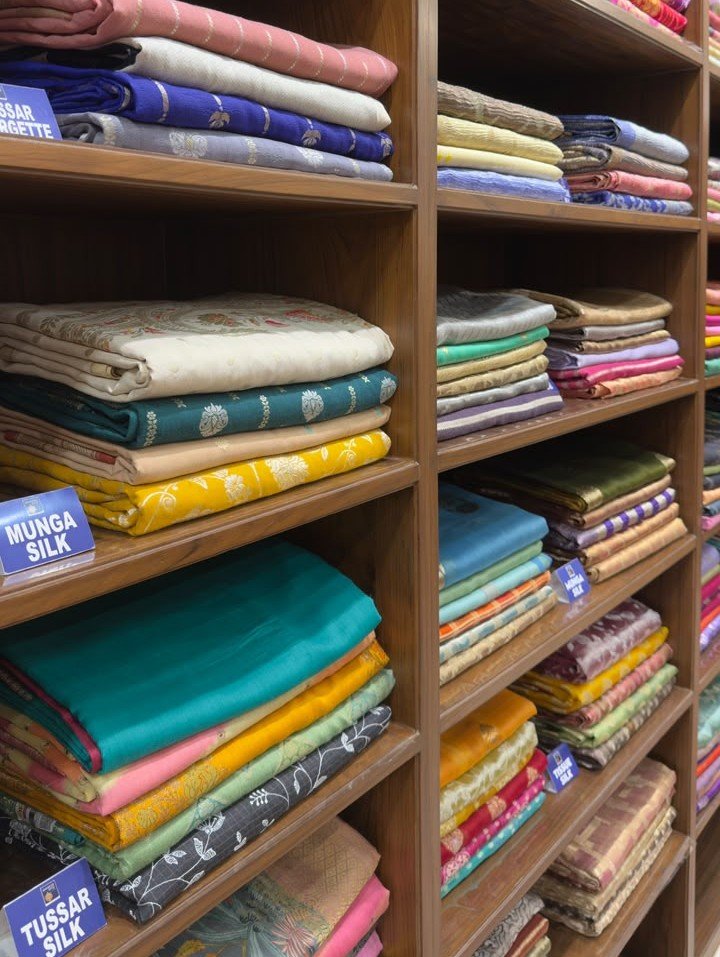
Feature Khaddi Georgette Katan Silk Munga / Muga Silk
What it describes A lightweight Georgette-based Banarasi fabric A traditional silk fabric/category used in Banaras weaving A distinctive wild silk originating in Assam
Texture Fine, slightly crinkled/crepe-like Smooth and refined Naturally lustrous with distinctive silk character
Drape Soft, fluid and close to the body More structured and substantial Depends on construction; generally elegant with a characteristic silk body
Visual effect Graceful and lightweight Rich, classic and regal Natural golden/lustrous character
Best for Long functions, festive wear, destination weddings Bridal, formal and ceremonial wear Heritage-inspired and distinctive occasion wear
Main attraction Easy drape and lightness Traditional Banarasi luxury Natural lustre, durability and unique origin
Buyer priority Comfort + movement Grandeur + tradition Uniqueness + silk character

Important: Fabric weight, drape and appearance also depend on yarn quality, weaving structure, zari density, motif density and finishing. Two sarees carrying the same broad fabric name can therefore feel noticeably different.


First, What Exactly Is a Banarasi Saree?

Before comparing the fabrics, it helps to understand what “Banarasi” actually means.

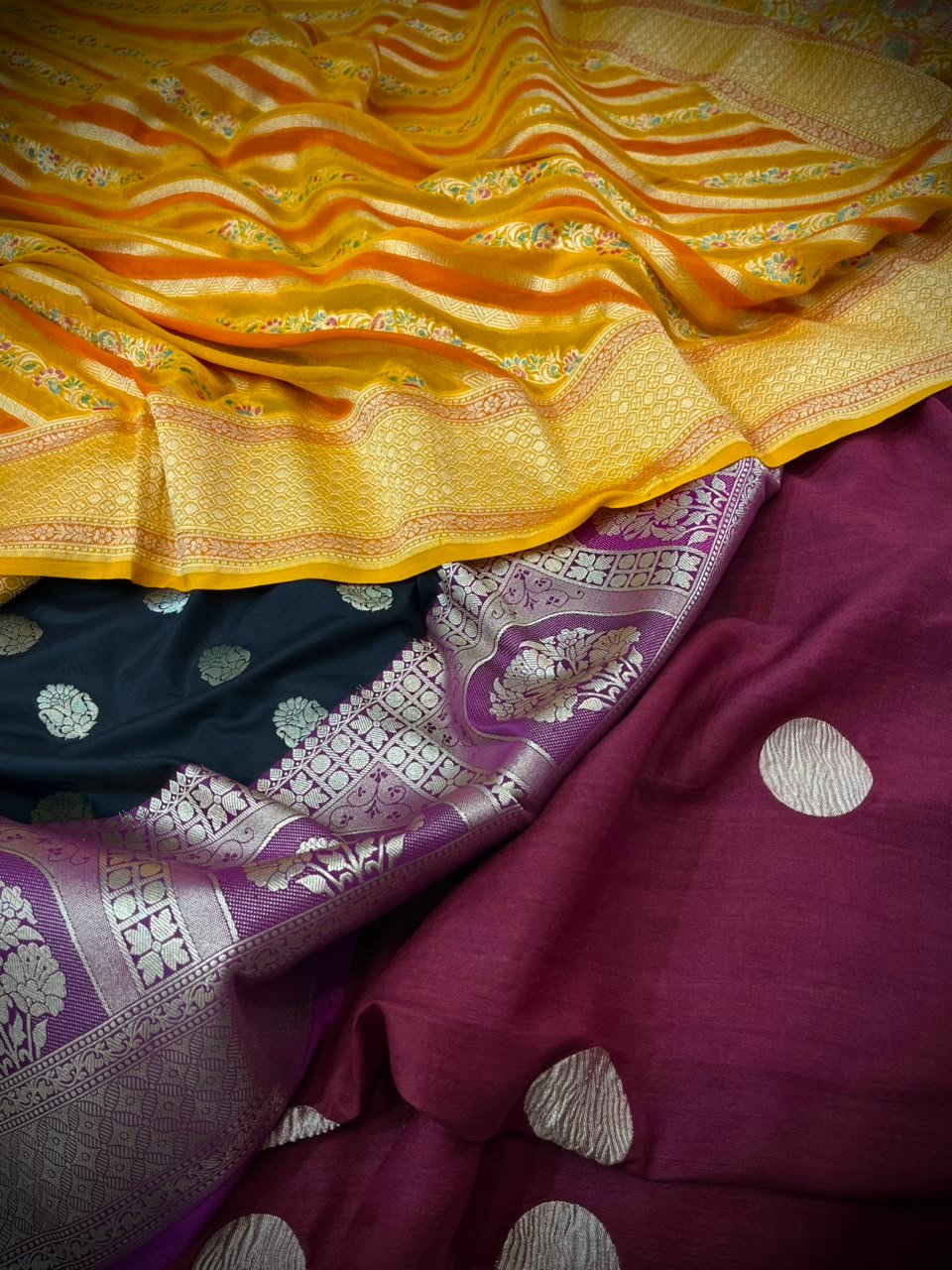
Banaras Brocades and Sarees are a registered Geographical Indication associated with Uttar Pradesh. Government sources describe Banaras brocades as finely woven silk textiles decorated with intricate zari designs, including floral and foliate motifs, kalga, bel, jala, meena work and other detailed ornamentation. Traditional Banaras looms have used technologies and attachments such as jacquard, jala, pagia and naka for creating motifs.

The important point is that Banarasi is a weaving tradition rather than one single uniform fabric.

Government documentation on Banaras textiles records different fabric constructions and notes the use of silk yarns in varieties including Katan, Georgette, Organza and others. Historical documentation from the Textiles Committee also records Banarasi sarees using Katan silk in the weft and examples where twisted threads create a Georgette-like feel.

That is why two sarees can both legitimately have a Banarasi identity while feeling completely different in your hands.


1. Khaddi Georgette Banarasi Saree

What Is Khaddi Georgette?

Georgette is a lightweight fabric associated with highly twisted yarns and a characteristic crepe-like texture. Textile references describe the fabric as light and drapey, with the twist of the yarn contributing to its distinctive surface.

In the Banaras context, Khaddi Georgette refers to the lightweight, textured Georgette family used for Banarasi weaving, where traditional motifs, borders, zari and pallu designs are incorporated into a much more fluid fabric base.

Government textile documentation of Banaras sarees specifically records the use of twisted threads to create a “georgette feel,” while contemporary Banaras textile sources describe Georgette as one of the principal fabric varieties used in the region.

What Does Khaddi Georgette Feel Like?

This is where Khaddi Georgette stands apart from a heavier silk Banarasi.

It generally feels:

Light + Fluid + Textured + Easy to Carry

The slightly crinkled surface is part of its character. Instead of creating a rigid silhouette, the fabric tends to fall naturally, making it particularly appealing to women who prefer movement and an effortless drape.

Why Do People Love Khaddi Georgette Banarasi Sarees?

The biggest advantage is wearability.

A beautifully woven Khaddi Georgette Banarasi can offer the traditional visual language of Banaras—zari, butis, floral motifs, intricate borders and a statement pallu—without the same substantial feel associated with some heavily woven silk sarees.

That makes it attractive for:

  • Wedding guests
  • Daytime celebrations
  • Festive functions
  • Destination weddings
  • Receptions
  • Family gatherings
  • Puja ceremonies
  • Long-duration events
  • Women who prefer lightweight sarees

Is Khaddi Georgette Good for Beginners?

It can be.

Because of its fluid nature, many wearers find Georgette-based sarees comparatively easy to manage. However, the exact drape still depends on the weave, zari density and finishing of the individual saree.

Who Should Buy Khaddi Georgette?

Choose Khaddi Georgette when comfort, movement and easy draping matter as much as traditional beauty.

It is particularly suitable for someone who loves Banarasi aesthetics but does not want every saree in their wardrobe to feel heavy or highly structured.


2. Katan Silk Banarasi Saree

What Is Katan Silk?

Katan is a traditional silk category strongly associated with Banaras weaving.

Historical documentation from the Textiles Committee records Banarasi sarees using Katan silk in the weft, and contemporary textile references describe Katan as a tightly constructed silk fabric with a smooth surface and substantial silk character.

Katan is especially associated with the traditional side of Banarasi craftsmanship.

When most people imagine a grand, classic Banarasi silk saree with a rich body, detailed zari and a formal silhouette, Katan is often close to that image.

What Does Katan Silk Feel Like?

Compared with Khaddi Georgette, Katan generally offers a:

Smoother + Richer + More Structured + More Traditional

experience.

The precise feel varies by weave and construction, but Katan is usually chosen by customers who want the saree to have greater body rather than an extremely soft, floaty drape.

Why Is Katan Popular for Bridal Sarees?

There is a reason Katan continues to occupy an important place in traditional Banarasi wardrobes.

Its richer silk character pairs beautifully with intricate brocade and zari work. Government descriptions of Banaras brocades highlight their detailed metallic ornamentation, compact weaving and elaborate floral and foliate motifs.

For a bride, that combination can create exactly the kind of:

Regal + Traditional + Ceremonial + Timeless

look that many families associate with a classic Banarasi bridal saree.

Best Occasions for Katan Silk

Katan is particularly suitable for:

  • Bridal ceremonies
  • Wedding functions
  • Reception looks
  • Engagement ceremonies
  • Traditional festivals
  • Important family occasions
  • Formal evening events
  • Heirloom-style purchases

Who Should Choose Katan?

Choose Katan if you want the classic Banarasi experience rather than the lightest possible saree.

It is ideal for someone who values traditional silk character, a more defined drape and a rich ceremonial appearance.


3. Munga / Muga Silk: A Different Kind of Luxury

This is where the comparison requires a little more care.

What Is Muga Silk?

Muga Silk, also commonly spelled Munga in retail contexts, is a distinctive silk native to Assam. The Geographical Indication Registry lists “Muga Silk of Assam” as a registered GI, with the registration covering Assam.

Government sources describe Muga as a wild silk associated with the silkworm Antheraea assamensis. It is particularly recognized for its natural yellowish-golden colour, lustre and durability.

The Assam government describes Muga as the “golden thread” of Assam and notes its naturally golden yarn, longevity and strength.

Is Munga the Same as Katan?

No.

This distinction is important.

Katan refers to a Banaras silk fabric/category, while Muga/Munga refers to the type and origin of silk fibre.

That means comparing “Katan vs Munga” is not always a perfect apples-to-apples technical comparison.

A Katan Banarasi and a Muga-based Banarasi-style saree can differ both in their silk type and construction.

For buyers, this means the product description should ideally tell you:

  • What silk is used?
  • Is the saree handwoven?
  • Where was it woven?
  • What is the weave construction?
  • Is it pure silk?
  • What type of zari is used?
  • Does it carry appropriate certification?

What Makes Muga Silk Special?

The first thing you notice is its distinctive natural lustre.

Unlike a fabric that depends entirely on heavy metallic work to look luxurious, Muga itself has a characteristic visual quality.

Government sources describe Muga as:

Durable + Naturally Lustrous + Golden-Tinted + Distinctive

and the official GI documentation highlights its durability and shimmering, glossy texture.

Is Muga Silk Good for Special Occasions?

Absolutely.

It is particularly attractive for women who want a saree with a strong sense of heritage but also something that feels different from the most commonly encountered silk sarees.

Muga silk has a particularly strong cultural connection with Assam, where the weaving tradition is deeply rooted in the state’s textile heritage.

So, when you see a Munga/Muga Silk Banarasi saree, look beyond the name and understand the exact construction of that particular product.


Khaddi Georgette vs Katan: Which One Should You Choose?

This is the most straightforward comparison of the three.

Choose Khaddi Georgette if You Want:

Lightness

You dislike heavy sarees or simply want something that does not feel cumbersome during long functions.

Fluid drape

You prefer soft pleats and natural movement.

Versatility

You want one saree that can work for festivals, family events, weddings and parties.

Contemporary elegance

You want the heritage of Banaras without necessarily looking overly traditional.


Choose Katan if You Want:

Traditional grandeur

You want a saree that feels unmistakably ceremonial.

A richer silk presence

You like a more substantial fabric with classic silk character.

A bridal look

You want to build a traditional bridal or wedding wardrobe.

Heirloom appeal

You are looking for a saree that feels like something you could pass down through the family.


Katan vs Munga Silk: Which Looks More Luxurious?

This is not a simple winner-takes-all comparison.

Luxury can come from different things.

Katan Luxury

Katan’s appeal is often about:

Silk richness + structure + zari + traditional Banarasi design

Muga Luxury

Muga’s appeal is more about:

Natural lustre + distinctive silk character + heritage + durability

Muga silk is especially unique because its natural golden character is intrinsic to the fibre itself. The Government of Assam and the official GI documentation both emphasize its distinctive natural colour and lustre.

So:

For classic Banarasi grandeur → Katan

For distinctive natural silk character → Muga


Khaddi Georgette vs Munga Silk: Which Is Better for Everyday Comfort?

Again, there is no universal winner.

If your priority is simply:

“I want something light, fluid and easy to carry for hours.”

then Khaddi Georgette is usually the more natural choice.

If your priority is:

“I want a distinctive silk with natural lustre and heritage character.”

then Muga becomes more interesting.

The important thing is not to assume that all sarees labelled “Munga” will have identical weight or drape. Construction matters enormously.


Which Banarasi Saree Is Best for a Bride?

For Classic Bridal Grandeur: Katan

Katan is the strongest choice when your vision is:

  • Traditional
  • Rich
  • Regal
  • Structured
  • Zari-heavy
  • Ceremonial

A heavily worked Katan Banarasi can create an unmistakably bridal appearance.

For a Lighter Bridal Function: Khaddi Georgette

If the saree is for a reception, engagement, mehendi, destination wedding or another event where comfort matters, a finely woven Khaddi Georgette can be a beautiful alternative.

For Something Distinctive: Muga

A Muga-based saree can make sense for someone who values individuality and wants a less conventional silk story.


Which Banarasi Saree Is Best for Summer Weddings?

For a warm-weather wedding, the practical question is not just “Which fabric is most luxurious?”

It is:

“Which saree will I still enjoy wearing after four or five hours?”

Khaddi Georgette’s lightweight and fluid nature makes it particularly attractive for daytime functions and extended wear.

But remember that zari density also affects comfort. A densely brocaded saree can feel substantially different from a lightly decorated saree made from the same base fabric.


Which Saree Is Best for First-Time Banarasi Buyers?

For someone buying their first Banarasi saree, Khaddi Georgette is often a comfortable starting point.

It combines recognizable Banarasi elements with a lighter, easier-to-manage fabric.

But if your first Banarasi is specifically for your wedding, do not automatically choose the lightest fabric.

Your first saree should reflect the occasion.

First everyday/festive Banarasi → Khaddi Georgette

First bridal Banarasi → Katan

First distinctive heritage silk → Muga


Does More Weight Mean a Better Banarasi Saree?

No.

This is one of the biggest misconceptions buyers have.

A heavier saree is not automatically:

  • More authentic
  • More expensive to produce
  • Better woven
  • More luxurious
  • More valuable

The Government of India describes Banaras brocades as often relatively heavy because of their intricate zari ornamentation, but that does not mean every authentic Banarasi must be heavy.

A lightweight saree can be highly sophisticated because of:

  • Fine silk yarn
  • Skilled weaving
  • Detailed motifs
  • High-quality zari
  • Precise pattern development
  • Excellent finishing

The real question is:

How well has the fabric, yarn and design been brought together?


How to Choose an Authentic Silk Banarasi Saree

When buying online, don’t rely only on photographs.

Silk can be difficult to authenticate by appearance and touch alone. The Silk Mark Organisation of India explicitly states that it is difficult to identify silk simply by feel and recommends the Silk Mark label as assurance for products made with 100% pure silk.

Check the Fabric Composition

Ask whether the saree is:

100% silk, silk blend, artificial silk or synthetic.

The word “silk” in a product title alone is not enough.

Check for Silk Mark Where Applicable

The Silk Mark label is intended to assure consumers that the product contains 100% pure silk.

Ask About the Weaving Location

For a Banarasi product, understand where it was actually woven.

Banaras Brocades and Sarees have GI protection, so geographical origin matters.

Understand the Zari

Silk Mark assures silk purity, not the quality or purity of zari. The Silk Mark Organisation specifically notes that its certification does not guarantee zari quality.

So always ask about:

  • Zari material
  • Zari type
  • Finish
  • Coverage
  • Whether it is tested or certified

Look at the Back of the Saree

A close-up of the back can reveal much more about workmanship than a heavily edited front photograph.

Look at:

  • Extra threads
  • Zari floats
  • Motif construction
  • Neatness
  • Selvage
  • Weave consistency

Handloom vs Powerloom: Why It Matters

Another important buying question is:

“Is this saree actually handwoven?”

The Banaras textile tradition has evolved over time. Government craft documentation notes that traditional pit looms and jalalooms have increasingly been replaced by jacquard-based systems for precision and efficiency, while the craft and motif traditions continue.

A modern jacquard setup does not automatically mean “bad”—the important distinction is whether the saree is genuinely produced as represented by the seller.

For a premium purchase, ask for clear details rather than assuming:

Banarasi = handloom.


Which One Should You Buy?

Here is the simplest answer.

Buy Khaddi Georgette when:

You want:
Lightweight comfort, easy movement and a graceful flow.

Best occasions:
Day functions, festive gatherings, wedding guest looks, destination weddings and long celebrations.

Your style:
Elegant, contemporary and effortless.


Buy Katan Silk when:

You want:
Traditional silk richness, structure and a regal Banarasi appearance.

Best occasions:
Wedding ceremonies, bridal wear, receptions, engagements and formal celebrations.

Your style:
Classic, luxurious and timeless.


Buy Munga/Muga Silk when:

You want:
Distinctive natural lustre, silk heritage and a less conventional luxury story.

Best occasions:
Special celebrations, traditional functions, weddings and heritage-inspired dressing.

Your style:
Distinctive, elegant and culturally rooted.


The Biggest Mistake: Choosing Only by Price

Two sarees can have completely different prices even when their photographs look similar.

The final value of a Banarasi saree can be influenced by:

Silk quality + yarn quality + weave + zari + motif complexity + handwork + weaving time + finishing + provenance

A government-supported study of Banaras textiles documents the complexity of the weaving ecosystem, including designers, yarn preparation, pattern development and weaving processes.

So when comparing two sarees, don’t simply ask:

“Why is this one ₹10,000 more?”

Ask:

“What is actually different in the silk, weaving, zari, design and workmanship?”

That is the question that leads to a smarter purchase.


Khaddi Georgette vs Katan vs Munga Silk: Final Verdict

There is no single fabric that is “the best.”

There is only the fabric that is best for you.

Khaddi Georgette

Best for lightweight comfort, graceful movement and easy everyday-to-occasion wear.

Katan Silk

Best for classic Banarasi richness, bridal dressing and traditional heirloom appeal.

Munga / Muga Silk

Best for distinctive natural lustre, durability and a silk heritage rooted in Assam.

And remember one important thing:

Muga is not simply another synonym for Katan or Georgette. Muga is a specific silk with Assam’s own GI identity, while Katan and Georgette are fabric categories encountered in Banaras weaving. When a saree is marketed as a “Munga Silk Banarasi,” check the exact silk composition, weaving location and construction rather than relying on the name alone.

Ultimately, the right Banarasi saree is the one that matches your occasion, comfort, personal style and the kind of legacy you want your wardrobe to carry.

A lightweight Khaddi Georgette may become the saree you reach for again and again.

A grand Katan may become the saree you wear on your most important day.

And a distinctive Muga silk may become the piece everyone remembers.

That is the beauty of Banarasi textiles: there is no single way to wear tradition.


Frequently Asked Questions

Is Khaddi Georgette better than Katan Silk?

Neither is universally better. Khaddi Georgette is generally chosen for a lighter, more fluid drape, while Katan is preferred when the wearer wants a richer and more structured traditional silk appearance.

Is Katan Silk good for bridal wear?

Yes. Katan has a strong association with traditional Banaras silk weaving and works particularly well with elaborate zari and brocade designs suitable for bridal and ceremonial dressing.

Is Munga Silk the same as Muga Silk?

“Muga” is the official name used in the GI registration for the Assam silk. “Munga” is commonly encountered as a spelling/retail variant. The officially registered GI is Muga Silk of Assam.

Is Munga Silk a Banarasi fabric?

Not in the same technical sense as Banaras fabric categories such as Katan or Georgette. Muga is an Assam-origin silk. It can, however, be used in woven sarees and Banarasi-style products, so the exact product construction and origin should be checked.

Which Banarasi saree is easiest to carry?

Khaddi Georgette is generally the natural choice when your priority is lightweight handling and fluid drape. The actual weight still depends on zari and motif density.

Which is better for a wedding guest: Khaddi Georgette or Katan?

For a long wedding function where comfort matters, Khaddi Georgette is often more practical. For a more formal, structured and traditional appearance, Katan can be the better choice.

How do I know if a silk saree is pure silk?

Appearance and touch alone are not reliable enough. The Silk Mark Organisation of India recommends Silk Mark-labelled products as an assurance of 100% pure silk, and silk can also be tested at designated testing centres.

Does Silk Mark guarantee zari quality?

No. Silk Mark is about the purity of the silk, not the quality or purity of zari.


Explore the Beauty of Banarasi Craftsmanship

From the flowing elegance of Khaddi Georgette to the timeless richness of Katan Silk and the distinctive golden character of Muga Silk, every textile tells a different story.

At The Banarasi Style, we believe choosing a saree should be about more than finding a beautiful colour.

It should be about understanding the fabric, weave, craftsmanship and character behind it.

Explore our Banarasi saree collection and find the saree that feels right for your story.

The Banarasi Style — Timeless Weaves. Indian Heritage. Your Style.

Banarasi Saree Price Guide 2026: What You Should Actually Pay.

If you have ever searched for “Banarasi saree price”, you already know how confusing the market can be.

You might find one saree for ₹2,000 and another labelled “pure Banarasi silk” for ₹25,000, ₹50,000 or even over ₹1 lakh.

So, which one is actually worth the money?

The truth is that there is no single price for a Banarasi saree. The price depends on several factors — the fabric, weaving technique, zari, design complexity, craftsmanship and whether the saree is handwoven or power-loom produced.

And that is exactly why two sarees that look similar in a photograph can have dramatically different prices.

In this guide, we break down Banarasi saree prices in 2026, what you can realistically expect at different budgets and why authentic Banarasi sarees can be expensive.


Banarasi Saree Price in 2026: A Quick Guide

As a broad buying guide, you can think about Banarasi sarees in these categories:

Price range What you can expect
Under ₹3,000 Banarasi-style, synthetic or power-loom options
₹3,000–₹8,000 Entry-level handloom/blended and lighter Banarasi options
₹8,000–₹15,000 Simpler pure-silk options and lighter designs
₹15,000–₹35,000 Good-quality pure silk Banarasi sarees
₹35,000–₹80,000 Intricate weaving, heavier zari and wedding-worthy pieces
₹80,000+ Highly intricate, heirloom and premium bridal Banarasis

These are indicative ranges rather than fixed prices because the same category can vary considerably depending on craftsmanship and materials. Current 2026 guides similarly show Katan silk and more elaborate handwoven Banarasis moving substantially above entry-level prices.


Can You Get a Banarasi Saree Under ₹5,000?

Yes — but you need to understand what you are buying.

The phrase “Banarasi saree under 5000” can refer to very different products.

At this price, you may find:

  • Banarasi-style synthetic sarees
  • Power-loom sarees
  • Blended silk options
  • Lighter handloom fabrics
  • Sarees with imitation zari
  • Simpler designs and fewer intricate motifs

That does not automatically make them bad sarees.

They can be beautiful, wearable and perfectly suitable for festive occasions.

The important thing is not to compare a ₹4,000 power-loom saree with a ₹20,000 handwoven pure-silk Banarasi as though they are the same product.

A particularly low price becomes a red flag when the saree is simultaneously advertised as pure silk, handwoven and made with real zari. Several 2026 buying guides caution buyers to be sceptical of such claims at very low prices.


Pure Banarasi Silk Saree Price: How Much Should You Expect?

If your priority is a pure Banarasi silk saree, your budget generally needs to move upward.

Simple pure-silk Banarasis can start in the high single-thousands, while more elaborate pieces can quickly move into ₹15,000–₹35,000 and beyond.

The price increases further when you introduce:

  • Intricate jaal or jangla designs
  • Kadwa weaving
  • Dense motifs
  • High-quality zari
  • More complex colour combinations
  • Heavier bridal work
  • Master-weaver craftsmanship

So, if you are shopping for a pure silk Banarasi for a wedding or as an heirloom, looking only at the lowest possible price can be misleading.


Katan Silk Saree Price: Why Does It Cost More?

Katan silk is one of the most sought-after Banarasi silk varieties.

It is known for its smooth silk base and luxurious appearance, making it particularly popular for weddings, festive occasions and bridal wardrobes.

Depending on the weave, zari and design, Katan silk Banarasi sarees can range from approximately ₹8,000–₹25,000 for simpler pieces, while more elaborate versions can go considerably higher.

A heavily worked Katan saree with intricate motifs is not simply more expensive because it uses “more silk”.

The time and skill involved in weaving the design are also part of what you are paying for.


Why Are Banarasi Sarees Expensive?

This is probably the most important question to ask before buying one.

A Banarasi saree isn’t priced only according to the amount of fabric used.

1. The silk

The quality and type of silk used affect the price significantly.

Pure silk and premium silk varieties generally cost more than blended or synthetic alternatives.

2. The zari

Zari can make a significant difference.

Imitation zari is considerably more affordable, while genuine zari and higher-quality metallic threads add to the cost.

3. The weaving technique

This is where the difference between an ordinary-looking saree and a highly crafted Banarasi can become substantial.

A simple design can be comparatively quick to produce, while intricate handwoven designs can require much more time and skill.

4. The complexity of the design

A minimal butta pattern and an all-over Jangla design don’t require the same amount of work.

More intricate motifs, dense borders and elaborate jaals generally mean more weaving time.

5. Handloom craftsmanship

Handwoven Banarasis involve skilled artisans working with traditional weaving techniques. Depending on the complexity of the saree, production can take significantly longer than power-loom production.

You aren’t just buying six yards of fabric.

You are buying hours of craftsmanship.


Handloom vs Power Loom: Does It Affect the Price?

Absolutely.

Power-loom Banarasi-style sarees can be considerably cheaper because they can be produced much faster.

That makes them accessible and can be a great choice if you’re looking for a festive saree without making a large investment.

But a handwoven Banarasi represents a different level of craftsmanship.

This is why you should always ask:

“Is this handwoven or power loom?”

Instead of simply asking:

“Is this Banarasi?”

The distinction matters.


What Should You Pay for a Wedding Banarasi?

If you’re buying a Banarasi for a wedding, don’t start with a fixed number.

Start with the kind of saree you want.

For a wedding guest

A budget of around ₹8,000–₹20,000 can give you plenty of options depending on fabric, weave and design.

For a premium festive or wedding saree

Around ₹15,000–₹35,000 can open up more luxurious pure-silk and intricately designed options.

For bridal and heirloom pieces

Once you move into highly intricate Kadhua, Jangla, Jamdani or premium zari work, prices can reach ₹50,000, ₹1 lakh and considerably beyond. Some 2026 market guides place elaborate bridal handwoven pieces at ₹2 lakh or more.


Is an Expensive Banarasi Saree Always Better?

Not necessarily.

This is an important distinction.

Expensive doesn’t automatically mean authentic.

A high price should be supported by the quality of the silk, weaving, zari, design and craftsmanship.

Similarly, an affordable saree isn’t automatically inferior.

The key is to know what you’re paying for.

A ₹5,000 saree and a ₹30,000 saree can both be excellent purchases if they deliver what they promise.

The problem begins when you pay ₹30,000 for something being marketed as a pure handwoven Banarasi when it isn’t.


5 Questions to Ask Before Buying a Banarasi Saree

Before you swipe your card or make that UPI payment, ask:

1. What fabric is it?
Pure silk, blended silk, organza, georgette, cotton or synthetic?

2. Is it handwoven or power loom?

3. What kind of zari is used?

4. What weaving technique has been used?

5. Does the price match the craftsmanship?

Don’t be afraid to ask questions.

A genuine seller should be able to explain what you’re purchasing.


So, What Is a Good Banarasi Saree Price in 2026?

There isn’t one magic number.

If you’re looking for an affordable festive saree, you can find beautiful options below ₹5,000.

If you specifically want pure silk, expect to spend more.

If you want an intricately handwoven Katan, Kadwa or bridal Banarasi, the price can move into ₹25,000, ₹50,000, ₹1 lakh or beyond depending on the craftsmanship.

The best price is not necessarily the lowest price.

It is the price that accurately reflects what is actually in the saree.

Because when you buy a genuine Banarasi, you’re not simply buying a saree.

You’re investing in silk, skill, time and a piece of Varanasi’s weaving heritage.

And that is what makes the right Banarasi worth paying for.


SEO FAQ

What is the price of a Banarasi saree in 2026?
Banarasi saree prices can range from under ₹3,000 for Banarasi-style or power-loom options to ₹1 lakh or more for intricate handwoven bridal and heirloom pieces. Pure silk Banarasis commonly sit in the higher price brackets.

Can I buy a Banarasi saree under ₹5,000?
Yes. You can find Banarasi-style, blended, lighter handloom and power-loom sarees under ₹5,000. However, be cautious of extremely low-priced sarees marketed simultaneously as pure silk and handwoven.

What is the price of a pure Banarasi silk saree?
Simple pure-silk Banarasi sarees can start around the high single-thousands, while more elaborate Katan and handwoven designs can cost ₹15,000–₹35,000 or more. Bridal and highly intricate pieces can cost substantially more.

Why are Banarasi sarees expensive?
The price is influenced by silk quality, zari, weaving technique, design complexity, craftsmanship and the amount of time required to create the saree.

What is the price of a Katan silk saree?
Katan silk Banarasi sarees can start around ₹8,000 for simpler pieces and move to ₹25,000 or more depending on design, zari and weaving complexity.

How do I know if a Banarasi saree is worth its price?
Ask about the fabric, silk purity, weaving method, zari and craftsmanship. Don’t judge authenticity based on appearance or price alone.

How to Identify a Pure Banarasi Silk Saree: 7 Checks Before You Buy

A Banarasi saree is more than a beautiful piece of Indian clothing. It is a piece of weaving heritage, craftsmanship and tradition. The intricate motifs, luxurious silk and unmistakable zari work have made Banarasi sarees a favourite for weddings, festivals and special occasions for generations.

But with so many sarees being sold as “Banarasi” today, how can you tell whether you are buying a genuinely authentic, pure silk Banarasi saree—or a synthetic imitation?

If you are planning to invest in one, knowing the basics of how to identify a pure Banarasi silk saree can help you make a more informed decision.

From the silk and zari to the weave, finishing and certification, here are seven important checks to make before you buy.

1. Check the Silk: Is It Actually Pure Silk?

The first and most important step in original Banarasi saree identification is understanding the fabric.

A genuine pure Banarasi silk saree is traditionally woven using silk yarn. Pure silk has a distinctive softness, natural lustre and depth that synthetic fabrics often struggle to replicate.

When you hold a pure silk saree, it should feel luxurious but not excessively slippery or plastic-like. The surface should have a natural sheen rather than an overly glossy, artificial appearance.

However, simply touching a saree is not always enough to determine whether it is pure silk. Experienced sellers and weavers can often identify differences in yarn and texture, but for a buyer, it is safer to ask specific questions about the fabric composition.

Look for clear information such as:

  • Pure silk or 100% silk
  • Silk composition mentioned on the product description
  • Details about the weaving technique
  • Information about the saree’s origin
  • Appropriate certification or authenticity markings, where applicable

Be particularly careful with terms such as “silk finish,” “silk-like,” or “silk blend.” These do not necessarily mean that the saree is made from pure silk.

Pure silk vs fake: what should you notice?

A synthetic saree may look beautiful, but the feel and fall can be noticeably different. Synthetic fibres can sometimes have a uniform, overly shiny surface, whereas genuine silk tends to have a richer and more natural appearance.

That said, visual appearance alone is not a foolproof test. Always combine this check with the other tests below.

2. Look Closely at the Weave and Reverse Side

One of the best ways to understand a Banarasi saree is to look beyond its front surface.

Turn the saree over and examine the reverse side.

A traditionally woven Banarasi saree may show details of the weaving process on the back, particularly around intricate motifs and zari work. The reverse can reveal how the threads have been woven into the fabric rather than simply printed or superficially applied.

Look carefully at:

  • The continuity of the weave
  • The neatness of the motifs
  • The way zari is incorporated
  • Loose or floating threads
  • The overall construction of the fabric

A genuine handwoven saree can have subtle variations because it is created by a human weaver rather than a completely uniform industrial process. These variations aren’t necessarily defects—they can be part of the character of a handloom textile.

However, this does not mean that every saree with loose threads or irregularities is automatically authentic. Poor finishing can also occur in low-quality products.

The reverse side is therefore a useful clue, not a standalone authentication test.

3. Examine the Zari Carefully

Zari is one of the defining visual elements of a Banarasi saree.

Traditional Banarasi weaving is known for elaborate zari work, including floral motifs, butis, jaal patterns, architectural-inspired designs and other intricate details.

When buying a saree, don’t just look at how shiny the zari is. Look at how the zari is woven into the saree.

High-quality zari should appear integrated with the fabric rather than looking like a decorative layer sitting on top.

Also ask the seller what type of zari has been used. Historically, genuine zari could involve precious metals, while modern sarees may use a variety of zari materials depending on the design and price.

This is important because “Banarasi” and “pure zari” are not interchangeable terms.

A saree can be a genuine Banarasi silk saree without having precious-metal zari.

So, if the seller claims that the saree contains a particular type of zari, ask for the details in writing.

4. Check for Authenticity and Certification

When purchasing an expensive Banarasi saree, certification can provide an additional layer of confidence.

One term you may come across is the Banarasi Silk Mark certification in India.

The Silk Mark is associated with the authenticity of silk as a fibre. It is important to understand, however, that silk certification and geographical authenticity are not exactly the same thing.

In other words, a silk-related certification can help establish information about the silk fibre, but buyers should still consider the saree’s weaving origin, construction and seller credentials.

You may also encounter information relating to handloom certification, geographical indication (GI) protection and other authenticity or traceability initiatives.

When buying, ask:

Is there any certification or authenticity documentation available for this saree?

A reputable seller should be willing to explain what the certification means rather than simply using the word “certified” as a marketing claim.

5. Feel the Weight, Fall and Texture

Here is a simple check you can perform while shopping: hold the saree and observe how it falls.

Pure silk generally has a distinctive combination of softness, strength and weight. A well-made Banarasi silk saree should feel substantial without feeling stiff or excessively heavy.

Run your fingers gently across the fabric.

Does it feel smooth and luxurious?

Does it have a natural warmth?

Does the fabric drape gracefully?

Does the zari feel integrated into the weave?

These observations can help you identify differences between silk and synthetic fabrics.

But again, there is no single “touch test” that can guarantee authenticity.

Modern textile manufacturing has become extremely sophisticated, and synthetic fabrics can imitate the appearance and feel of silk surprisingly well.

For an expensive purchase, rely on documentation and a trusted seller in addition to your own observations.

6. Don’t Rely on the Burn Test Alone

One of the most commonly discussed methods for checking silk is a Banarasi saree burn test.

The basic idea is that natural silk behaves differently from synthetic fibres when exposed to flame. Silk is a protein fibre and tends to burn differently from many synthetic materials.

However, there is a major problem:

You should not perform a burn test on your saree.

Cutting a piece from an expensive saree and exposing it to fire can damage the fabric, and the test is not a reliable way for an ordinary buyer to establish whether the entire saree is authentic.

If you see a seller recommending that you burn the saree to check whether it is pure silk, be cautious.

For valuable textiles, professional fibre testing is a much safer and more reliable option.

If you genuinely need scientific confirmation of the fibre composition, ask whether the saree can be tested by an appropriate textile-testing facility.

A burn test can be discussed as a traditional fibre-identification method, but it should not be your primary purchasing test.

7. Buy From a Seller Who Can Tell You the Saree’s Story

Perhaps the most overlooked part of buying a Banarasi saree is the person selling it to you.

A trustworthy seller should be able to answer basic questions about the saree.

Ask:

Where was it woven?

Is it handloom or powerloom?

What silk has been used?

What type of zari has been used?

What is the weaving technique?

Is there any certification?

How should the saree be maintained?

If the seller is unable or unwilling to provide basic information, take a step back before making an expensive purchase.

A genuine Banarasi saree has a story behind it—from the yarn and design to the weaving process and the people who created it.

This is particularly important if you are buying a saree as an heirloom or wedding investment.

What Is the Difference Between a Banarasi Silk Saree and a Fake Banarasi?

The word “Banarasi” is often used very broadly in the market.

A saree may have Banarasi-inspired motifs or a similar-looking zari design without being an authentic traditional Banarasi weave.

This is why original Banarasi saree identification requires you to look at multiple factors rather than simply checking whether the saree looks “Banarasi.”

Consider these five questions:

Check What to Look For
Fabric Clear information about silk composition
Weave Examine the construction and reverse side
Zari Understand what type of zari is being used
Certification Ask for relevant authenticity documentation
Seller Choose someone who can explain the saree’s origin

A Quick Checklist Before You Buy

Before paying for your saree, take a few minutes to go through this checklist:

☐ Is the fabric composition clearly mentioned?

☐ Have you checked the reverse side of the saree?

☐ Have you examined the zari closely?

☐ Have you asked whether it is handloom or powerloom?

☐ Is there relevant certification or documentation?

☐ Can the seller explain where and how it was woven?

☐ Have you avoided relying solely on a burn test or appearance?

If you can answer these questions confidently, you are already a much more informed buyer.

The Most Important Rule: Don’t Judge a Banarasi Saree by Appearance Alone

A beautiful saree isn’t necessarily an authentic saree—and an authentic saree isn’t necessarily the most heavily embellished one.

The true beauty of a Banarasi lies in its craftsmanship.

From the silk yarn to the intricate motifs, from the zari to the hands that operate the loom, every element contributes to the final piece.

So, when you’re learning how to identify a pure Banarasi silk saree, remember that there isn’t one magical test that provides all the answers.

Instead, combine what you can see, feel and verify.

Ask questions. Understand the weave. Check the fabric. Learn about the zari. Look for appropriate certification. And most importantly, purchase from a seller who is transparent about the saree’s origin and craftsmanship.

Because when you buy an authentic Banarasi, you aren’t simply buying a saree.

You’re taking home a piece of India’s weaving heritage.

Looking for an Authentic Banarasi Saree?

At Banarasi Style, we believe that buying a Banarasi saree should be as much about understanding its story as it is about choosing its colour, motif or design.

With our presence in Banaras and Nagpur, we help customers discover the world of Banarasi textiles while understanding the craftsmanship behind them.

Whether you’re looking for a wedding saree, a festive Banarasi silk saree or a timeless piece to add to your collection, take the time to ask questions and understand what you’re buying.

Explore our collection of Banarasi sarees and discover the craftsmanship behind every weave.

Meet the Weavers of Varanasi: The Hands Behind Every Banarasi Saree

The hands, heritage and human stories behind one of India’s most treasured textiles

When you see a Banarasi saree, the first things you may notice are the silk, the zari, the intricate border, the pallu and the unmistakable richness of the design.

But there is something much more important behind every finished saree:

a pair of hands.

Hands that prepare threads.
Hands that read patterns.
Hands that operate the loom.
Hands that correct tiny imperfections.
Hands that may have learned the craft inside a family workshop and spent decades refining it.

The Banarasi saree is often described as a symbol of Indian luxury, bridal tradition and heritage. Yet the textile’s history cannot be separated from the people who make it.

In Varanasi, weaving remains one of the city’s best-known craft traditions. The Government of Uttar Pradesh describes silk weaving and Banarasi sarees as among Varanasi’s most renowned handicrafts, while Banaras Brocades and Sarees has registered Geographical Indication status. The official GI description highlights finely woven silk, intricate zari ornamentation, compact weaving and characteristic motifs and techniques associated with Banaras.

This is the story behind the saree you see in a shop window or on an online product page.

It is the story of the weavers of Varanasi.


Who Are the People Behind a Banarasi Saree?

A Banarasi saree does not emerge from one simple step.

Its creation can involve several stages of specialised work, from yarn preparation and design development to setting the loom and weaving the final fabric.

In traditional weaving communities, skills have often been passed through families and generations. A 2024 study of Varanasi handloom weavers found that 92% of respondents identified weaving as a family occupation, illustrating how strongly inherited knowledge continues to shape the sector. The same study also found that many respondents had decades of weaving experience.

This is important because weaving knowledge is not only written in manuals.

Much of it is learned through practice.

A young person growing up around a loom may first observe. Then assist. Later, they may learn individual processes before eventually taking responsibility for a complete section of weaving.

Over years, the movement of the hand becomes almost instinctive.

The weaver learns to understand tension, alignment, rhythm, pattern, thread behaviour and the subtle differences that can influence the finished cloth.

That experience is part of what gives handmade textiles their character.


Varanasi: A City Where Weaving Is Part of Everyday Life

Banarasi weaving is not confined to a museum or a historical display.

It has developed within neighbourhoods, homes, workshops and weaving clusters across the Varanasi region.

Government handloom documentation identifies Varanasi as a major handloom cluster. The Varanasi Mega Handloom Cluster, announced in 2008–09, covers the entire Varanasi district and has received interventions involving loom upgradation, raw-material supply, credit support, training, marketing and common facilities.

This cluster-level approach reflects an important reality:

The Banarasi saree is part of an ecosystem, not just an individual artisan’s product.

Within that ecosystem are weavers, designers, yarn suppliers, dyers, traders, master weavers, cooperatives, exporters, retailers and institutions that provide technical or financial support.

A saree may ultimately reach a customer thousands of kilometres away, but its production can begin inside a modest weaving room in Varanasi.


What Does a Banarasi Weaver Actually Do?

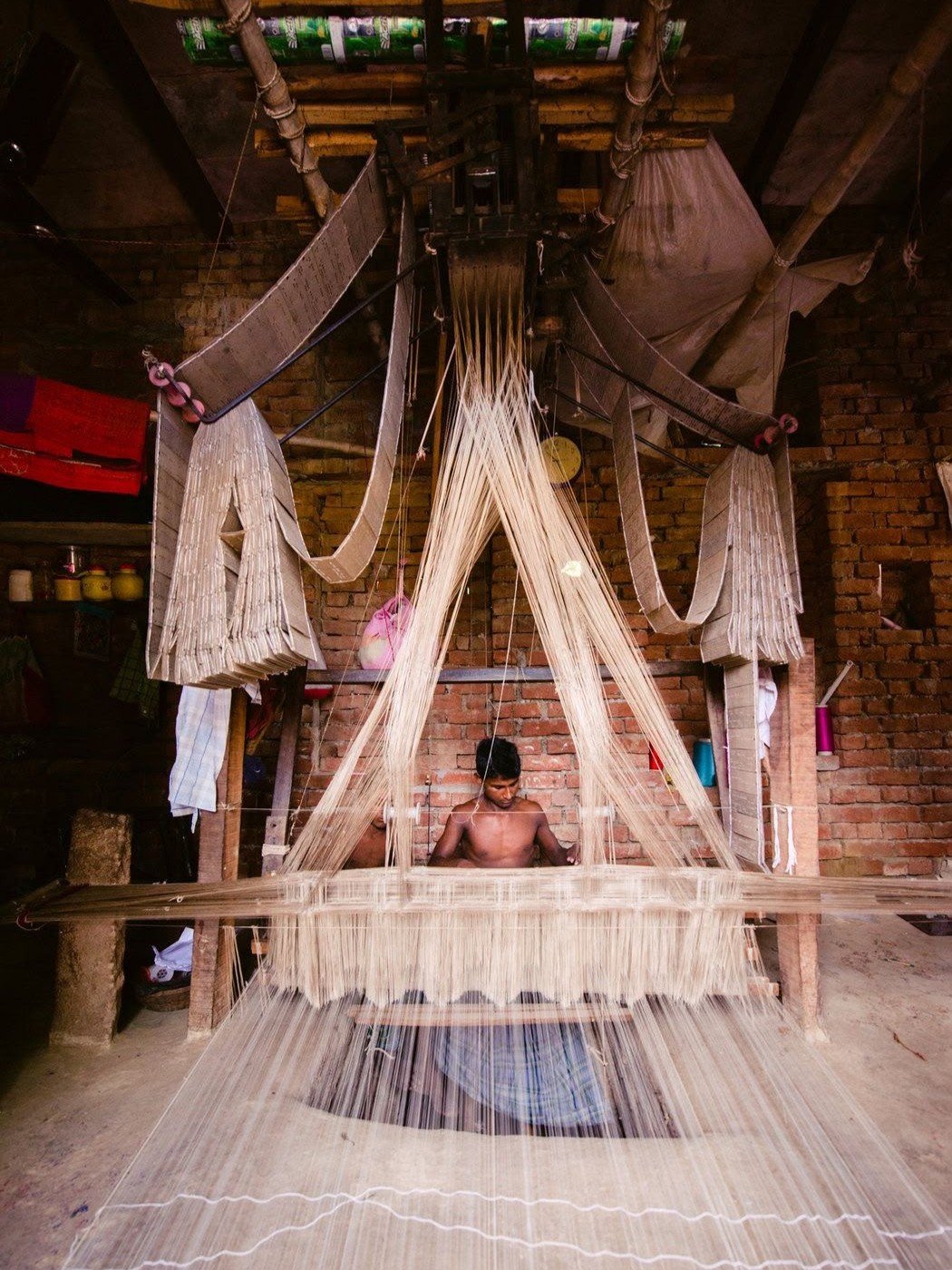
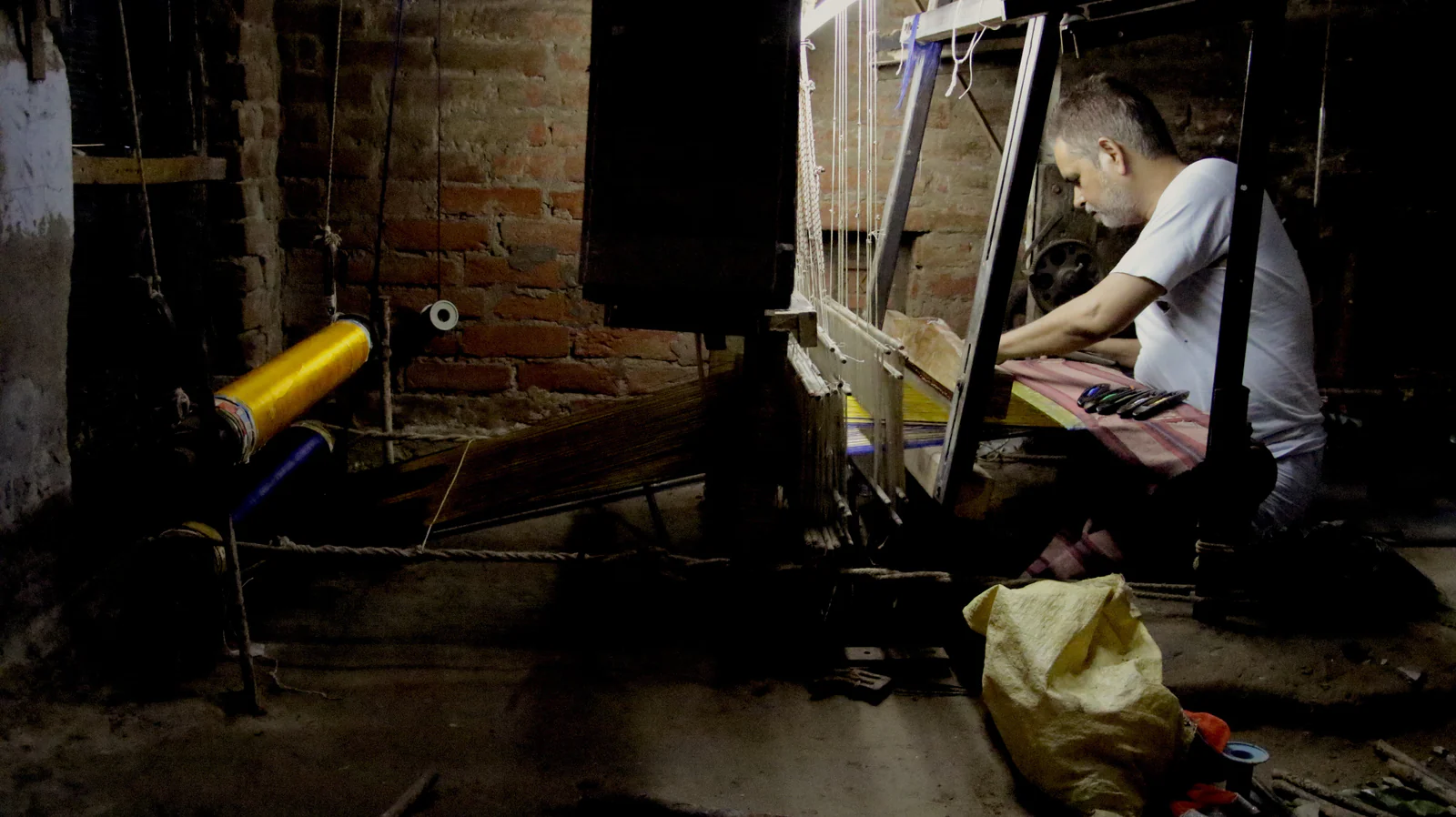
A traditional Banarasi loom may look complicated to a visitor seeing it for the first time.

For the weaver, however, every component has a purpose.

The official GI description of Banaras brocades and sarees notes the use of conventional Banaras handloom jacquard systems and traditional attachments such as jala, pagia and naka for creating motifs.

Historically documented Banaras weaving also includes techniques such as Kadhua, Cutwork and Fekwa, along with products such as Butidar, Tanchoi and Jangla styles. Government handloom literature describing the Cholapur cluster in Varanasi records pit looms fitted with jacquard systems and identifies several of these techniques among the area’s weaving practices.

The technical process can therefore involve much more than simply “putting thread through a loom.”

A skilled weaver must coordinate:

warp and weft + pattern + tension + timing + zari + fabric structure

and maintain consistency across the length of the saree.

That is why the finished design can look so effortless even though the process behind it is highly demanding.


The Art of Reading a Design

One of the most fascinating aspects of Banarasi weaving is the relationship between design and weaving.

The motifs seen on a saree do not simply appear after the fabric has been made.

They must be planned and translated into a form the loom can execute.

Traditional Banarasi designs can include floral and foliate patterns, kalga, bel, jali structures, meena work, paisleys and other decorative elements. The Varanasi district’s official GI description specifically highlights these characteristics.

For the weaver, this means the finished saree is simultaneously:

textile + geometry + craftsmanship + timing

A small error in the pattern can affect the visual continuity of the design.

The weaver therefore needs concentration for long periods.

This is one reason the word “craftsmanship” is so important when talking about Banarasi sarees.

The craft is not simply visible in the finished motif.

It is present in every decision made while that motif is being woven.


Why Banarasi Sarees Can Take So Much Time

Not every Banarasi saree takes the same amount of time to weave.

The duration depends on the fabric, design complexity, zari density, weaving technique, pattern repeat and other production factors.

A simple design and a highly intricate brocade are not equivalent projects.

The more complex the design, the greater the concentration and labour involved.

This is especially visible in intricate forms of weaving where decorative motifs must be integrated carefully into the fabric rather than simply printed onto its surface.

The result is one of the reasons Banarasi textiles have long been associated with ceremonial clothing and heirloom wardrobes.

When a customer sees a detailed Banarasi pallu, they are seeing the final expression of a much longer process.


The Loom Is More Than a Tool

For a weaving family, the loom may be both workplace and source of livelihood.

Government documentation on Varanasi’s handloom clusters notes substantial investment in loom upgradation and technical support. In the Varanasi Mega Handloom Cluster, more than 45,000 handloom parts were distributed, while a raw-material bank supplied 18.5 lakh kilograms of yarn worth about ₹307.62 crore through March 2023.

These figures demonstrate the scale of the handloom ecosystem, but they also reveal something else:

the loom cannot function independently of the larger supply chain around it.

Good yarn must be available.

Tools must work.

Designs must remain commercially relevant.

Weavers need access to finance.

And finished products must reach customers who understand their value.


The Skill You Cannot See in a Photograph

When we buy a saree online, we see an image.

We do not see:

  • How many hours the weaver sat at the loom.
  • How many times a thread had to be corrected.
  • How much concentration was required.
  • Who taught the weaver the technique.
  • How many generations of knowledge influenced the design.
  • How much of the final retail value actually reached the producer.

That gap between what the customer sees and what the maker experiences is one of the most important things to understand about handloom textiles.

The beauty of a Banarasi saree is visible immediately.

The labour behind it is not.


The Challenges Facing Varanasi’s Weavers

The story of Banarasi weaving should not be romanticised.

The craft has immense cultural value, but many weavers also face economic and occupational challenges.

A 2024 study focusing on Varanasi handloom weavers reported concerns including delayed payments, low income during off-seasons, difficulty obtaining credit, rising input costs and competition from powerloom production. In that study, 80% of respondents identified powerloom competition as a challenge. It also reported concerns related to long working hours and health problems associated with prolonged loom work.

Earlier studies have similarly identified financial pressure, raw-material costs, marketing difficulties, changing designs and irregular income among major concerns for Varanasi’s handloom community.

These challenges matter because a craft does not survive simply because consumers love the finished product.

It survives when the people making it can also build a sustainable livelihood from that craft.


Why Powerlooms Have Changed the Market

Technology has not simply entered the Banarasi industry from outside.

It has changed the competitive environment in which handloom weavers operate.

Powerloom production can offer speed, consistency and lower production costs for certain products.

For a handloom weaver, the comparison can be difficult.

A handmade saree may involve significantly more time and skilled labour, while a mechanically produced textile can imitate some of the visual elements of traditional designs at a different price point.

Research on Varanasi’s handloom sector has highlighted modernisation and mechanisation as important pressures on traditional weaving livelihoods.

This does not mean every machine-made textile is inferior in every respect.

It means that buyers need to understand what they are purchasing.

A handloom saree and a powerloom saree can belong to very different production systems even when photographs look surprisingly similar.


Why Young People Do Not Always Want to Become Weavers

A craft can be culturally prestigious while still being economically difficult.

This is one of the central challenges facing traditional weaving communities.

If younger generations see long working hours, uncertain earnings and limited opportunities for growth, they may understandably look toward other professions.

A 2024 study of Varanasi weavers found that most respondents had entered weaving through their family occupation, while the same research highlighted concerns regarding income, health, market access and opportunities.

This creates a difficult question:

How do you preserve a centuries-old skill when the next generation needs a financially viable future?

The answer cannot simply be “preserve tradition.”

Tradition must also evolve economically.


Government Support for Varanasi’s Weaving Community

There have been significant efforts to support the handloom sector.

The Varanasi Mega Handloom Cluster records interventions covering:

raw materials, loom parts, solar lighting, credit, marketing, design development, training and common facilities.

As of March 2023, the cluster report recorded:

  • 4,000 solar lighting units distributed
  • 45,253 handloom parts distributed
  • 18.5 lakh kg of yarn supplied through the raw-material bank
  • Loans sanctioned to 2,336 weavers under credit support
  • 220 new designs introduced through the market-development initiative
  • 31 training and 7 awareness programmes completed

These are cluster-level figures reported by the Development Commissioner (Handlooms), not a count of every weaver or every Banarasi saree produced in the city.

The Government of India’s Weavers’ Service Centre, Varanasi also identifies technical guidance, skill upgrading, product development, design, weaving, dyeing, printing and implementation support for handloom schemes among its functions.

The broader handloom support system also includes mechanisms such as the Weaver MUDRA / concessional credit framework.


Meet the Master Weavers

Varanasi’s weaving community includes artisans whose skills have been formally recognised through national and state-level awards.

The Development Commissioner (Handlooms) maintains official records of handloom awardees and weavers from Varanasi, including artisans recognised for specialist Banarasi skills such as Kaduwa Jangla.

The Ministry’s official weaver database also records individual Varanasi weavers working on specific Banarasi products and techniques. For example, the database lists Haji Rais Ahmad, associated with Satin Tanchoi and Banaras Brocade, and Reyazuddin Ansari, associated with Kaduwa Jangla and Butidar sarees, among other handloom products.

These names matter because they remind us that “the Banarasi weaver” is not an abstract character.

They are real people with highly specialised skills.

At the same time, it is important not to assume that every weaver has the same background, income, technique or working arrangement. Varanasi’s weaving community is diverse, and individual stories differ.


Weaving Is Often a Family Story

One of the most meaningful aspects of Banarasi weaving is its intergenerational nature.

A design may be modern.

A colour palette may change.

A buyer may discover the saree through Instagram.

But the knowledge of how to work the loom can still come from a parent, grandparent or another experienced artisan.

This is how craft knowledge survives.

Not necessarily through a single textbook, but through:

watching + practising + repeating + correcting + teaching

A saree made today can therefore contain knowledge that predates the person who is weaving it.

That is one reason handloom textiles carry a different emotional meaning from mass-produced fashion.


What Makes a Handwoven Banarasi Saree Special?

It is tempting to say that handloom means “perfect.”

But that is not quite right.

Handloom production can contain subtle irregularities that are natural to handmade textiles.

The stronger argument for handloom is not that every inch must be mechanically identical.

It is that the textile is produced through human skill and controlled manually at the loom.

The official Varanasi GI description connects Banaras Brocades and Sarees with conventional handlooms and specialised attachments used to create intricate motifs.

That human involvement can influence:

  • The rhythm of the weave
  • The handling of yarn
  • Pattern execution
  • Small variations
  • Fabric character
  • The overall tactile experience

For many collectors, these qualities are exactly what make a handwoven saree special.


How Buyers Can Support the Weaver

Supporting weavers does not require buying the most expensive saree in the store.

It begins with buying consciously.

Before purchasing a Banarasi saree, ask:

Is it handloom or powerloom?

Do not assume that every product using the word “Banarasi” is handmade.

What is the fabric?

Ask whether it is pure silk, a blend, or another fibre.

Where was it woven?

Understanding provenance is particularly important when buying a high-value textile.

What is the zari?

The Silk Mark system concerns silk purity, not the quality or purity of zari, so buyers should seek separate clarity about the zari used.

Who made it?

When the seller can provide meaningful information about the artisan, weaving cluster or production process, it creates a stronger connection between the buyer and the craft.

Is the price realistic for the claimed craftsmanship?

A very low price for a supposedly highly intricate handwoven silk saree should encourage questions rather than automatic excitement.


Why the Story of the Weaver Matters

Imagine wearing a Banarasi saree at a wedding.

People notice the colour.

They notice the zari.

They compliment the border.

Someone asks where you bought it.

But the most important story is rarely visible.

Somewhere in Varanasi, a skilled artisan may have spent long hours transforming threads into the cloth you are now wearing.

That person may have inherited the skill.

They may work in a family workshop.

They may have learned techniques that are no longer widely practised.

They may also be facing the same pressures affecting many traditional artisans: rising input costs, uncertain income, competition, changing consumer preferences and the need to attract the next generation to the craft.

That is why buying a handwoven Banarasi saree can mean more than purchasing clothing.

It can mean participating in the continuation of a craft.


Banarasi Sarees Are Changing — and That Is Not Necessarily a Bad Thing

Preserving the Banarasi tradition does not mean freezing it in the past.

The Varanasi handloom cluster itself has supported new designs, product development, training and market-oriented initiatives. The cluster report records 220 new designs introduced through one market-development intervention, showing that innovation is already part of the sector’s evolution.

Modern Banarasi weaving can therefore include:

  • Traditional bridal sarees
  • Contemporary colour palettes
  • Lightweight sarees
  • Dupattas
  • Home textiles
  • Fashion fabrics
  • Designer collaborations
  • New motif interpretations

The craft survives not by refusing change, but by carrying its core skills into new contexts.


The Future of the Varanasi Weaver

The future of Banarasi weaving depends on more than nostalgia.

It depends on whether the next generation can see a future in the profession.

That requires:

fairer market access

better financing

skill development

design innovation

consumer awareness

technology that supports rather than simply replaces craft

and stronger recognition of the artisan’s contribution

The Development Commissioner (Handlooms) continues to operate support systems for training, credit, marketing, cluster development and technological assistance, while the Varanasi Weavers’ Service Centre explicitly describes its role as supporting technical and skill development in the sector.

But consumers also have a role.

When buyers ask informed questions, value genuine craftsmanship and purchase from transparent sellers, they help create demand for the kind of textile economy in which skilled weaving remains worth preserving.


Every Banarasi Saree Has Two Stories

The first story is the one everyone sees:

silk, colour, zari, motifs, border and beauty.

The second story is the one hidden inside the fabric:

time, skill, family knowledge, concentration, labour and human hands.

The second story is what we want to remember.

Because a Banarasi saree is not beautiful only because it looks beautiful.

It is beautiful because an extraordinary amount of knowledge has been transformed into something you can wear.

The Government of Uttar Pradesh recognises Banarasi sarees as one of Varanasi’s defining crafts, and the GI framework formally protects the identity of Banaras Brocades and Sarees.

But the true living heritage of Banaras is not the GI certificate, the loom, the zari or the finished saree by themselves.

It is the weaver.

The person sitting at the loom.

The person checking the pattern.

The person correcting the thread.

The person teaching the next generation.

The person whose hands turn an idea into fabric.

And when you wear a Banarasi saree, you carry a small part of that story with you.


How You Can Help Keep the Tradition Alive

The next time you shop for a Banarasi saree, take a moment to look beyond the photograph.

Ask about its fabric.

Ask about its weaving.

Ask whether it is handloom.

Ask where it was made.

Ask what makes that particular saree special.

And most importantly, remember the person behind it.

Because when we value the craft, we also create value for the craftsperson.

Every Banarasi saree has a weaver behind it.
Every weaver has a story behind the skill.
And every story deserves to be remembered.


Final Thoughts

The magic of Varanasi’s Banarasi saree tradition is not only found in its centuries-old motifs or shimmering zari.

It lives in workshops, homes and weaving clusters.

It lives in family knowledge.

It lives in the patience required to make something slowly in a world increasingly built around speed.

And it lives in the hands of artisans who continue to adapt an old craft to a changing market.

So the next time you see a Banarasi saree, don’t see only a saree.

See the weaver.

Because behind every beautiful Banarasi is a human hand—and behind that hand is a story of skill, patience, heritage and hope.


Frequently Asked Questions

Who makes Banarasi sarees?

Banarasi sarees are made by skilled textile artisans and weaving communities in and around Varanasi. The production ecosystem can involve weavers and other specialised workers connected with yarn, design, weaving and finishing.

Are all Banarasi sarees handwoven?

No. Buyers should verify whether a particular saree is handloom or powerloom rather than assuming that every saree labelled Banarasi is handwoven. Research on the Varanasi handloom sector specifically discusses competition from powerloom production.

What makes a Banarasi saree special?

Traditional Banaras brocades are known for finely woven silk, intricate zari ornamentation, compact weaving and characteristic motifs and techniques.

Is Banarasi weaving a family tradition?

Often, yes. A 2024 study of Varanasi handloom weavers found that the majority of respondents had entered weaving through family occupation, reflecting the importance of intergenerational skill transmission.

Why are authentic handwoven Banarasi sarees expensive?

The price reflects several factors, including silk, zari, design complexity, weaving time, skill and production costs. Highly intricate weaving requires significant labour and specialised expertise.

How can I support Banarasi weavers?

Buy from transparent sellers, ask whether the saree is handloom or powerloom, understand the fabric composition and weaving origin, and value craftsmanship rather than choosing only by the lowest price.


SEO Information for The Banarasi Style

Primary Keyword:
Weavers of Varanasi

Secondary Keywords:
Banarasi saree weavers, Varanasi handloom weavers, Banarasi saree weaving, Banarasi artisans, Banarasi handloom, Varanasi silk weaving, Banarasi saree craftsmanship, Banarasi weavers history, Banarasi saree artisans

Long-Tail Keywords:

  • Meet the weavers of Varanasi
  • Who makes Banarasi sarees
  • Banarasi saree weaving process
  • Varanasi Banarasi handloom weavers
  • Story behind Banarasi saree
  • Life of Banarasi saree weavers
  • How Banarasi sarees are woven
  • Traditional Banarasi weaving techniques
  • Banarasi handloom vs powerloom
  • How to support Banarasi weavers
  • Banarasi saree artisan stories
  • History of Banarasi weaving in Varanasi

SEO Title:
Meet the Weavers of Varanasi: The Hands Behind Every Banarasi Saree

Meta Description:
Discover the skilled weavers behind every Banarasi saree—explore Varanasi’s handloom heritage, weaving techniques, artisan families, challenges and the future of Banarasi craftsmanship.

Recommended URL Slug:
/meet-the-weavers-of-varanasi-banarsi-saree-artisans/

Suggested Featured Image Alt Text:
Banarasi saree weaver working on a traditional handloom in Varanasi


Research Sources

  1. District Varanasi, Government of Uttar Pradesh — Banaras Brocades and Sarees GI / craft description.
  2. District Varanasi, Government of Uttar Pradesh — Handicrafts and silk-weaving overview.
  3. Development Commissioner (Handlooms), Government of India — Varanasi Mega Handloom Cluster report.
  4. Weavers’ Service Centre, Varanasi — official Citizen’s Charter and technical-support role.
  5. Development Commissioner (Handlooms) — official weaver database for Uttar Pradesh/Varanasi.
  6. Development Commissioner (Handlooms) — national handloom awardee records.
  7. Paul, Biswas & Bhattacharya (2024) — study of opportunities and challenges faced by Varanasi handloom weavers.
  8. Naik, Bhardwaj & Mishra — post-COVID assessment of challenges in Varanasi’s handloom industry.
  9. Dwivedi, Kesarwani & Singh — study of problems of handloom weavers in Varanasi district.
  10. Government of India handloom publication documenting Banaras weaving clusters and techniques.

The Banarasi Style – Timeless Elegance Woven in Varanasi

Welcome to The Banarasi Style, where tradition meets elegance through the finest collection of authentic Banarasi sarees. Inspired by the rich weaving heritage of Varanasi, we bring you handcrafted masterpieces that reflect grace, culture, and timeless beauty.

Our collection features exquisite Banarasi silk sarees, luxurious Katan weaves, delicate Organza designs, and elegant Georgette drapes. Each saree is crafted by skilled artisans whose expertise has been passed down through generations, preserving the true essence of Banarasi craftsmanship.

At The Banarasi Style, we believe a Banarasi saree is more than just an outfit—it is a symbol of heritage, artistry, and sophistication. From grand weddings and festive celebrations to special family occasions, our sarees are designed to make every moment memorable.

The intricate zari work, traditional motifs, rich textures, and vibrant colors showcase the beauty of Indian handloom traditions. Whether you prefer classic designs or contemporary patterns, our carefully curated collection offers something for every style and occasion.

We are committed to providing premium quality, authentic craftsmanship, and exceptional customer satisfaction. Every piece in our collection reflects attention to detail, superior weaving techniques, and the timeless charm that has made Banarasi sarees treasured across generations.

Explore our exclusive collection and experience the elegance of genuine Banarasi sarees. Let The Banarasi Style bring the royal legacy of Varanasi into your wardrobe with designs that celebrate tradition, beauty, and individuality.

Choosing the Right Banarasi Fabric for Every Season: A Guide Based on Indian Weather

Banarasi fabrics, known for their timeless elegance, intricate weaving, and regal charm, are an integral part of Indian fashion. Originating from Varanasi (also known as Banaras), these textiles come in various materials, each with its unique texture, drape, and seasonal suitability. Given India’s diverse climate — ranging from the scorching summers to chilly winters — choosing the right Banarasi fabric for the season is key to staying comfortable while looking stylish.

Here’s a season-wise guide to help you choose the ideal Banarasi weave, including popular varieties such as Khaddi GeorgetteKora, Organza, MugaChiniyaKataanCotton Silk, and Banarasi Silk.

Summer (May – June): Stay Cool, Look Rich

Indian summers can be unforgiving, especially in the northern regions. High temperatures and humidity demand breathable and light fabrics that don’t cling to the skin.

Best Fabrics:

Cotton Silk: A perfect blend of the crispness of cotton and the sheen of silk, cotton silk Banarasi weaves offer elegance with comfort. These sarees or suits are airy, soft, and ideal for formal summer gatherings.

Kora (Silk Organza): Kora is known for its translucency and smoothness. Despite its rich appearance, it’s very breathable and remains cool against the skin.blank

Khaddi Georgette: Handwoven Khaddi Georgette sarees, though slightly heavier than cotton silk, are still great for evenings. They have a unique grainy texture and drape beautifully without adding too much weight.

blank

Why These Work:

Natural fibers like cotton mixed with silk or lighter silk forms help the skin breathe and prevent overheating while maintaining the festive or traditional vibe.

Monsoon (July – September): Minimalist and Moisture-Friendly

Monsoon brings humidity and occasional stickiness, so it’s best to avoid heavy silks that retain moisture. Opt for quick-drying, low-maintenance Banarasi fabrics that don’t lose their structure in humid air.

Best Fabrics:

Khaddi Georgette: Its slightly crinkled texture makes it easier to manage in damp weather. Georgette’s synthetic base doesn’t absorb too much moisture, making it suitable for monsoon occasions.

blank

Tissue: Tissue works surprisingly well in monsoons for festive events. It resists moisture better than thicker silks and retains its shape and crispness even in high humidity.

Why These Work:

These fabrics dry quickly, maintain their look, and don’t cling, which is crucial in monsoon weather.

Winter (December – February): Layered Luxury

Winter in northern India, especially, allows for the full indulgence of heavier and more opulent Banarasi fabrics. This is the peak wedding season, and the luxurious warmth of thick silk makes it ideal for grand occasions

Best Fabrics:

Banarasi Silk (Pure Silk): Heavier and more opulent than Chiniya or Cotton Silk, pure Banarasi silk is warm and regal — ideal for winter weddings and festive events.

blank

Muga Silk: Originally from Assam but now also woven in Banaras, Muga silk is known for its golden sheen and durability. It’s heavier, richer, and adds the warmth needed during cold weather.

blank

Kataan: This again shines during winters. Pair it with a shawl or heavy jewelry for a complete winter wedding look.

blank

Why These Work:

These luxurious silks offer warmth and allow for layering without compromising on traditional beauty.

Conclusion: Dress Seasonally, Wear Traditionally

Choosing the right Banarasi fabric isn’t just about aesthetics — it’s also about comfort and practicality in India’s varied climate. Whether it’s the crisp airiness of Organza in spring, the breathable coolness of Cotton Silk in summer, or the opulence of Banarasi Silk in winter, there’s a Banarasi weave for every season and every celebration.
Investing in season-appropriate Banarasi fabrics ensures that you look your best while feeling comfortable — blending tradition with thoughtful dressing.

Banarasi Silk for Weddings: The Epitome of Elegance and Tradition

The Cultural Significance of Banarasi Silk

The Banarasi silk is one of the prime silk products of the city of Varanasi (also called Banaras). The city of Varanasi is pioneered in artistry and silk weaving. Banarasi silk is a sign of wealth due to its pricing. Moreover, it is enriched with luxurious texture having lace work of gold or silver. Zari work, increases the Banarasi silk’s opulence further.

The weaving of Banarasi silk started in the Mughal era when the Persians introuduced delicate weaving techniques. The weaving craft of Banarasi silk has over the years seen the incorporation of Indian motifs for embellishments. Traditionally, Banarasi fabrics have been a status symbol for weddings and royal attire. The traditional craftsmanship of weaving silk is becoming increasingly rare and is dying with the older generation. It is with no to little doubt that Banarasi silk is still regarded as one of the finest fabrics for bridal wear.

The Banarasi Silk Saree for Weddings: Steeped in Culture, the Silk Saree

The Banarasi silk saree is undeniably one of the most assorted bridal clothes with silk sress in India. It is best known for its regal and elegant grace. The exquisite floral designs, paisleys and other geometric shapes that are intricately woven onto the saree adds to the grace of the saree.

Banarasi Pure Silk Saree: This variant is considered the most luxurious and is made from 100% pure silk. With its smooth texture and shimmering finish, a pure Banarasi silk saree becomes a symbol of elegance. Many brides opt for pure silk Banarasi sarees, as they provide a sense of authenticity and are deeply rooted in cultural heritage. These sarees are often paired with traditional jewelry, such as kundan or polki sets, which complement the richness of the fabric.

blank

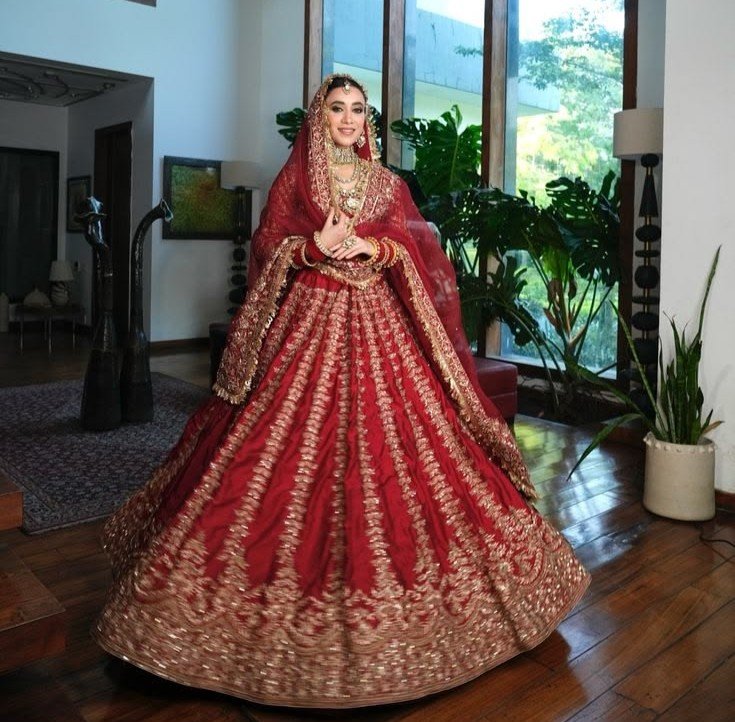
Red Banarasi Saree: Among the many colors available, the red Banarasi saree is perhaps the most iconic. The color red, symbolizing prosperity, fertility, and passion, holds great significance in Indian weddings. A red Banarasi saree, adorned with gold zari work, is a favorite choice for brides who wish to combine tradition with opulence. The golden embroidery on a red saree adds a touch of regal glamour, making it the ideal choice for a wedding celebration.

blank

Pink Banarasi Saree: For brides who prefer a lighter, softer hue but still want to maintain an aura of tradition, a pink Banarasi saree is an excellent choice. Light pink or blush tones, adorned with intricate gold or silver threadwork, create a sophisticated and ethereal look. A pink Banarasi saree, with its delicate beauty, is perfect for brides looking for a romantic yet traditional wedding outfit.

blank

Purple Banarasi Saree: Purple, the color of royalty, is another option that has gained popularity in recent years. A purple Banarasi saree, with rich, intricate designs in gold, looks luxurious and elegant. This color provides a unique yet regal look, offering a modern twist on the traditional red and pink hues typically seen in wedding sarees.

blank

Banarasi Lehenga: A Modern Take on Tradition

In recent years, many brides have opted for the Banarasi lehenga, a blend of traditional Banarasi fabric with a more contemporary bridal style. The Banarasi lehenga is perfect for brides who want to move away from the classic saree but still retain the rich, traditional touch of Banarasi silk.

Banarasi Lehenga Choli: A Banarasi lehenga, typically paired with a beautifully designed choli (blouse), is often a mixture of vibrant colors like red, maroon, gold, or green. The lehenga itself is made from pure Banarasi silk, ensuring its luxurious feel and intricate detailing. Zari work, floral motifs, and paisley designs are common features of Banarasi lehengas. The choli may also feature modern elements like sequins, stones, or embroidery, making it a perfect fusion of traditional and contemporary bridal fashion.

A Banarasi lehenga can be paired with a dupatta or veil, usually made from matching Banarasi fabric, creating a harmonious look. Many brides today are choosing the lehenga style because it offers greater mobility while still making a bold, traditional statement.

blank

Banarasi Dupatta for Draping: The Finishing Touch

No bridal ensemble is complete without the perfect dupatta. The Banarasi dupatta, woven from the same luxurious silk fabric as the saree or lehenga, is a perfect complement to any bridal outfit. The dupatta is often draped over the head or shoulders, adding a layer of grace and modesty.

Banarasi Dupatta for Draping: Brides typically opt for Banarasi dupattas that feature elaborate zari work, creating an intricate pattern that ties the entire look together. Whether draped over the head, across the shoulders, or wrapped around the waist, a Banarasi dupatta enhances the bride’s appearance, adding volume and elegance to the outfit. Often, brides choose to match the dupatta color with the saree or lehenga, ensuring a coordinated and harmonious bridal look.

Banarasi dupattas are also available in various colors, such as red, gold, maroon, and pink, allowing brides to select the perfect piece to match their chosen wedding attire. The fabric’s sheen and texture, combined with the intricate embroidery, create a striking effect when the bride moves.

Modern Banarasi Saree Blouse Design: A Contemporary Twist

While the saree remains a traditional staple for brides, the blouse that accompanies it has evolved dramatically over the years. The traditional Banarasi saree blouse has seen a modern twist, with innovative designs and contemporary cuts making their way into bridal fashion.

Modern Banarasi Saree Blouse Design: The modern bride today has a wide array of blouse designs to choose from. High-neck blouses, off-shoulder designs, and sheer sleeves are just some of the stylish options that can be paired with a Banarasi saree. While the fabric and embroidery of the blouse may remain rooted in tradition, brides are opting for bold, trendy cuts that enhance their personal style.

A popular trend is the use of cut-out blouses, with a contemporary twist that incorporates the traditional gold or silver zari work. Brides are also experimenting with back designs—v-neck, halter neck, or deep-back cuts—to add a touch of modernity. The blouse may also feature hand-embroidered motifs in Banarasi style, ensuring that the entire ensemble remains cohesive.

Banarasi Fabric: More Than Just Silk

While Banarasi silk remains the most popular choice for wedding attire, the term “Banarasi fabric” encompasses more than just silk. Over the years, Banarasi fabric has been woven from different types of yarn, including cotton and georgette, which are often used for festive wear or less formal occasions. These fabrics may feature the same intricate designs and motifs, but the texture and feel differ from pure silk.

Banarasi fabric is often used for making a range of wedding accessories, from dupattas to shawls. The richness of the fabric and its detailed weaving techniques give it an elevated appearance, making it an ideal choice for festive occasions like weddings, receptions, and other cultural celebrations.

Conclusion

Banarasi silk continues to be the fabric of choice for brides who seek elegance, opulence, and tradition in their wedding attire. Whether you choose a Banarasi lehenga, a saree, or a dupatta, this fabric’s rich history, intricate designs, and luxurious feel ensure that the bride looks stunning on her wedding day. With modern twists on traditional blouse designs and the versatility of Banarasi fabric, brides today can enjoy a unique blend of the old and the new, celebrating their cultural heritage while embracing contemporary trends.