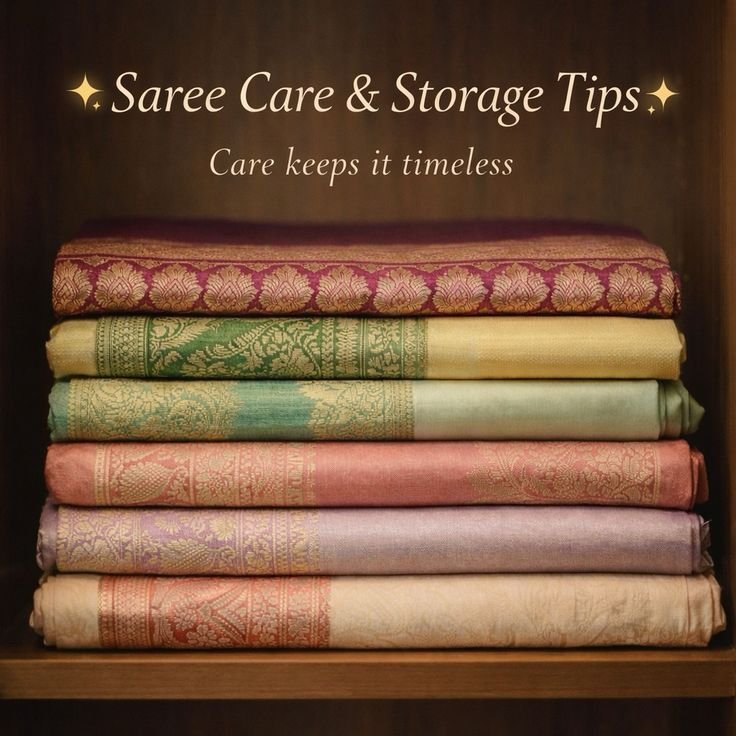
How to Wash, Store and Iron a Banarasi Silk Saree So It Lasts 30 Years
The complete guide to washing, drying, ironing, folding and storing your Banarasi silk saree for decades
A beautiful Banarasi silk saree is not an ordinary piece of clothing.
It may be something you wear to a wedding, receive as a special gift, preserve for your daughter’s wedding or eventually pass down as a family heirloom.
But beautiful silk requires careful handling.
The wrong detergent, excessive heat, direct sunlight, careless ironing or poor storage can gradually damage silk and zari.
The good news is that proper care does not have to be complicated.
With the right routine, a high-quality silk saree can last for decades. The Silk Mark Organisation of India states that, with proper care, a silk sari can last for generations.
So, rather than asking only:
“How do I clean my Banarasi saree?”
ask:
“How do I preserve my Banarasi saree for the next 20, 30 or even 50 years?”
This guide explains exactly how to do it.
Why Banarasi Silk Sarees Need Special Care
A Banarasi saree can contain several delicate elements:
Silk fibres + woven motifs + zari + dyes + finishing
Silk is a natural protein fibre and should be protected from harsh chemicals, excessive heat, prolonged light exposure and rough handling.
The metallic zari also deserves attention.
When moisture, chemicals, pressure and friction are repeatedly introduced into storage and cleaning, the decorative threads can deteriorate over time.
That is why your Banarasi saree should be treated more like a heritage textile than an everyday cotton garment.
The Smithsonian Institution recommends keeping valuable textiles clean, cool, dry and protected from light, while avoiding drastic changes in temperature and humidity.
The 30-Year Banarasi Saree Care Rule
There is no magic number of years that can be guaranteed for every saree.
The lifespan depends on:
- Silk quality
- Zari quality
- Dye stability
- Weaving quality
- Frequency of wear
- Cleaning method
- Storage environment
- Exposure to sunlight
- Humidity
- Handling
So 30 years should be treated as a preservation goal, not a guarantee.
A well-made silk saree that is carefully maintained can last much longer. Silk Mark Organisation of India specifically says a properly cared-for silk sari can last for generations.
STEP 1: Don’t Wash Your Banarasi Saree After Every Wear
This is one of the easiest ways to increase its lifespan.
A saree does not automatically need cleaning simply because you wore it once.
After wearing it:
- Remove jewellery carefully.
- Check for food, makeup or oil stains.
- Allow the saree to air out in a clean, shaded area.
- Make sure it is completely dry.
- Fold or roll it gently.
- Return it to proper storage.
This is especially important for silk sarees that are worn only occasionally.
Important
Do not immediately put a recently worn, slightly warm or damp saree into a closed storage box.
Allow it to air first.
Moisture trapped inside storage can encourage deterioration and, in humid environments, mould or mildew.
The Smithsonian recommends clean, dry storage and periodic airing of stored textiles.
STEP 2: When Should You Dry-Clean a Banarasi Silk Saree?
For a valuable or heavily zari-worked Banarasi silk saree, professional cleaning is usually the safer approach than experimenting at home, particularly when there are stains.
Silk Mark Organisation of India recommends dry cleaning for the first three washes of pure silk and says stained silk should be taken to a professional dry cleaner specialising in silk garments rather than being treated with water at home.
Choose a Professional Cleaner Who Understands Silk
Don’t simply hand over an expensive Banarasi to any nearby laundry.
Tell the cleaner:
“This is a silk saree with zari work.”
Ask whether they have experience with silk and delicate zari textiles.
This small conversation can prevent careless treatment.
STEP 3: Can You Wash a Banarasi Saree at Home?
This is where you need to distinguish between general silk-care guidance and the needs of a specific Banarasi saree.
The Central Silk Board provides general silk-care guidance that allows careful washing for certain silk textiles using soft or lukewarm water and neutral soap, followed by flat, shaded drying.
However, a valuable Banarasi saree may contain:
- Dense zari
- Multiple colours
- Complex woven motifs
- Delicate finishing
- Handloom construction
Because of that, home washing should not be treated as a universal recommendation for every Banarasi saree.
For expensive bridal Banarasis, heavily zari-worked pieces, heirloom sarees or sarees with uncertain colourfastness:
Professional cleaning is the safer choice.
If the product’s own care label gives specific instructions, follow those instructions first.
STEP 4: Never Use Regular Laundry Detergent
If silk needs cleaning, avoid aggressive household detergents.
Silk Mark recommends a neutral soap for silk and advises gentle handling.
Avoid experimenting with:
- Strong washing powder
- Bleach
- Whitening agents
- Harsh stain removers
- Fabric softeners not intended for silk
- Unknown chemical mixtures
The problem is not just colour.
Harsh chemicals can affect the silk fibre itself and alter the textile’s surface.
STEP 5: Never Rub a Stain Aggressively
This is one of the biggest mistakes people make.
You see a stain.
You immediately rub it.
Don’t.
Rubbing can spread the stain and put unnecessary mechanical stress on the silk.
Instead:
Blot gently.
Do not scrub.
Do not use hot water.
Do not pour detergent directly on the saree.
Do not try multiple household remedies.
Silk Mark specifically advises avoiding water treatment for stains and recommends professional dry cleaning for stained silk.
STEP 6: What Should You Do If Tea, Food or Makeup Falls on Your Saree?
Act quickly—but gently.
Fresh spill:
Use a clean, dry, absorbent cloth and blot.
Do not rub.
Do not spread the stain.
Do not apply perfume, soap or chemical cleaner.
Then take the saree to a professional cleaner experienced in silk.
The sooner a stain is professionally evaluated, the better your chances of avoiding a permanent mark.
STEP 7: Never Wring or Twist Silk
If a silk textile becomes wet, never twist it like cotton clothing.
Silk Mark advises gentle handling and specifically says to avoid excessive squeezing or wringing.
Mechanical stress can damage the fabric.
The safest rule is:
Silk should be handled gently even when you are doing something as simple as removing moisture.
STEP 8: Dry Your Saree Correctly
Drying is just as important as washing.
The Central Silk Board advises that silk should be dried flat and in shade, while Silk Mark gives the same basic guidance and specifically cautions against hanging wet silk because it can stretch or distort.
Never:
- Dry in direct sunlight
- Hang wet silk from a hanger
- Use a clothes dryer
- Place it near a heater
- Leave it in a damp room
Instead:
Dry flat in shade.
For a valuable Banarasi, use a clean surface and handle the fabric gently.
Why Direct Sunlight Is Dangerous
Sunlight may appear harmless, but prolonged exposure can contribute to fading and deterioration.
The Smithsonian advises protecting silk and other textiles from light because light exposure can damage textile fibres and colours over time.
So don’t dry your precious Banarasi on:
an open terrace + strong afternoon sunlight
even when you’re trying to dry it quickly.
For silk, slow and shaded is better than fast and harsh.
STEP 9: How to Iron a Banarasi Silk Saree Safely
Ironing is where one wrong setting can permanently affect a beautiful saree.
Silk Mark Organisation of India recommends low to medium heat and advises ironing silk on the reverse side. It also warns against spraying water directly on silk before ironing because this can create water spots.
The Central Silk Board gives similar guidance.
Safe Ironing Method
- Turn the saree to the reverse side.
- Use the silk/low-temperature setting.
- Place a clean thin cotton cloth between the iron and saree when appropriate.
- Move the iron gently.
- Avoid staying in one place for too long.
- Be especially careful around zari.
Most Important:
Do not iron directly over heavily decorated zari areas at high temperature.
STEP 10: Never Spray Water Directly on the Saree Before Ironing
This is a small detail that can save you from unnecessary marks.
Silk Mark explicitly advises:
Don’t spray water directly onto silk before ironing.
Water spots can develop on certain silk surfaces.
So the old habit of spraying water everywhere before pressing a garment should not automatically be used on Banarasi silk.
STEP 11: How to Fold a Banarasi Saree for Long-Term Storage
This is where long-term preservation really begins.
First:
Clean → dry completely → inspect → fold → store
Never store the saree while it is damp or dirty.
The Smithsonian notes that dust and dirt can cause mechanical damage to textile fibres through friction and abrasion, and recommends storing textiles clean.
STEP 12: Don’t Fold the Saree Along Exactly the Same Creases Forever
This is a useful long-term preservation habit.
When a textile is repeatedly folded along the exact same lines, the same areas can experience repeated stress.
The Smithsonian recommends periodically refolding stored textiles and changing fold positions so the same fibres are not continuously stressed.
Practical habit:
Every few months when you inspect your saree:
refold it differently.
You do not need to obsessively refold it every week.
Periodic rotation is enough.
STEP 13: Use Soft, Breathable Storage
For long-term storage, natural breathable wrapping such as clean cotton or undyed muslin can be useful.
The Central Silk Board specifically recommends wrapping zari sarees in cotton cloth to help protect the zari from discoloration.
The Smithsonian also discusses muslin and acid-free tissue as protective materials for textile storage.
Good storage materials:
Clean cotton cloth
Undyed muslin
Acid-free tissue paper for padding where appropriate
Avoid:
Dirty old cloth
Newspaper
Direct contact with wood
Tightly sealed plastic for long-term storage
The Central Silk Board advises avoiding direct contact with wood, while the Smithsonian cautions against sealing historic silk textiles in plastic because trapped moisture can become a problem.
STEP 14: Why You Should Avoid Newspaper
It may seem convenient to wrap a saree in newspaper.
Don’t.
Ink, paper acidity and long-term contact can create unwanted risks for valuable textiles.
For heirloom-quality storage, use appropriate textile-safe wrapping materials instead.
The Smithsonian’s conservation guidance favours materials such as acid-free tissue for protecting textiles.
STEP 15: Don’t Store Your Banarasi in a Tight Plastic Cover
Plastic may appear protective, but tightly sealed storage can trap moisture.
That is particularly risky in climates with higher humidity.
The Smithsonian warns against sealing silk textiles in plastic for long-term storage because condensation can create a damaging environment.
Better:
Wrap the saree in clean breathable fabric and store it inside a clean, dry cupboard or suitable textile-storage box.
STEP 16: Protect the Saree from Light
The storage area should ideally be:
Dark + dry + clean + cool + stable
The Smithsonian specifically recommends protecting stored textiles from light and drastic temperature/humidity changes.
Therefore avoid storing your most valuable Banarasis:
- Beside a sunny window
- On an open shelf exposed to daylight
- Under strong lights
- In a damp cabinet
- In an area exposed to regular moisture
STEP 17: Control Moisture and Humidity
India’s climate can make textile storage challenging, particularly during monsoon periods.
Silk does not benefit from prolonged dampness.
The Smithsonian recommends controlling temperature and relative humidity for textile preservation and notes that clean, dry storage helps discourage mildew and insects.
For home storage, the practical goal is:
avoid damp cupboards + allow occasional airing + don’t trap moisture.
The Central Silk Board also recommends protecting silk from excessive moisture and suggests silica sachets in storage racks.
Important:
Do not let a moisture absorber touch the saree directly.
STEP 18: Air Your Sarees Periodically
Long-term storage does not mean forgetting about the saree for five years.
Periodically:
- Remove the saree.
- Inspect it.
- Air it briefly in a clean shaded environment.
- Check for moisture, insects or unusual odour.
- Refold using a slightly different fold position.
- Return it to storage.
The Smithsonian recommends periodic airing and refolding of stored textiles.
STEP 19: Never Store a Used Saree Without Checking It
After a wedding or event, inspect the saree before putting it away.
Look for:
- Food stains
- Makeup
- Perfume residue
- Sweat
- Moisture
- Loose threads
- Zari damage
- Pulls
- Fold stress
A small stain that seems insignificant today can become a permanent problem after years of storage.
STEP 20: Be Careful with Perfume and Deodorant
Don’t spray perfume directly onto your Banarasi saree.
Apply perfume to your skin first and allow it to settle.
Then put on the saree.
This reduces direct contact between fragrance chemicals and the textile.
The same principle applies to:
hair sprays + body sprays + cosmetic products
Keep them away from the saree wherever practical.
STEP 21: Be Careful with Jewellery
A Banarasi saree can be damaged by something as small as a rough jewellery edge.
Before wearing:
Check your:
bangles
necklace
brooch
safety pins
rings
for sharp edges or rough surfaces.
Metal can catch delicate threads.
One accidental snag can turn into a visible pulled thread.
STEP 22: Pin Carefully
Safety pins can be useful, but careless pinning can damage the fabric.
When pinning the pallu:
- Use good-quality pins
- Avoid forcing pins through dense zari areas
- Don’t repeatedly pin in exactly the same location
- Remove pins gently after wearing
Never pull the saree away from a stuck pin.
Remove the pin carefully first.
STEP 23: How to Store Heavy Zari Banarasi Sarees
Heavy zari sarees need extra attention.
The Central Silk Board specifically recommends wrapping zari sarees in cotton cloth to help prevent discoloration.
For a heavily worked Banarasi:
Fold gently
Pad important folds when appropriate
Avoid direct pressure
Do not place heavy objects on top
Protect from moisture
Inspect periodically
STEP 24: What About Muga, Katan and Khaddi Georgette Banarasi Sarees?
Different Banarasi fabrics can have different care needs.
Katan Silk
Rich silk with substantial body should be protected from harsh cleaning and excessive heat.
Khaddi Georgette
Its lighter, more fluid construction still requires gentle handling, particularly if it has zari or delicate embellishment.
Muga / Munga-Based Silk
The exact care depends on the composition and construction of the product.
The Golden Rule:
Always check the product-specific care instructions before washing.
The word “Banarasi” alone does not tell you everything about the fibre, dye, zari or finishing.
STEP 25: How Often Should You Dry-Clean Your Saree?
There is no universal schedule.
Do not dry-clean a saree simply because a certain number of months have passed.
Instead:
Clean when necessary.
Excessive cleaning can itself place stress on textiles, so cleaning should be based on actual use and condition.
For expensive heirloom pieces, discuss the textile with a professional cleaner before deciding on treatment.
STEP 26: Don’t Assume “Dry Clean” Means Every Cleaner Is Safe
This is very important.
A silk saree should not automatically go to whichever dry cleaner is closest.
Tell the cleaner:
“This is a Banarasi silk saree with zari.”
Ask about their experience with delicate silk.
For very valuable or antique textiles, professional textile conservation advice may be more appropriate than routine garment cleaning. The Smithsonian specifically advises seeking professional conservation advice for fragile antique textiles.
STEP 27: Monsoon Storage Routine
For Indian homes, monsoon deserves special attention.
During humid weather:
Check the cupboard.
Make sure it is dry.
Inspect sarees more frequently.
Look for:
musty odour + dampness + mildew + insects
Air the saree.
Only in a clean, dry, shaded environment.
Check moisture absorbers.
Replace them as needed, while keeping them away from direct fabric contact.
The goal is not to make the storage environment completely moisture-free.
The goal is to avoid trapped moisture and prolonged dampness.
STEP 28: Winter and Summer Care
Summer
Avoid prolonged sunlight.
Don’t leave silk in a hot car.
Monsoon
Watch humidity and moisture.
Winter
Avoid storing near heaters or direct heating appliances.
Throughout the Year
Keep the storage area clean, dark and dry.
STEP 29: What NOT to Do with a Banarasi Silk Saree
Never:
❌ Machine wash it without manufacturer approval.
❌ Use bleach.
❌ Scrub stains aggressively.
❌ Wring or twist silk.
❌ Dry it in strong sunlight.
❌ Iron at high temperature.
❌ Spray water directly before ironing.
❌ Iron directly over heavy zari.
❌ Store it while damp.
❌ Keep it tightly sealed in plastic for long-term storage.
❌ Store it directly against untreated wood.
❌ Put perfume directly on the saree.
❌ Leave sharp jewellery attached.
STEP 30: The 5-Minute Post-Wear Routine
Every time you wear your Banarasi, follow this simple routine.
After removing it:
1. Inspect
Check for stains, moisture and pulls.
2. Air
Let it breathe in a clean, shaded place.
3. Clean if necessary
Handle stains professionally.
4. Fold
Change fold positions periodically.
5. Store
Wrap in breathable fabric and return to a clean, dry, dark storage area.
These five small habits can make a major difference over the years.
30-Year Banarasi Saree Preservation Checklist
After Every Wear
☐ Check for stains
☐ Check for moisture
☐ Remove pins carefully
☐ Air in shade
☐ Fold gently
☐ Store properly
When Cleaning Is Needed
☐ Check care label
☐ Identify fabric composition
☐ Use an experienced silk cleaner
☐ Inform cleaner about zari
☐ Avoid DIY stain chemicals
During Storage
☐ Keep away from direct light
☐ Use breathable cotton/muslin wrapping
☐ Avoid damp cupboards
☐ Avoid tight plastic storage
☐ Periodically inspect
☐ Change fold positions
☐ Keep moisture absorbers away from direct contact
Before a Major Occasion
☐ Inspect for fold damage
☐ Check zari
☐ Check for stains
☐ Press gently if required
☐ Check blouse and pins
☐ Handle carefully while dressing
The Most Important Banarasi Care Rule
If you remember only one thing from this entire article, remember this:
Silk prefers gentle handling, not aggressive cleaning.
Don’t clean unnecessarily.
Don’t scrub.
Don’t expose it to strong heat.
Don’t store it damp.
Don’t leave it in the sun.
Don’t repeatedly fold exactly along the same crease.
Don’t assume every dry cleaner understands silk.
And don’t treat a valuable Banarasi like an ordinary everyday garment.
How to Preserve a Banarasi Saree for the Next Generation
The best way to think about your Banarasi saree is not:
“How do I make it last 30 years?”
Think:
“How do I prevent unnecessary damage?”
Every avoided mistake helps.
A proper storage environment protects the silk.
Careful handling protects the zari.
Gentle ironing protects the surface.
Professional cleaning protects the colour and structure.
Periodic inspection catches problems before they become serious.
Together, these habits can help a well-made silk saree remain beautiful for decades.
Silk Mark’s consumer guidance goes even further, stating that properly cared-for silk sarees can last for generations.
Final Thoughts
A Banarasi silk saree is often bought for a special moment.
But its real value can continue long after that moment has passed.
The saree you wear today may become the saree you preserve tomorrow.
It may appear in your daughter’s wedding photographs.
It may be worn again for a family celebration years later.
It may eventually become an heirloom.
That future depends partly on how you care for it today.
So:
Wash carefully.
Dry gently.
Iron lightly.
Fold thoughtfully.
Store properly.
Inspect regularly.
And most importantly, remember that a beautiful Banarasi deserves patience.
Because the goal isn’t merely to keep your saree looking beautiful this year.
The goal is to preserve its beauty for the years—and generations—to come.
The Banarasi Style
Timeless Elegance Woven in Varanasi.
Frequently Asked Questions
How often should I wash my Banarasi silk saree?
Do not wash it after every wear unless necessary. Air it after wearing and clean it when needed, following the product’s specific care instructions. For pure silk, Silk Mark recommends dry cleaning for the first three washes.
Can I wash a Banarasi saree at home?
Some silk textiles can be carefully hand-washed under suitable conditions, according to Central Silk Board guidance. However, valuable Banarasi sarees with zari, uncertain colourfastness or delicate construction are better handled by a professional silk cleaner.
Can I iron a Banarasi silk saree?
Yes, but use low to medium heat, iron from the reverse side and avoid excessive heat on zari. Silk Mark specifically recommends low-to-medium heat and reverse-side ironing.
Can I use steam on a Banarasi saree?
Do not assume that direct steam is safe for every Banarasi. Follow the care label or ask a professional cleaner, particularly for heavy zari, delicate silk or valuable heirloom pieces.
How should I store a Banarasi silk saree?
Store it clean and completely dry in a cool, dry, dark environment. Wrapping zari sarees in cotton cloth is recommended by the Central Silk Board, while museum conservation guidance also supports breathable/protective textile storage and protection from light.
Should I store a Banarasi saree in plastic?
Avoid tightly sealed plastic for long-term storage because trapped moisture can create problems. Breathable textile wrapping is preferable.
Should I refold my Banarasi saree?
Yes. Periodically changing the fold positions reduces prolonged stress on the same areas of the textile.
Can sunlight damage a silk saree?
Yes. Prolonged light exposure can damage silk fibres and colours, so valuable silk should be kept away from strong direct sunlight.
How long can a pure silk saree last?
There is no fixed lifespan because it depends on the textile and care. The Silk Mark Organisation of India states that a silk sari receiving proper care can last for generations.
What should I do if my Banarasi saree gets a stain?
Blot gently without rubbing and avoid experimenting with water or household stain removers. Silk Mark recommends taking stained silk to a professional dry cleaner experienced with silk.