A practical guide to choosing the right Banarasi saree based on height, proportions, fabric, border, motifs and drape
Choosing a Banarasi saree is usually an exciting experience.
You see a beautiful colour, admire the zari, fall in love with the pallu—and then comes the question:
“Will this saree actually look good on me?”
The answer depends on more than your height or body shape.
A Banarasi saree can look completely different depending on its:
fabric + border + motif size + pallu + colour + blouse + drape
That means there is no single Banarasi saree that is “made” for one body type.
Instead, the goal is to understand proportion and choose the combination that makes you feel comfortable and confident.
Whether you are petite, tall, curvy, straight, broad-shouldered or somewhere in between, there is a Banarasi style that can work beautifully for you.
In this guide, we’ll look at Banarasi sarees for different heights and body proportions, along with practical tips for borders, motifs, fabrics, blouses and draping.
First: There Is No “Perfect Body” for a Banarasi Saree
Before we talk about height and proportions, let’s clear up one thing.
You do not need a particular body shape to wear a Banarasi saree.
The saree is one of the most adaptable garments in Indian fashion because the drape itself can change the silhouette.
Instead of trying to “hide” your body, think about:
balance + proportion + comfort + personal style
The right saree should work with your body rather than make you feel like you have to work around it.
The 5 Things That Make the Biggest Difference
When choosing a Banarasi saree, pay attention to these five elements:
1. Fabric
Katan, Khaddi Georgette, Organza, cotton-silk and other constructions can drape very differently.
2. Border Width
A broad zari border creates a stronger horizontal visual line, while a slimmer border creates a more understated look.
3. Motif Size
Small butis create a different visual effect from large floral motifs or dense jaal.
4. Pallu
A heavily decorated pallu can become the focal point of the entire outfit.
5. Drape
The same saree can look completely different in a classic Nivi, Gujarati, open-pallu or other styling.
So don’t choose based only on the saree colour.
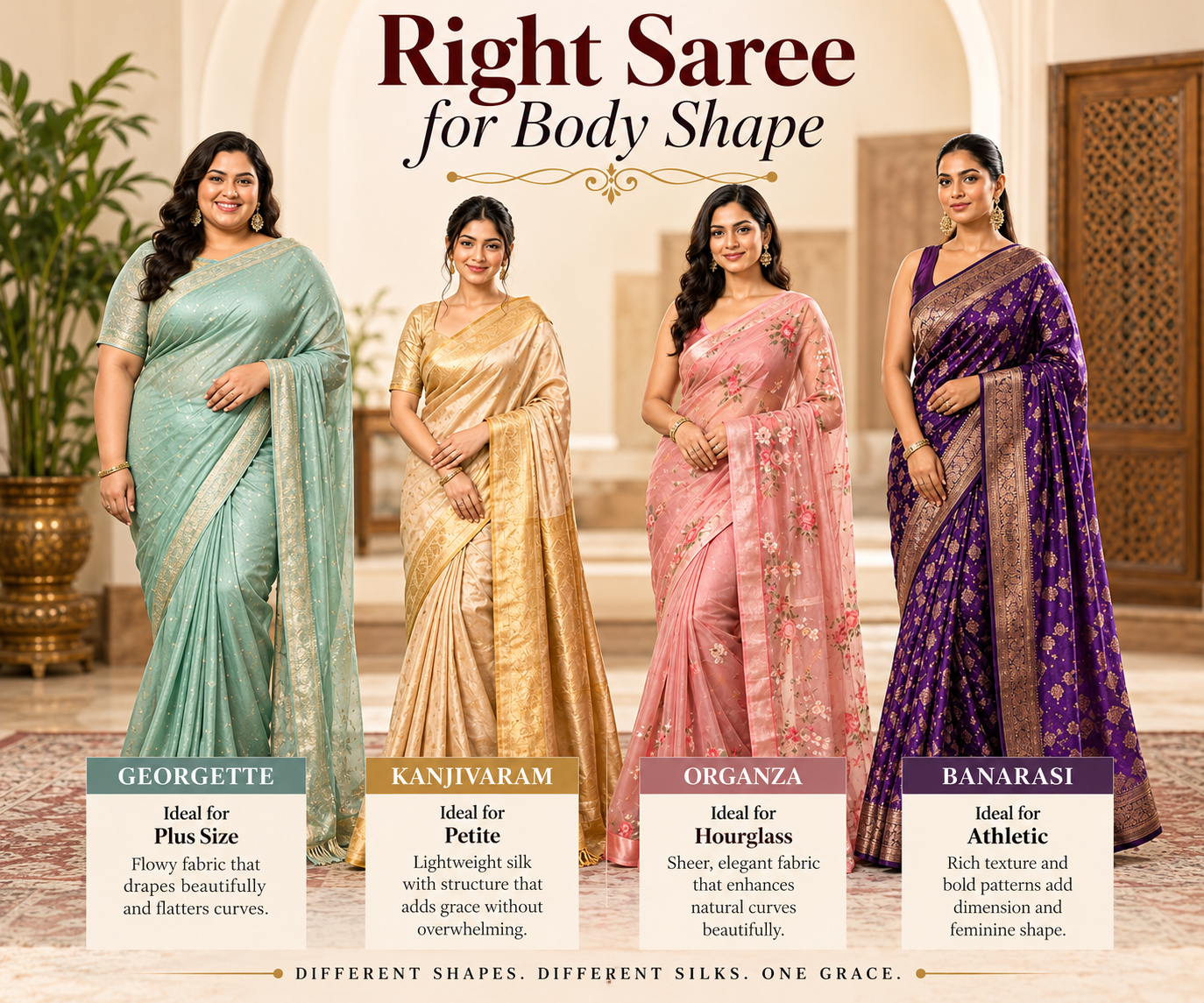
Banarasi Sarees for Petite or Shorter Heights
If you are shorter in height, you may prefer styling that creates a visually clean, elongated line.
This does not mean you should avoid heavy Banarasi sarees.
It simply means proportion becomes more important.
Fabrics to Consider
Lighter or medium-weight fabrics can be easier to manage visually and physically.
Consider:
Khaddi Georgette
Lighter silk Banarasi
Fine Banarasi blends
A very heavy saree can still work, but a more controlled drape may feel more balanced.
Border Tip for Petite Frames
A very wide contrasting border can create a strong horizontal break.
That doesn’t mean you cannot wear one.
But when you want a visually elongated look, consider:
medium or narrower borders
or
borders that blend more closely with the saree colour
This allows the overall vertical line to remain cleaner.
Motif Tip
Smaller or medium-sized motifs can be easier to balance on a petite frame.
Try:
butis + small floral motifs + delicate jaal
rather than automatically choosing extremely oversized motifs.
Again, this is about visual proportion—not a rule.
Drape Tip
A clean Nivi drape with neat, narrow pleats can create a streamlined appearance.
Avoid creating excessive bulk around the waist if your goal is a cleaner silhouette.
Blouse Tip
A well-fitted blouse is particularly important.
A blouse with:
clean neckline + correct shoulder fit + appropriate sleeve length
can make the entire saree look more polished.
Banarasi Sarees for Tall Heights
Tall women often have more room to experiment with dramatic Banarasi designs.
A rich saree with:
broad border + large motifs + detailed pallu
can create a striking look.
Fabrics to Consider
You can comfortably experiment with:
Katan Silk
Heavy Banarasi Brocade
Rich silk
Organza Banarasi
Statement tissue-based Banarasi styles
The exact choice depends on how much structure or flow you prefer.
Border Tip
Tall frames can carry a broad zari border beautifully.
Try:
wide gold border + elaborate pallu
for a dramatic traditional look.
Motif Tip
Large floral motifs, Jangla-inspired patterns and larger woven designs can create a strong visual impact.
If you love statement Banarasis, this is an excellent place to experiment.
Drape Tip
An open pallu can be particularly effective when you want to showcase the length of the saree and its woven details.
Gujarati-style or other broad pallu arrangements can also create a dramatic appearance.
Banarasi Sarees for Curvy Body Types
Curves and Banarasi silk can work beautifully together.
The key is not to find a saree that “hides” curves.
Instead, think about:
fabric fall + blouse fit + pleat control + proportion
Fabric Choice
Soft fabrics with a graceful fall can create beautiful movement.
Consider:
Khaddi Georgette
Soft silk constructions
Light-to-medium weight Banarasi
A very stiff saree may create more structure than you personally prefer, while a fluid fabric can follow the body more naturally.
Border Choice
If you love broad borders, absolutely wear them.
For a more elongated visual effect, you can choose a border that is:
tonal + medium width + vertically integrated with the overall colour palette
For a traditional grand look, a contrasting broad zari border can be beautiful as well.
Motifs
Medium-sized motifs often provide a balanced visual effect.
You can also choose strategically placed motifs instead of extremely dense designs throughout the entire body.
Blouse Fit Is Crucial
With any body proportion, but especially when the saree is richly woven, blouse construction can make a huge difference.
Check:
Bust fit
Shoulder width
Armhole
Sleeve comfort
Blouse length
A poorly fitted blouse can make an otherwise beautiful Banarasi look uncomfortable.
Banarasi Sarees for Straight or Slimmer Body Types
If you prefer to create more visual dimension, look for Banarasis with texture and pattern.
Consider:
Floral motifs
All-over butis
Woven jaal
Contrasting borders
Rich pallu work
These can add visual interest without requiring heavy embroidery.
Fabric Choice
Both fluid and structured fabrics can work.
A slightly structured silk can create a more defined silhouette, while a fluid Georgette can create softer movement.
Choose according to the look you want rather than trying to follow a body-type rule.
Blouse Tip
This is a great place to experiment with:
Boat necks
Statement sleeves
Elbow sleeves
Structured blouses
Textured or embellished fabrics
The blouse can add another layer of visual interest.
Banarasi Sarees for Broad Shoulders
If you have a broader shoulder proportion and want the saree to feel visually balanced, the blouse neckline can make a noticeable difference.
Consider:
V-neck
Soft U-neck
Moderate scoop neck
These can create a more open vertical line.
If your goal is to emphasise the shoulders instead, a boat neckline or more structured blouse can also look beautiful.
The important thing is to choose based on the effect you want, not on a rule that says you have to hide your shoulders.
Banarasi Sarees for Narrow Shoulders
You can use the blouse to create more visual presence around the upper body.
Try:
Boat neck
Square neck
Elbow sleeves
Statement sleeves
Embellished blouse details
A detailed blouse can balance a richly woven saree particularly well.
Banarasi Sarees for a Fuller Midsection
If comfort around the waist is your priority, focus on the drape and blouse fit.
A fluid Banarasi can create beautiful movement without feeling too rigid.
When pleating:
Keep pleats neat and evenly spaced.
Avoid excessive fabric bunching at the waist.
A well-structured underskirt can also help the saree fall more smoothly.
Banarasi Sarees for Longer or Shorter Torso Proportions
This is an area many buyers overlook.
The position of the saree and blouse can change your overall proportions.
If You Have a Shorter Torso
A slightly deeper neckline and a carefully positioned waistline can create a more balanced appearance.
If You Have a Longer Torso
A longer blouse or slightly higher visual waistline can create proportion.
The important point is that blouse length matters as much as saree choice.
Which Banarasi Fabric Should You Choose?
Fabric is one of the most important decisions.
Katan Silk
Best when you want:
Rich + Traditional + Structured
Excellent for bridal wear and formal occasions.
Khaddi Georgette
Best when you want:
Lightweight + Soft + Fluid
Excellent for weddings, festive events and long-duration wear.
Organza Banarasi
Best when you want:
Crisp + Lightweight + Elegant
The fabric can create more structure while retaining a lighter visual appearance.
Tissue-Based Banarasi
Best when you want:
Lustrous + Festive + Statement-making
Particularly useful for receptions and evening celebrations.
Which Banarasi Border Should You Choose?
The border can dramatically change the look of the saree.
Narrow Border
Creates a more understated, minimalist appearance.
Good for:
Petite frames + contemporary styling
Medium Border
One of the most versatile choices.
Good for:
Everyday festive wear + weddings + family functions
Broad Border
Creates a stronger traditional and regal appearance.
Excellent for:
Bridal wear + formal occasions + statement looks
What About Heavy Zari?
Heavy zari doesn’t automatically mean the saree will look good or bad on a particular body type.
It depends on:
where the zari appears + how dense it is + border width + motif size + drape
A heavily zari-worked saree can look spectacular on any height.
The key is to balance the rest of the outfit.
Heavy Saree
Keep the blouse comparatively clean.
Simple Saree
Let the blouse become the statement.
How Motif Size Changes the Look
This is one of the easiest ways to customise your Banarasi.
Small Butis
Delicate and versatile.
Medium Floral Motifs
Balanced and elegant.
Large Motifs
Dramatic and statement-making.
All-Over Jaal
Rich and luxurious.
Don’t choose motif size solely according to body type.
Choose it according to how bold you want the overall saree to feel.
Choosing the Right Saree Colour for Your Proportions
Colour can also change the visual impact.
Monochromatic Styling
Saree, blouse and pallu in similar colours.
Creates a continuous visual story.
Contrast Styling
Contrasting blouse or border.
Creates stronger visual breaks.
Dark Saree + Bright Border
Creates dramatic definition.
Pastel Saree + Tonal Border
Creates a softer, understated look.
Which Banarasi Saree Is Best for a Wedding Guest?
For wedding guests, versatility is usually more important than extreme grandeur.
Try:
Khaddi Georgette Banarasi
Medium-weight silk Banarasi
Floral Banarasi
Elegant Katan with moderate zari
Choose a saree you can comfortably wear for several hours.
Which Banarasi Saree Is Best for a Bride?
For bridal wear, richer fabrics and more elaborate designs can create the desired ceremonial appearance.
Consider:
Katan Silk
Heavy Banarasi Brocade
Rich zari
Jangla-inspired floral designs
Elaborate pallu
Your bridal saree should also be tested for:
weight + movement + pleat structure + blouse comfort
Which Banarasi Saree Is Best for Petite Women?
A practical starting point is:
lighter fabric + controlled border + neat pleats + well-fitted blouse
Khaddi Georgette can be a particularly comfortable option.
But a petite bride can absolutely wear a heavy Katan or broad-border Banarasi if that is the look she loves.
There is no restriction.
Which Banarasi Saree Is Best for Tall Women?
Tall women can experiment with:
large motifs + broad borders + elaborate pallus + statement zari
But you don’t need to choose a dramatic saree simply because you are tall.
A minimalist Banarasi can look equally sophisticated.
Which Banarasi Saree Is Best for Curvy Women?
Consider:
fluid fabric + controlled pleats + comfortable blouse + proportionate border
Khaddi Georgette and other softly draping constructions can be especially appealing when you want the saree to fall naturally.
Which Banarasi Saree Is Best for a Slim Body Type?
You can experiment with:
textured silk + floral motifs + woven jaal + contrasting blouse
But minimal sarees can look equally elegant.
The goal is not necessarily to add volume.
It’s to create the silhouette you personally like.
The Blouse Can Change Everything
Two women can wear the same Banarasi saree and look completely different because of the blouse.
The blouse determines:
neckline + shoulder proportion + waist placement + sleeve balance + overall styling
For a versatile Banarasi wardrobe, consider having more than one blouse.
One saree can become:
Traditional
with a classic silk blouse.
Contemporary
with a minimal tailored blouse.
Festive
with an embellished blouse.
Modern
with a statement neckline.
The Right Drape for Your Height and Shape
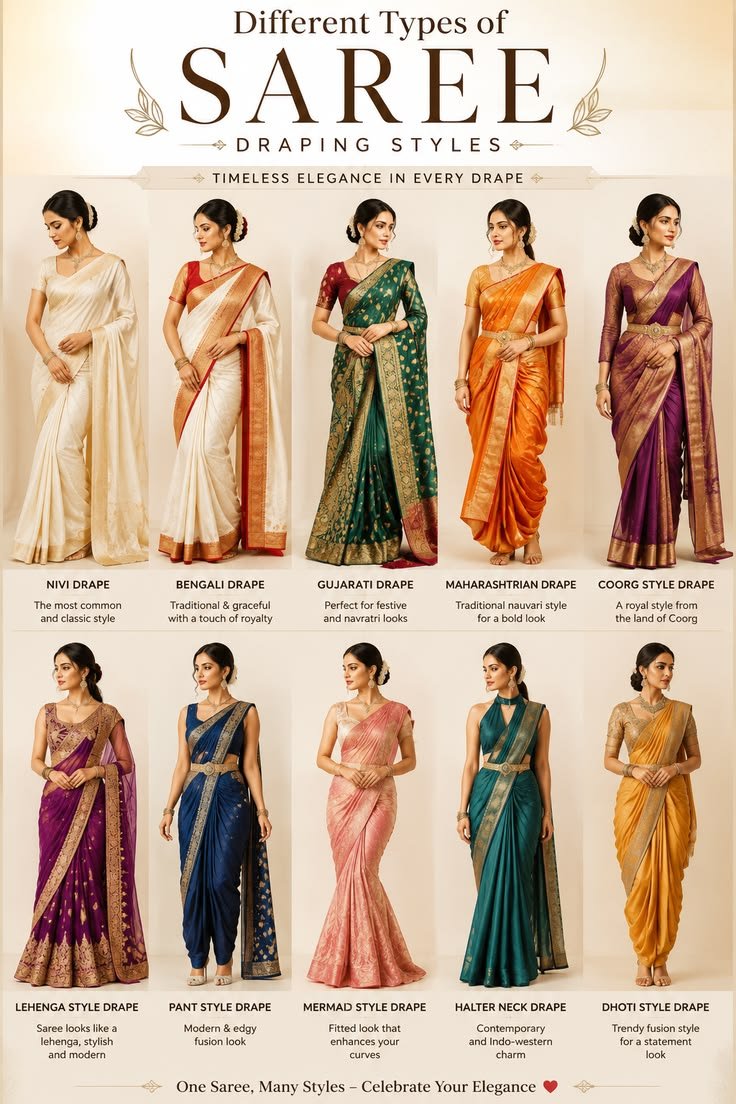
Nivi Drape
Classic and versatile.
Works for almost everyone.
Gujarati / Seedha Pallu
Excellent when you want to showcase the pallu.
Open Pallu
Beautiful for photography and statement looks.
Belted Drape
Modern and structured.
Bengali-Inspired Drape
Traditional and visually distinctive.
The best drape is the one that makes you feel comfortable and allows the saree’s design to remain visible.
A Simple Banarasi Saree Formula
When you’re standing in a store and feeling confused, use this formula:
Step 1
Look at the fabric.
Light or heavy?
Step 2
Look at the border.
Narrow or broad?
Step 3
Look at the motifs.
Small or large?
Step 4
Look at the pallu.
Minimal or elaborate?
Step 5
Imagine your blouse.
Simple or statement?
Step 6
Think about your occasion.
Wedding / festival / party / daily wear?
Step 7
Think about comfort.
Can I wear this for several hours?
That’s enough to make a much more informed choice.
Common Mistakes When Choosing a Banarasi Saree
Mistake 1: Choosing Only by Colour
Colour matters, but fabric matters too.
Mistake 2: Choosing Only by Body Type
A saree that supposedly “doesn’t suit” one body type may look beautiful when styled differently.
Mistake 3: Ignoring the Border
Border width dramatically affects the final appearance.
Mistake 4: Ignoring the Blouse
The blouse can completely change proportions.
Mistake 5: Buying Without Considering Weight
A beautiful saree that you cannot comfortably wear for three hours isn’t necessarily the best purchase.
Mistake 6: Following Fashion Rules Too Literally
Your personal preference should always be part of the decision.
A Better Way to Think About “Body Type”
Instead of asking:
“Which saree hides my body?”
ask:
“Which saree highlights the way I want to look?”
Maybe you want:
A longer-looking silhouette.
Or:
A dramatic traditional look.
Or:
A minimalist appearance.
Or:
A very feminine silhouette.
Or simply:
Comfort.
All of these are legitimate goals.
Quick Banarasi Saree Guide by Height
| Height / Proportion | What to Explore |
|---|---|
| Petite | Lighter fabrics, controlled borders, neat pleats |
| Average Height | Wide range of fabrics and borders |
| Tall | Broad borders, larger motifs, statement pallus |
| Shorter Torso | Blouse and waist placement become important |
| Longer Torso | Consider blouse length and drape position |
Quick Banarasi Saree Guide by Style Preference
| Your Preference | Banarasi Direction |
|---|---|
| Lightweight | Khaddi Georgette |
| Traditional | Katan Silk |
| Grand | Heavy Brocade |
| Minimal | Small motifs + fine border |
| Statement | Large motifs + broad zari |
| Contemporary | Tonal border + modern blouse |
| Bridal | Rich silk + elaborate zari |
| Easy festive wear | Lightweight or medium-weight Banarasi |
The Most Important Rule
There is no scientific formula that says:
“If you are this height, you must wear this saree.”
Fashion is not that rigid.
These suggestions are simply tools for understanding proportion.
If you are petite and love a broad-border Banarasi, wear it.
If you are tall and prefer a delicate pastel saree, wear it.
If you have curves and love structured silk, wear it.
If you have a slim frame and prefer minimal styling, wear it.
Confidence is part of the outfit.
Final Thoughts
The perfect Banarasi saree is not determined by a measurement chart.
It is determined by how the fabric, design, drape and styling work together.
Petite?
Try a clean drape and controlled proportions.
Tall?
Experiment with statement borders and motifs.
Curvy?
Focus on fluid fall and comfortable structure.
Slim?
Explore texture, motifs and contrast.
But never treat these as rules you must follow.
A Banarasi saree is meant to be expressive.
Choose the fabric you love.
Choose the colour that makes you happy.
Choose the border that catches your eye.
Choose the blouse that feels like you.
And then drape it with confidence.
Because the most flattering Banarasi saree is ultimately the one in which you feel your best.
The Banarasi Style
Timeless Elegance Woven in Varanasi.
Frequently Asked Questions
Which Banarasi saree is best for short women?
There is no single best saree for shorter women. Lighter fabrics, controlled borders and neat pleats can create a clean proportion, but shorter women can also wear broad borders and heavy silk when styled intentionally.
Which Banarasi saree is best for tall women?
Tall women can comfortably experiment with broad borders, large motifs and elaborate pallus. They can also wear minimal Banarasi sarees beautifully.
Which Banarasi saree is best for curvy women?
Focus on the drape and fit rather than trying to hide your shape. Fluid fabrics, controlled pleats and a well-fitted blouse can create an elegant silhouette.
Is Katan Silk good for every body type?
Yes. Katan Silk can be worn by women of different heights and proportions. Styling, blouse construction and drape will influence the final silhouette.
Is Khaddi Georgette good for petite women?
It can be a very practical choice because of its lighter, fluid character, but petite women can also wear heavier Banarasi sarees.
Should short women avoid broad Banarasi borders?
Not necessarily. A broad border creates a stronger horizontal visual element, but the final effect depends on the saree colour, blouse, drape and personal styling.
What Banarasi saree is easiest to carry?
Lighter Banarasi constructions, including many Khaddi Georgette sarees, can be easier to carry for long functions. Zari density also affects overall weight.
Which blouse makes you look taller in a saree?
A well-fitted blouse with carefully considered neckline and waist placement can create a more streamlined appearance. There is no single neckline that works identically for everyone.
Can I wear a heavy Banarasi saree if I am petite?
Absolutely. The key is proportion and comfort. You can balance a heavy saree with a clean blouse and controlled drape.
What is more important—height or body type?
Neither is more important. Fabric, proportions, drape, blouse fit, occasion and personal preference all contribute to how a saree looks.