
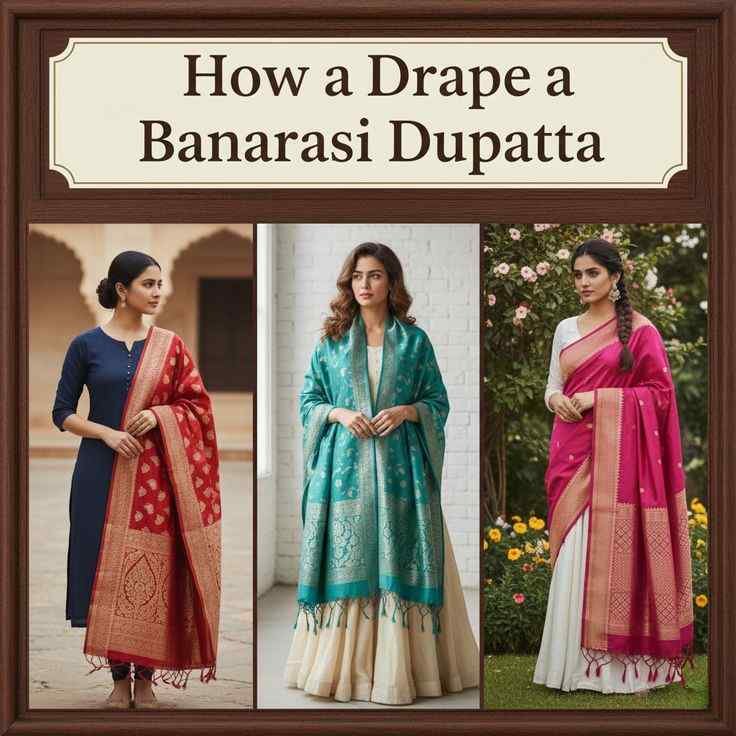
From saree drapes to lehengas and contemporary outfits, discover new ways to wear the timeless Banarasi dupatta
A Banarasi dupatta is one of those pieces that can completely transform an outfit.
Known for its rich woven texture, traditional motifs, zari details and unmistakable festive appeal, a Banarasi dupatta does not have to live inside a salwar suit.
In fact, one beautiful dupatta can work with much more than a matching kurta.
You can drape it over a saree, pair it with a lehenga, style it with a plain kurta, layer it over an anarkali or even use it to bring a traditional touch to a contemporary outfit.
That versatility makes a Banarasi dupatta one of the most useful additions to an Indian ethnic wardrobe.
So, whether you already own one or are planning to buy your first one, here are 8 stylish ways to wear a Banarasi dupatta beyond the traditional suit.
Why Every Ethnic Wardrobe Needs a Banarasi Dupatta
A beautifully woven Banarasi dupatta can add instant richness to even the simplest outfit.
You do not necessarily need:
- A heavily embroidered kurta
- A designer lehenga
- A statement blouse
- Excessive jewellery
Sometimes, a plain outfit paired with a beautiful Banarasi dupatta is enough.
The contrast between a simple base and a richly woven dupatta allows the fabric and craftsmanship to stand out.
This is particularly useful when you want an outfit that feels festive without looking overdone.
1. Style a Banarasi Dupatta with a Plain Kurta
Let’s start with the easiest combination.
Take a simple solid-colour kurta and add a contrasting Banarasi dupatta.
That’s it.
A plain ivory kurta can be paired with a magenta dupatta.
A yellow kurta can work beautifully with pink or green.
A black kurta can become instantly festive with a rich gold-toned Banarasi dupatta.
An off-white or beige outfit can be elevated with almost any jewel-toned Banarasi weave.
Styling Tip
Keep the kurta simple.
The purpose of the dupatta is to become the statement piece.
Add:
small jhumkas + comfortable sandals + a simple hairstyle
for an effortless festive look.
Best for:
- Family functions
- Festive lunches
- Puja
- Small celebrations
- Office festive events
2. Drape a Banarasi Dupatta Over a Saree
This is one of the most elegant ways to experiment with a Banarasi dupatta.
Instead of wearing your dupatta as part of a suit, layer it over a saree.
This works particularly well when the saree itself is relatively simple.
For example:
Plain silk saree + Banarasi dupatta
or
Lightweight cotton/silk saree + richly woven dupatta
The additional layer creates depth and gives the overall outfit a more dramatic, occasion-ready appearance.
How to Style It
Drape your saree normally.
Then place the Banarasi dupatta over one shoulder, allowing it to fall naturally.
You can keep the pleats minimal so that the saree and dupatta remain visually distinct.
Important Styling Rule
Avoid pairing an extremely ornate saree with an extremely heavy dupatta unless you intentionally want a maximalist look.
The easiest formula is:
Simple Saree + Statement Dupatta
3. Pair It with a Lehenga
A Banarasi dupatta can be an excellent alternative to the heavily embroidered dupattas often paired with lehengas.
Imagine:
Plain or lightly embellished lehenga + Banarasi dupatta
The woven texture of the dupatta adds sophistication without requiring the entire outfit to be covered in embroidery.
This can be particularly beautiful for:
- Engagements
- Mehendi
- Festive celebrations
- Day weddings
- Family functions
Colour Combination Ideas
Blush lehenga + Rani pink Banarasi dupatta
Yellow lehenga + Green Banarasi dupatta
Ivory lehenga + Red Banarasi dupatta
Pastel blue lehenga + Magenta Banarasi dupatta
Deep green lehenga + Gold-toned Banarasi dupatta
The contrast does most of the styling work.
4. Wear It with a Sharara or Gharara
Sharara and gharara sets are naturally festive silhouettes, and a Banarasi dupatta can make them feel even more luxurious.
Try a simple sharara set in:
ivory, peach, pink, yellow or green
and add a richly patterned Banarasi dupatta.
For a more traditional look, drape the dupatta across both shoulders.
For a more contemporary appearance, let one side fall freely while keeping the other side pinned.
Jewellery Tip
Because the outfit already has volume, avoid excessive jewellery.
A statement pair of earrings may be enough.
Best for:
Festivals, family celebrations and wedding-related events.
5. Use a Banarasi Dupatta to Transform a Plain Anarkali
Have an old or simple Anarkali sitting in your wardrobe?
Give it a completely new look with a Banarasi dupatta.
A plain Anarkali in a single colour can sometimes look dramatically different when paired with a contrasting woven dupatta.
Try:
Plain cream Anarkali + red Banarasi dupatta
or
Plain black Anarkali + gold Banarasi dupatta
or
Pastel Anarkali + rich jewel-tone Banarasi dupatta
This is one of the easiest ways to create a new festive outfit without buying an entirely new set.
Styling Tip
Match one small element of the dupatta with your footwear, jewellery or handbag.
You don’t need to match everything.
6. Create a Banarasi Dupatta + Palazzo Look
For women who prefer a relaxed silhouette, pair your dupatta with:
straight kurta + wide-leg palazzo + Banarasi dupatta
The result is comfortable enough for daytime wear while still looking festive.
This combination is particularly useful when you want traditional styling without wearing a fully traditional silhouette.
Choose:
simple kurta + solid palazzo + statement Banarasi dupatta
and let the dupatta add all the colour and texture.
Perfect for:
- Festive office dressing
- Casual celebrations
- Family lunches
- Cultural events
- Small pujas
7. Style It with a Contemporary Indo-Western Outfit
A Banarasi dupatta does not have to stay completely traditional.
Pair it with a contemporary outfit such as:
solid maxi dress + Banarasi dupatta
plain jumpsuit + Banarasi dupatta
long skirt + simple blouse + Banarasi dupatta
solid co-ord + Banarasi dupatta
The key is contrast.
A modern silhouette combined with a traditional textile can create a sophisticated Indo-Western look.
The Styling Rule
Keep the base outfit clean.
Avoid too many competing prints.
Let the Banarasi dupatta provide the heritage element.
This approach works especially well when you want Indian craftsmanship to feel modern rather than heavily traditional.
8. Use It as a Statement Drape for Festive Photography
Sometimes the best way to style a Banarasi dupatta is simply to make it the hero.
Instead of constructing an elaborate outfit, wear:
plain kurta + trousers or skirt + statement Banarasi dupatta
Then experiment with the drape.
Try:
One-Shoulder Drape
Allow the dupatta to fall naturally from one shoulder.
Front-Fall Drape
Place it over both shoulders and let the ends fall evenly in front.
Belted Drape
Wrap the dupatta across the torso and secure it with a slim belt.
Open-Shoulder Drape
Let one shoulder remain uncovered while the dupatta is arranged loosely across the other.
These styling variations are particularly effective for photographs because the woven border and pallu-like details remain visible.
How to Choose the Right Banarasi Dupatta
Not every Banarasi dupatta will work equally well with every outfit.
Before buying one, think about:
1. Colour
If you already own many plain outfits, choose a strong statement colour.
If your wardrobe is already colourful, a neutral or muted Banarasi dupatta may give you more versatility.
2. Border
A bold zari border creates a stronger traditional effect.
A smaller border can feel more contemporary.
3. Fabric
Banarasi dupattas can be made in different textile constructions, so check the exact fabric rather than relying only on the word “Banarasi.”
The fabric affects:
- Weight
- Fall
- Texture
- Transparency
- Comfort
- Overall drape
4. Motifs
Floral motifs work well with feminine festive outfits.
Geometric or smaller motifs can create a more modern appearance.
Large traditional motifs can become a statement feature when paired with a minimal outfit.
5 Easy Colour Combinations for a Banarasi Dupatta
Choosing the combination is often easier than choosing the entire outfit.
Ivory + Rani Pink
Elegant and festive.
Yellow + Green
Fresh and traditional.
Black + Gold
Dramatic and sophisticated.
Peach + Magenta
Soft with a festive contrast.
Royal Blue + Gold
Rich and formal.
The simplest approach is to choose one dominant outfit colour and one statement dupatta colour.
How to Keep the Dupatta as the Hero
One of the biggest styling mistakes is creating too much competition.
If your dupatta already has:
- Dense zari
- Large woven motifs
- A wide border
- A rich contrasting colour
then the rest of your outfit does not need to be equally elaborate.
Think:
Simple Base + Beautiful Banarasi Dupatta
rather than:
Heavy Kurta + Heavy Skirt + Heavy Jewellery + Heavy Dupatta
The first combination usually looks more sophisticated.
Banarasi Dupatta Styling for Different Occasions
For Raksha Bandhan
Try:
Pastel kurta + Banarasi dupatta + delicate jewellery
Light, comfortable and festive.
For Diwali
Try:
Solid anarkali + rich Banarasi dupatta + statement earrings
For Wedding Guest Dressing
Try:
Plain lehenga + Banarasi dupatta + traditional jewellery
For Mehendi
Try:
Yellow or green sharara + contrasting Banarasi dupatta
For Puja
Try:
Simple cotton/silk kurta + elegant Banarasi dupatta
For a Festive Office Event
Try:
Straight kurta + trousers + lightweight Banarasi dupatta
This keeps the outfit polished without feeling too formal.
Can a Banarasi Dupatta Be Worn with Western Clothing?
Absolutely.
In fact, this can be one of the easiest ways to make traditional Indian textiles feel contemporary.
A solid black dress can become an Indo-Western outfit with a richly woven Banarasi dupatta.
A plain long skirt can instantly gain an Indian character.
A minimalist jumpsuit can be softened with a colourful traditional textile.
The secret is restraint.
Let one traditional piece make the statement.
Why Banarasi Dupattas Are So Versatile
The strength of a Banarasi dupatta is that it sits somewhere between accessory and garment.
It can:
- Add colour
- Add texture
- Create layering
- Define the silhouette
- Introduce traditional craftsmanship
- Transform a plain outfit
- Change the overall mood of a look
That means you can wear the same dupatta repeatedly while creating completely different outfits.
One day it can be paired with a kurta.
Another day with a saree.
Another day with a lehenga.
Another day with a contemporary dress.
That is excellent wardrobe value.
How to Care for Your Banarasi Dupatta
Because many Banarasi dupattas are made using delicate textile constructions and metallic decorative threads, they should be handled carefully.
Avoid prolonged direct sunlight.
Store it clean and completely dry.
Fold gently and avoid crushing heavy zari areas.
Use breathable fabric storage rather than trapping the textile in plastic for long periods.
Follow the care instructions supplied with the particular textile.
For valuable or delicate silk pieces, professional cleaning may be preferable to experimenting with home washing.
The Best Way to Style a Banarasi Dupatta?
There isn’t one.
That’s the beauty of it.
You can wear it traditionally.
You can style it minimally.
You can make it festive.
You can make it contemporary.
You can pair it with another traditional garment or place it against a modern silhouette.
The key is to understand the visual strength of the textile.
If the dupatta is heavy:
Keep the base simple.
If the dupatta is lightweight:
You can experiment with layering.
If the dupatta has a bold border:
Use an open drape so the border remains visible.
If the dupatta has detailed motifs:
Avoid hiding them inside excessive pleats.
Final Thoughts
A Banarasi dupatta deserves more than one outfit.
It deserves a wardrobe of possibilities.
From a simple kurta to a flowing saree, a festive lehenga to a contemporary dress, this timeless Indian textile can bring colour, texture and heritage into almost any look.
So the next time you reach for your Banarasi dupatta, don’t automatically pair it with the matching suit.
Try something different.
Drape it over a saree.
Wear it with a lehenga.
Style it with a plain Anarkali.
Pair it with a contemporary outfit.
Or simply let it become the statement piece of your entire look.
Because true style is not about wearing something only one way.
It is about discovering how many stories one beautiful piece can tell.
The Banarasi Style
Timeless Elegance Woven in Varanasi.
Frequently Asked Questions
Can I wear a Banarasi dupatta without a suit?
Absolutely. A Banarasi dupatta can be styled with sarees, lehengas, shararas, ghararas, Anarkalis, palazzos, skirts and contemporary Indo-Western outfits.
What can I wear with a Banarasi dupatta?
A simple kurta, plain Anarkali, lehenga, sharara, saree, skirt, palazzo outfit or even a minimalist contemporary dress can work beautifully.
How do I style a Banarasi dupatta with a saree?
Pair a relatively simple saree with a contrasting Banarasi dupatta and drape it over one shoulder. Keeping the saree understated helps the dupatta stand out.
Can I wear a Banarasi dupatta with a lehenga?
Yes. A plain or lightly embellished lehenga paired with a richly woven Banarasi dupatta creates an elegant festive look.
Can I wear a Banarasi dupatta with Western clothes?
Yes. A Banarasi dupatta can add a sophisticated Indian element to a plain dress, skirt, jumpsuit or other minimalist contemporary outfit.
What type of outfit works best with a heavily designed Banarasi dupatta?
A simple solid-colour outfit generally works best because it allows the woven motifs, zari and border of the dupatta to remain the focus.
Is a Banarasi dupatta suitable for weddings?
Yes. Depending on its fabric, zari and design, a Banarasi dupatta can work beautifully for weddings, receptions, mehendi, engagements and other festive occasions.