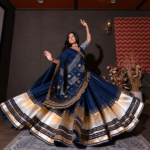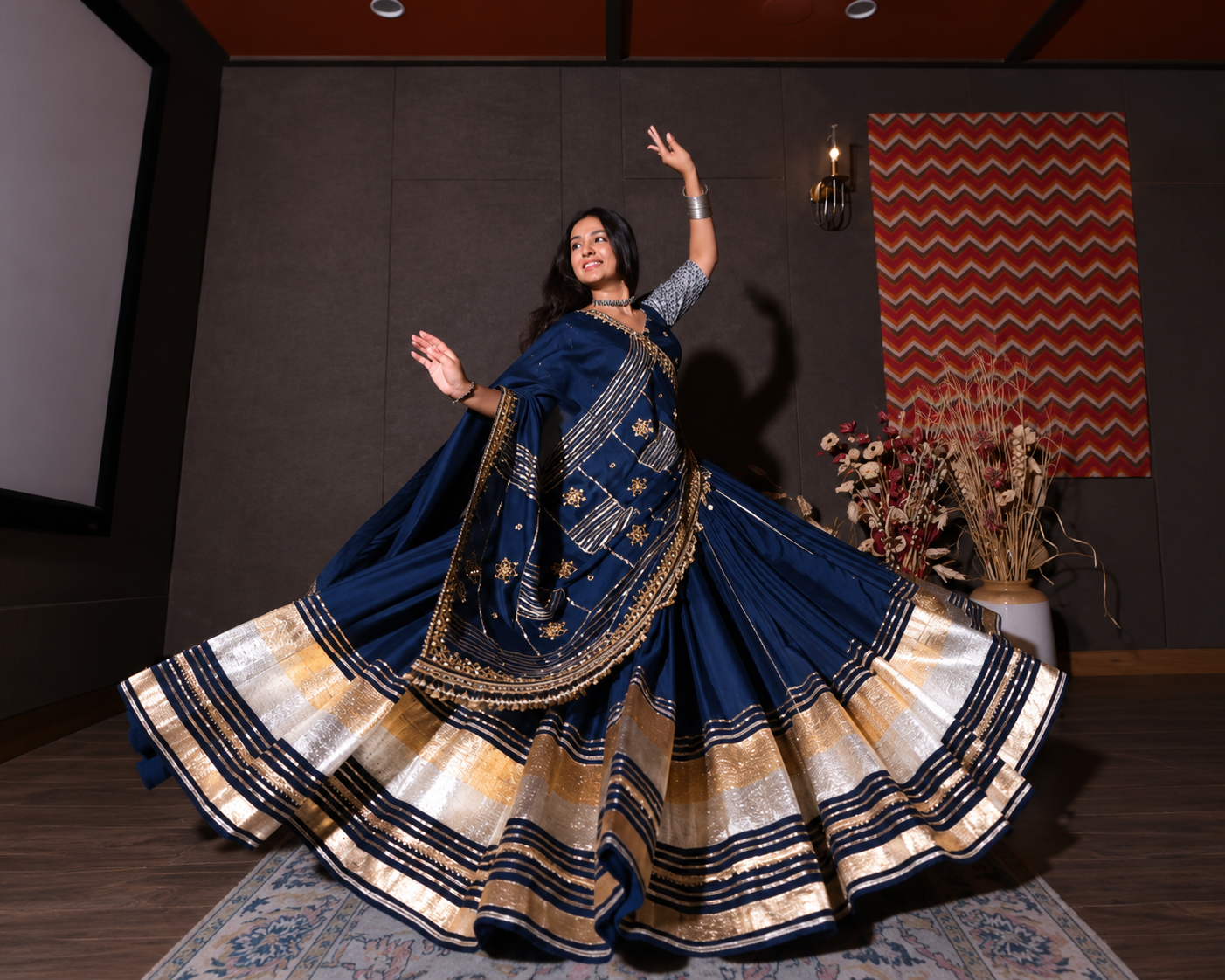
Garba and Dandiya in a Banarasi: Drapes That Survive Nine Nights of Dancing
How to wear a Banarasi saree for Navratri without sacrificing comfort, movement or traditional elegance
Nine nights of Garba and Dandiya mean colourful outfits, traditional music, energetic dancing and countless festive photographs. And while lehengas and chaniya cholis are popular choices, you don’t have to leave your love for Banarasi textiles at home.
A beautifully styled Banarasi saree can create a distinctive Garba look, combining the richness of traditional Indian weaving with the energy of Navratri fashion.
But there is one important consideration.
A saree that looks stunning when you stand still may become difficult to manage when you are spinning, dancing in a circle or playing Dandiya for several hours.
The secret isn’t simply finding the prettiest Banarasi saree. It is choosing the right fabric, planning your drape, securing the pallu and making sure you can move comfortably.
From a Gujarati-inspired front-pallu drape to a secure Nivi saree and a contemporary belted look, here are practical ways to wear a Banarasi during nine nights of celebration.
The Banarasi Style — Timeless Elegance Woven in Varanasi.
Why Wear a Banarasi for Garba and Dandiya?
Banarasi textiles are known for their distinctive woven designs, decorative borders, traditional motifs and rich visual character. A Banarasi saree can bring a different kind of elegance to Navratri, especially when styled with contrasting blouses, traditional jewellery and festive accessories.
The advantage is versatility.
You can create a traditional look with Katan Silk, a lighter outfit with Khaddi Georgette, or a contemporary Indo-festive ensemble with a Banarasi dupatta.
However, not every Banarasi saree is suitable for several hours of dancing. A heavily woven silk saree with dense zari can feel substantial, while a lighter construction may offer more freedom of movement.
Before choosing your outfit, consider three questions:
- Will I be dancing for several hours or mainly attending puja?
- Is the saree comfortable enough to spin and walk in?
- Can I secure the pleats and pallu without damaging the fabric?
Your answers will help determine the best Banarasi style for the occasion.
1. The Secure Nivi Drape: Best for Beginners
The classic Nivi drape is a practical starting point if you want to dance in a Banarasi saree without experimenting with a complicated regional style.
The saree is tucked securely at the waist, the front pleats are arranged neatly, and the pallu falls over the shoulder.
Why it works
The familiar construction makes it easier to check whether your pleats, waistband and pallu remain secure while moving.
For Garba, keep the front pleats neat rather than excessively wide or bulky. Arrange the pallu so that it does not trail near your feet.
How to style it
Saree: Lightweight Banarasi or Khaddi Georgette
Blouse: Fitted short-sleeve or elbow-sleeve blouse
Jewellery: Jhumkas and a modest set of bangles
Footwear: Comfortable, secure flats or traditional footwear
Best for
First-time saree dancers, community celebrations and people who want a traditional silhouette without complicated draping.
Style tip: Practise a few turns at home before the event. If the saree shifts during a test spin, adjust it before leaving.
2. The Gujarati-Inspired Front-Pallu Drape
The Gujarati or seedha pallu drape is a natural choice when you want to bring a regional touch to your Garba outfit.
In this style, the pallu is brought across the front rather than falling entirely behind the shoulder. This can display the saree’s border and woven details more prominently. Contemporary Navratri styling guides also feature the Gujarati front-pallu arrangement as a way to highlight decorative fabric while creating a distinct festive look.
Why it works
A Banarasi saree often has an elaborate pallu. Bringing it to the front can turn the woven design into the main feature of the outfit.
How to make it dance-friendly
- Keep the pallu controlled rather than excessively long.
- Secure it at the shoulder and, where suitable, to the blouse.
- Check that the lower edge does not interfere with your arms or Dandiya sticks.
- Avoid loose fabric that could catch on jewellery or other dancers.
Best for
Garba nights, festive photographs and women who want a Gujarati-inspired look.
Style tip: A contrasting blouse in magenta, green, red or gold can make a simple Banarasi saree look more festive.
3. The Belted Banarasi Drape: Modern and Structured
A slim waist belt can add a contemporary element to a traditional saree.
Start with a secure Nivi drape, arrange the front pleats, and use a comfortable belt to help hold the waist area in place.
A belt can provide additional structure, but it is not a substitute for properly securing the saree underneath.
Which saree works best?
Choose a lightweight or medium-weight Banarasi with a border that complements the belt. A very heavy saree may feel uncomfortable if the belt presses too tightly against the waist.
Styling ideas
Magenta Banarasi + antique-gold belt
Emerald Banarasi + simple metallic belt
Royal-blue Banarasi + narrow contrasting belt
Best for
Fashion-conscious Garba dancers who want a contemporary appearance without abandoning the traditional saree silhouette.
Comfort check: Sit down, raise your arms and practise a few turns before committing to the belt for an entire evening.
4. The Short-Pallu Drape: Keep the Fabric Under Control
If you plan to dance for hours, an excessively long or loose pallu can become difficult to manage.
A short, controlled pallu is often more practical than a dramatic trailing arrangement.
This does not mean making it so tight that it restricts your movement. The goal is to keep the fabric secure while allowing enough freedom for your arms and shoulders.
How to style it
Arrange the pallu neatly over one shoulder and pin it carefully in a concealed, structurally secure area. Keep the fabric away from your feet and make sure the border is still visible.
Best for
Fast-paced Garba, crowded dance floors and long Dandiya sessions.
Style tip: Avoid putting a pin directly through delicate zari whenever possible. Use an appropriate secure point through a sturdy fold or blouse edge, and test the attachment before dancing.
5. The Open-Pallu Look: Beautiful for Photographs, With Careful Securing
An open pallu can show off an elaborate Banarasi design beautifully.
It creates a flowing, dramatic effect and works particularly well for photographs or a short festive appearance.
However, a completely loose pallu may catch on jewellery, other dancers or Dandiya sticks.
Make it more practical
Instead of allowing the entire pallu to hang freely, secure the upper section to the shoulder and arrange the loose portion so it remains clear of your feet.
If the saree is heavy, you may prefer to enjoy this look for photographs and switch to a more secure drape before dancing.
Best for
The opening aarti, outfit photographs, family pictures and shorter periods of dancing.
Style tip: Let the saree’s pallu provide the visual drama. Keep your blouse and jewellery balanced so that the outfit does not feel overcrowded.
6. The Pleated-Pallu Drape: Neat, Traditional and Easy to Inspect
If you love the classic Banarasi look, try arranging the pallu into neat pleats.
This creates a more controlled finish and makes it easier to check whether the shoulder section is sitting securely.
Why it works
A heavily patterned pallu can look beautiful when its border and motifs remain visible. Controlled pleats can prevent excess fabric from moving unpredictably.
How to style it
- Arrange the pleats evenly.
- Secure the shoulder section without pulling the fabric too tightly.
- Make sure the border is visible.
- Keep the pallu length manageable.
Best for
Traditional festive events, family gatherings and moderate dancing.
Remember that no drape is completely movement-proof. Check it periodically during the evening.
7. The Banarasi Dupatta and Chaniya-Choli Look
Here is an option for anyone who loves Banarasi textiles but doesn’t want to manage a full saree on the dance floor.
Pair a chaniya choli or lehenga with a Banarasi dupatta.
This gives you the opportunity to feature the richness of Banarasi weaving while keeping the lower garment designed for dancing.
Try these combinations
Plain chaniya choli + magenta Banarasi dupatta
Yellow lehenga + green Banarasi dupatta
Ivory outfit + red Banarasi dupatta
Royal-blue choli + gold-toned Banarasi dupatta
How to secure the dupatta
Keep it away from your feet, secure the shoulder or waist section appropriately, and avoid excessively long fabric that could interfere with movement.
Contemporary Navratri fashion coverage includes several ways of styling dupattas, from shoulder drapes to waist-secured arrangements, to combine traditional looks with practical wearability.
Best for
High-energy Garba, Dandiya and anyone who wants Banarasi elegance with a more dance-oriented silhouette.
8. The Banarasi Suit With a Statement Dupatta
Sometimes the most practical festive outfit is not a saree at all.
A well-fitted kurta and trouser set paired with a Banarasi dupatta can create an elegant ethnic look without the need to manage saree pleats.
Outfit formula
Straight kurta + fitted trousers + Banarasi dupatta
For a more festive appearance, choose a contrasting dupatta with zari details or traditional motifs.
Best for
Long Garba sessions, people who do not regularly wear sarees, and dancers who prefer greater freedom of movement.
Style tip: If your dupatta is heavy, secure it at the shoulder and avoid letting its ends swing freely while dancing.
Which Banarasi Fabric Is Best for Garba?
The fabric can make a bigger difference than the colour.
Khaddi Georgette
A useful option when you prefer a lighter, more fluid saree. It can be easier to arrange into controlled pleats, depending on the individual construction.
Best for: Longer celebrations and people who prioritise ease of movement.
Lightweight Silk or Banarasi Silk Blend
These can provide a silk-inspired festive appearance without the substantial feel of some densely woven brocades.
Best for: Dancers who want a traditional look but prefer a manageable fabric weight.
Katan Silk
Katan can create a rich and structured Banarasi appearance. However, its weight varies considerably by construction and zari density.
Best for: Traditional celebrations, aarti, photographs and dancing when the specific saree feels comfortable and can be securely draped.
Heavy Banarasi Brocade
A heavily woven saree with dense zari may look spectacular but can be tiring during prolonged dancing.
Best for: Opening-night photographs, aarti, special appearances or shorter periods of dancing—unless you have tried the particular saree and found it comfortable for longer wear.
Important: Do not choose a saree on its fabric name alone. Check its actual weight, stiffness, border construction and fall before deciding how you will wear it.
Nine Nights, Nine Styling Ideas
You do not need nine new sarees to create nine different looks.
Use this as a rotation plan.
| Night | Outfit idea | Styling focus |
|---|---|---|
| Night 1 | Orange Banarasi saree | Traditional start with gold accessories |
| Night 2 | Ivory Banarasi with contrast blouse | Minimal and elegant |
| Night 3 | Red Banarasi saree | Classic festive styling |
| Night 4 | Royal-blue Banarasi | Deep colour and metallic details |
| Night 5 | Yellow Khaddi Georgette | Lightweight, daytime-friendly look |
| Night 6 | Green Banarasi saree | Fresh colour and simple jewellery |
| Night 7 | Banarasi dupatta with chaniya choli | Dance-focused styling |
| Night 8 | Purple Banarasi or festive suit | Contemporary evening look |
| Night 9 | Peacock-green or magenta Banarasi | Statement look for the final celebration |
These colours are styling suggestions, not compulsory daily colours. Follow your family’s or community’s preferred Navratri colour tradition if it differs.
The Five-Point Security Check Before Dancing
Before entering the Garba circle, take two minutes to check the entire outfit.
1. Check the waist
The saree should remain secure when you walk, turn and raise your arms.
2. Check the front pleats
They should not drag on the floor or open excessively while moving.
3. Check the pallu
The upper section should stay secure, and the loose end should not obstruct your arms or get tangled in Dandiya sticks.
4. Check the hem
Walk, turn and take a few larger steps. The saree should not catch under your footwear.
5. Check the footwear
Choose shoes or flats that fit securely and have a comfortable sole. Avoid untested footwear and slippery or unstable high heels for energetic dancing. Recent Navratri footwear guidance also recommends comfortable shoes and avoiding footwear that creates friction or instability during Garba.
If anything shifts during the test, fix it before the dancing begins.
How to Pin a Banarasi Saree Without Damaging It
Banarasi sarees can contain delicate silk, zari and woven motifs, so careless pinning can pull threads or damage the fabric.
Follow these practical precautions:
- Use good-quality, smooth safety pins.
- Avoid forcing pins through dense zari or delicate woven motifs.
- Place pins through secure folds or suitable blouse areas where possible.
- Do not overload the saree with pins.
- Remove every pin carefully after the event.
- Never pull the fabric hard if it becomes caught on a pin.
For a valuable or heirloom Banarasi, practise the drape with a tailor or experienced draper before the event.
The Right Blouse Makes a Difference
Your blouse affects both comfort and the stability of your drape.
For Garba, choose a blouse that fits securely without restricting breathing or arm movement.
Consider:
Short sleeves: Practical for movement and easy to pair with traditional sarees.
Elbow sleeves: A classic look that can work well for more formal celebrations.
Back closures or secure ties: Make sure they remain fastened while dancing.
Comfortable armholes: You should be able to raise your arms without pulling at the blouse or saree.
Avoid untested blouse designs that become uncomfortable once you start moving.
Jewellery That Won’t Get in the Way
Traditional jewellery can complete a Banarasi look, but Garba is not the occasion to wear every heavy piece at once.
Choose accessories that are secure and comfortable.
Jhumkas: A traditional choice for Banarasi sarees.
Bangles: Festive, but avoid pieces that snag the fabric.
Light necklaces: Useful when your saree already has dense zari.
Hair accessories: Secure your hairstyle so it stays in place during turns.
Avoid sharp brooches, loose chains or accessories that might catch on your saree or another dancer.
What Footwear Should You Wear?
Your footwear matters as much as your drape.
For a long evening of Garba or Dandiya, choose comfortable flats, traditional footwear or low, stable heels that you have worn before.
Make sure they fit securely and allow you to turn without slipping.
Keep the saree hem at a length that will not catch under your footwear.
A beautiful outfit is not worth an avoidable trip or fall. If the venue has a specific footwear policy, follow it.
Should You Wear a Heavy Banarasi Saree for All Nine Nights?
You can, but the more useful question is whether you want to.
If you are attending puja, taking photographs or spending most of the evening with family, a rich Katan or brocade saree may be perfect.
If you plan to dance for several hours, a lighter saree or a Banarasi dupatta-based outfit may be a more practical choice.
You can also create two looks in one evening:
Look 1: Heavy Banarasi saree for aarti and photographs.
Look 2: Lightweight ethnic outfit with a Banarasi dupatta for dancing.
That way, you can enjoy the textile you love without asking one outfit to do everything.
How to Build a Banarasi Navratri Wardrobe on a Budget
Nine nights do not have to mean nine new purchases.
Start with a few versatile pieces:
- One lightweight Banarasi saree.
- One rich statement saree for special evenings.
- One Banarasi dupatta.
- One plain kurta or chaniya choli that works with contrasting colours.
- One or two blouses that can be reused with different sarees.
Change your jewellery, blouse, hairstyle and pallu arrangement to create new looks.
This approach gives you more wardrobe flexibility and helps ensure that your purchases remain useful after Navratri.
Final Thoughts: Dance Beautifully, Dress Practically
Garba and Dandiya are about rhythm, movement, community and celebration. Your outfit should help you enjoy them—not leave you worrying about loose pleats or a slipping pallu all evening.
For an all-night dance, prioritise a manageable fabric weight, a secure drape, comfortable footwear and a blouse that allows you to move freely.
Choose a classic Nivi drape when you want familiarity, a Gujarati-inspired front pallu when you want traditional flair, or a Banarasi dupatta with a chaniya choli or suit when movement is your biggest priority.
And if your favourite Banarasi is heavy or precious, let it shine during puja and photographs before switching to a lighter dancing outfit.
Because the best Navratri style is not simply the one that looks beautiful in a photograph.
It is the one that lets you dance with confidence, celebrate comfortably and enjoy all nine nights.
The Banarasi Style
Timeless Elegance Woven in Varanasi.
Frequently Asked Questions
Can you dance Garba wearing a Banarasi saree?
Yes. A lighter Banarasi saree with a secure drape can work well for dancing. Check the fabric weight, arrange neat pleats, secure the pallu and test your movement before joining the dance floor.
Which saree drape is best for Garba?
A secure Nivi drape is a practical choice for beginners. A Gujarati-inspired front-pallu drape offers a more regional look, provided the pallu is secured and kept clear of your feet and arms.
Is a heavy Katan Silk saree suitable for Dandiya?
It depends on the individual saree. A heavily woven Katan with dense zari may feel tiring during prolonged dancing. Test the saree’s weight and movement before committing to a full evening.
Which Banarasi fabric is best for nine nights of dancing?
A lighter, fluid construction such as Khaddi Georgette can be practical for longer celebrations. The best choice depends on the saree’s actual weight, weave, border and how comfortably it can be secured.
How do I stop my saree from coming loose during Garba?
Use a secure waist tuck, neat front pleats and a well-positioned pallu. Pin carefully through secure folds where possible, and practise walking and turning before the event.
Can I wear a Banarasi dupatta instead of a saree for Garba?
Absolutely. Pair a Banarasi dupatta with a chaniya choli, lehenga or a comfortable kurta-and-trouser set. Secure the dupatta so it cannot interfere with movement.
Should I use a belt with a Banarasi saree for dancing?
A belt can add structure to a secure base drape, but it should not be too tight and should not damage delicate fabric. Test the full outfit before dancing.
Which jewellery works best with a Banarasi Garba outfit?
Jhumkas, light necklaces and selected bangles can complement a Banarasi saree. Choose secure accessories that will not snag the fabric or interfere with Dandiya sticks.