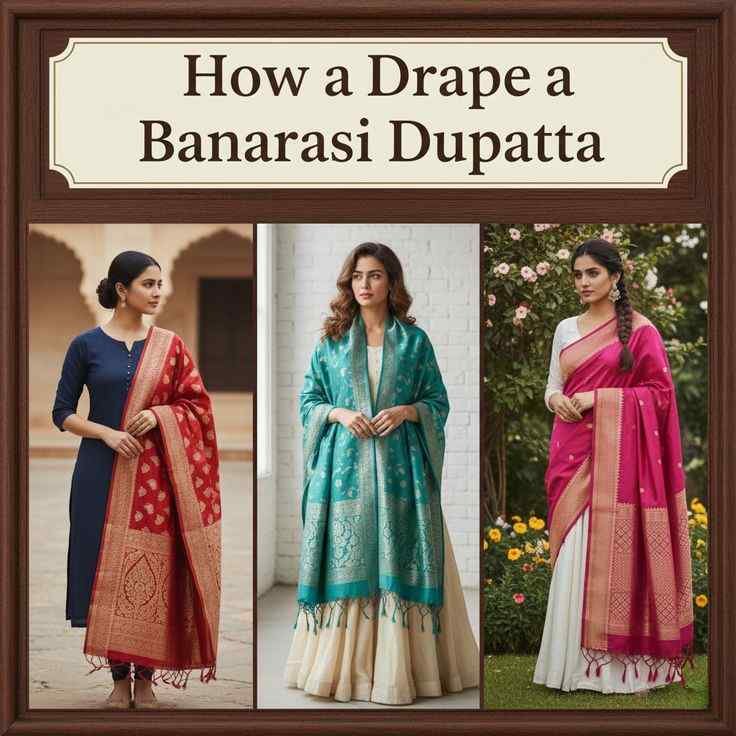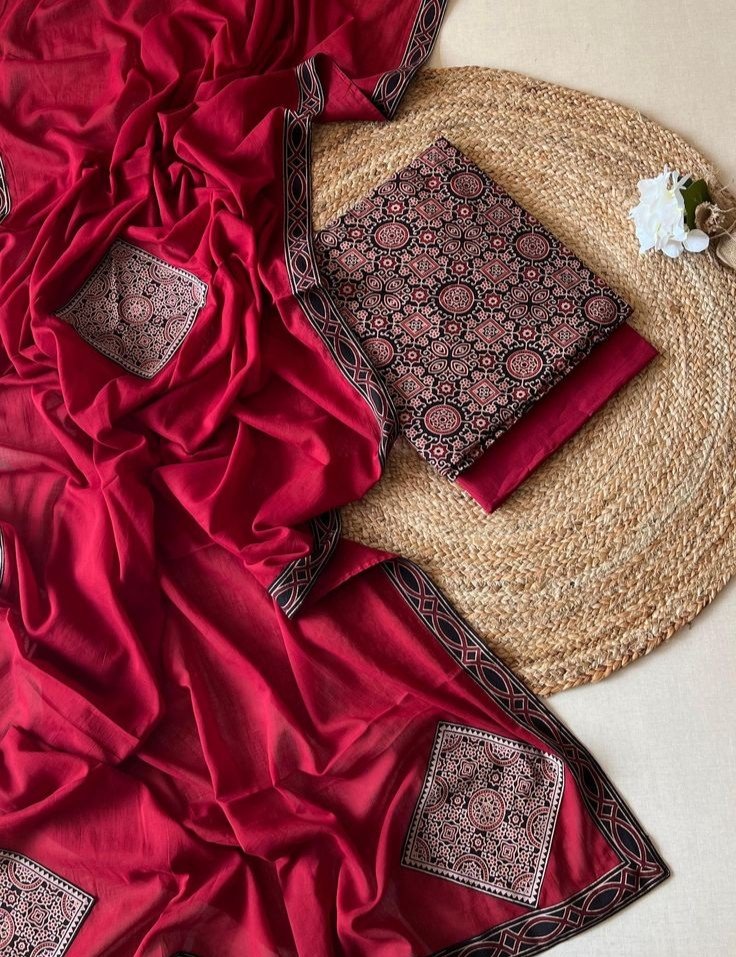
A complete buyer’s guide to choosing, measuring, stitching and styling a Banarasi 3-piece dress material
An unstitched Banarasi dress material gives you something a ready-made suit cannot always provide:
the freedom to create the outfit your way.
Instead of buying a fixed-size kurta, trouser and dupatta, you receive coordinated fabric that can be tailored according to your measurements, preferred silhouette and personal style.
That makes an unstitched Banarasi dress material particularly attractive for women who want a custom fit, a specific kurta length, a different sleeve style or a more personalised festive outfit.
A typical 3-piece dress material consists of:
Top/Kurta fabric + Bottom fabric + Dupatta
But the exact fabric lengths can vary by product and seller. Current Indian dress-material listings commonly show combinations such as around 2.5 metres for the top, 2–2.5 metres for the bottom and 2.25–2.5 metres for the dupatta.
So before purchasing one, it is important to understand exactly what you are getting.
What Is an Unstitched Banarasi Dress Material?
An unstitched Banarasi dress material is a coordinated fabric set sold without a finished garment.
Instead of receiving a ready-made suit, you receive fabric that can be taken to a tailor and converted into your desired outfit.
A standard 3-piece set usually contains:
1. Top / Kurta Material
This is the main fabric used to make the kurta, kameez or top.
2. Bottom Material
This can be used for a salwar, churidar, straight pants, cigarette pants, palazzos or other bottom styles.
3. Dupatta
The third piece completes the outfit and may feature matching zari, motifs, borders or a contrasting design.
Current retail examples show 3-piece dress materials with approximately 2.5 m top + 2–2.5 m bottom + 2.25–2.5 m dupatta, although measurements are not universal and should always be checked on the individual product page.
Why Choose Unstitched Banarasi Dress Material?
The biggest advantage is customisation.
A ready-made suit gives you a predetermined:
- Length
- Fit
- Sleeve style
- Neckline
- Bottom shape
With unstitched fabric, you can decide how the final outfit will look.
You can create:
Straight Kurta
A-Line Kurta
Anarkali
Long Kurta
Short Kurta
Palazzo Set
Sharara Set
Straight Pants
Churidar
Salwar
This makes an unstitched Banarasi dress material more than just fabric.
It is a starting point for your own outfit.
How Much Fabric Is Usually Included?
This is one of the first things buyers should check.
There is no single universal measurement for every unstitched dress material.
Different fabrics, widths, designs and sellers use different measurements.
For example, current Indian dress-material listings include:
- Top: around 2.5 m
- Bottom: around 2–2.5 m
- Dupatta: around 2.25–2.5 m
A general 2026 fabric guide also gives approximately 2–2.5 m for a standard kameez/top, 2–2.5 m for the bottom and 2.25–2.5 m for a dupatta for common adult suit proportions.
But this should be treated as a general guide, not a guarantee.
Always check the exact measurements listed by the seller.
What Does a 3-Piece Banarasi Dress Material Usually Contain?
| Component | Common Approximate Length | Purpose |
|---|---|---|
| Top / Kurta | 2–2.5 m | Kurta / Kameez |
| Bottom | 2–2.5 m | Salwar / Pants / Palazzo |
| Dupatta | 2.25–2.5 m | Dupatta |
| Total | About 6.5–7.5 m | Complete 3-piece outfit |
These ranges are commonly seen in current Indian dress-material listings, but the actual quantity depends on the particular product.
Important:
Do not buy based only on “3-piece set.”
A 3-piece label tells you the number of components, not necessarily their exact lengths.
Why Fabric Width Matters
Length is only half of the measurement equation.
Fabric width is equally important.
Two fabrics can both be 2.5 metres long but provide different usable amounts if their widths differ.
This becomes important for:
- Larger sizes
- Long kurtas
- Full sleeves
- Anarkalis
- Flared styles
- Wide palazzos
A tailoring guide using common 44–45 inch fabric widths notes that fabric requirements can increase when the garment is larger, longer or more structured.
So before finalising your design, tell your tailor:
fabric length + fabric width + your measurements + desired garment style
What Size Can a 2.5-Metre Top Make?
This depends on:
- Your bust measurement
- Kurta length
- Sleeve length
- Fabric width
- Flare
- Design
- Neckline
- Panel requirements
For many standard straight-cut adult kurtas, around 2–2.5 metres can be sufficient, but a tall customer or someone wanting a very long, flared or full-sleeved design may require more fabric.
That is why never assume the same length works for every design or every body type.
Stitching Idea 1: Straight-Cut Banarasi Kurta
This is one of the easiest and most versatile options.
The silhouette is:
Clean + Elegant + Classic
A straight kurta allows the fabric and Banarasi motifs to remain the centre of attention.
This works particularly well when the top fabric already has:
- Woven motifs
- Zari butis
- A decorative border
- Rich texture
Style It With
Cigarette pants + matching or contrasting dupatta
Perfect for:
- Festive lunches
- Family gatherings
- Office celebrations
- Puja
- Small functions
Stitching Idea 2: A-Line Kurta
Want a little more movement?
Try an A-line silhouette.
It gradually flares from the upper body toward the hem, creating a feminine shape without requiring the amount of fabric used for a heavily flared Anarkali.
Best With
A Banarasi fabric that has a beautiful body or border.
Style Tip
Keep the neckline simple.
Let the flare and woven fabric create the visual interest.
Stitching Idea 3: Long Festive Kurta
A longer kurta can turn a simple dress material into a much more dramatic outfit.
Try:
Long straight kurta + narrow pants + statement dupatta
or
Long A-line kurta + straight bottom + Banarasi dupatta
This is especially useful for women who prefer a more elegant, elongating silhouette.
Best For
Festivals, receptions and evening family functions.
Stitching Idea 4: Anarkali
An Anarkali can create a beautiful occasion-wear look from an unstitched dress material.
However, this is where fabric quantity becomes especially important.
A heavily flared Anarkali can require significantly more fabric than a straight kurta. A general tailoring guide, for example, places a standard adult Anarkali at around 4–6 metres, depending on construction and flare.
Therefore:
Check your fabric quantity before choosing an Anarkali.
A 2.5-metre top piece alone may not be enough for the full flare you have in mind.
Solution
Ask your tailor about using:
- Additional matching fabric
- Contrast panels
- Separate lining
- Coordinated plain fabric
before cutting the material.
Stitching Idea 5: Peplum-Style Kurta
For a contemporary ethnic look, try a shorter Banarasi peplum-style top with:
Straight pants + statement dupatta
This works particularly well when the fabric has intricate zari or woven motifs.
The shorter silhouette lets the bottom remain relatively clean.
Best For
Festive parties, engagements and contemporary ethnic events.
Stitching Idea 6: Banarasi Palazzo Set
A wide-leg palazzo can create a relaxed but luxurious silhouette.
Pair:
Banarasi Kurta + Plain Palazzo + Rich Dupatta
or
Simple Kurta + Banarasi Palazzo + Statement Dupatta
The choice depends on how elaborate your fabric is.
If the top is heavily decorated, a plain bottom often creates better balance.
Stitching Idea 7: Sharara or Gharara Look
If you are buying a festive Banarasi 3-piece material, you can explore a sharara-inspired silhouette.
However, a standard bottom piece may not always provide enough fabric for a heavily flared sharara.
This depends on:
- Bottom length
- Leg width
- Number of panels
- Volume
- Your measurements
So always discuss the desired silhouette with your tailor before cutting.
Best For
Wedding guests, festive celebrations and special occasions.
Stitching Idea 8: Straight Pants + Long Kurta
This is an excellent modern option.
Try:
Long Banarasi kurta + ankle-length straight pants + matching dupatta
The clean bottom creates a contemporary contrast with the traditional texture of the Banarasi fabric.
It is elegant without feeling overly traditional.
Stitching Idea 9: Short Kurta + Palazzo
A shorter kurta can make a Banarasi dress material feel much younger and more contemporary.
Pair it with:
Wide-leg palazzo
and let the dupatta remain the main festive element.
Choose this when you want:
Comfort + movement + contemporary ethnic style
Stitching Idea 10: Jacket-Style Ethnic Outfit
You can also experiment with layering.
For example:
Simple inner kurta + Banarasi jacket + straight pants
This is especially useful if you already have a plain kurta and want to use the Banarasi fabric creatively.
However, creating a jacket from the same 3-piece material depends heavily on the fabric quantity.
How to Decide the Right Stitching Style
Before giving the fabric to your tailor, decide:
Desired Length
Do you want:
Hip length?
Knee length?
Calf length?
Ankle length?
Sleeve
Sleeveless
Short sleeve
Elbow sleeve
Full sleeve
Silhouette
Straight
A-line
Flared
Anarkali
Peplum
Bottom
Churidar
Straight pant
Cigarette pant
Palazzo
Salwar
Sharara
Making these choices before cutting can help reduce fabric wastage.
How Much Does Stitching Cost?
This is one area where buyers should be careful with fixed price claims.
There is no single nationwide stitching price for an unstitched suit.
The final tailoring cost depends on:
- City
- Tailor’s experience
- Garment design
- Fabric
- Lining
- Number of panels
- Embroidery
- Piping
- Neck detailing
- Sleeve construction
- Bottom style
- Dupatta finishing
- Urgency
A simple straight-cut kurta will generally require less tailoring work than an elaborate Anarkali, sharara or heavily detailed suit.
Therefore, rather than treating one number as a national standard, it is better to ask your local tailor for a quote based on the exact design.
Typical Pricing Structure
A tailor may separately charge for:
Kurta stitching
Bottom stitching
Dupatta finishing
Lining
Extra flare/panels
Neck design
Sleeve detailing
Embroidery or embellishment
So the final cost should be calculated as:
Fabric Cost + Tailoring + Lining + Additional Work + Finishing
A Practical Way to Calculate Your Total Outfit Cost
Suppose your unstitched Banarasi dress material costs:
₹2,500
And your tailor charges:
₹800
For stitching.
Additional lining and finishing cost:
₹300
Then:
Total outfit investment = ₹3,600
This is only an illustration—not a market-wide price benchmark.
Always use your actual fabric price and your tailor’s quote.
Why the Same Dress Material Can Have Different Final Costs
Two people can buy the same fabric but spend completely different amounts on stitching.
Customer A
Straight kurta + simple pants
Lower tailoring complexity.
Customer B
Long A-line kurta + full sleeves + lining + palazzo
Higher complexity.
Customer C
Anarkali + heavy flare + can-can + detailed neck + sleeve work
Much higher complexity.
The fabric is identical.
The finished garment cost is not.
Is Unstitched Dress Material More Economical?
It can be, particularly when you already have a trusted tailor and want custom sizing.
You may be able to avoid the premium associated with a fully finished designer-style garment.
But do not assume:
Unstitched = always cheaper.
A complex custom-stitched outfit can become more expensive than a simple ready-made suit.
The real benefit is control and personalisation.
Unstitched vs Ready-Made Suit
| Feature | Unstitched Dress Material | Ready-Made Suit |
|---|---|---|
| Fit | Customised | Fixed size |
| Length | Your choice | Pre-determined |
| Sleeve | Your choice | Pre-determined |
| Neckline | Custom | Fixed |
| Silhouette | Highly flexible | Limited |
| Tailoring Needed | Yes | No |
| Alterations | Usually easier | Depends on garment |
| Personalisation | High | Moderate |
| Convenience | Lower | Higher |
Choose Unstitched If:
You have a trusted tailor.
You know your preferred fit.
You want a specific silhouette.
You enjoy custom clothing.
Choose Ready-Made If:
You need the outfit quickly.
You prefer convenience.
You do not want to arrange tailoring.
What Should You Check Before Buying an Unstitched Banarasi Dress Material?
Don’t look only at the photograph.
Check:
1. Fabric
Is it silk, semi-silk, georgette, brocade or another textile?
2. Exact Length
How many metres are included in the top, bottom and dupatta?
3. Width
What is the usable fabric width?
4. Work
Is the design woven, printed, embroidered or embellished?
5. Dupatta
Does it have a border?
Is it fully decorated?
Is it lightweight?
6. Bottom
Is matching bottom fabric included?
7. Colour
Does the product description accurately specify the colour?
8. Care
Can it be dry-cleaned?
Does the seller provide specific care instructions?
9. Return Policy
This is particularly important for unstitched products.
10. Product Photos
Look for clear close-ups of:
- Fabric texture
- Motifs
- Border
- Dupatta
- Reverse side where relevant
Why Fabric Composition Matters
The phrase “Banarasi” tells you about the textile tradition or design association, but it does not automatically tell you that the material is pure silk.
An unstitched Banarasi-style dress material could use different fibre compositions.
So check the product description carefully.
Look for clear wording such as:
Pure Silk
Silk Blend
Viscose
Georgette
Semi Silk
or another specified composition.
For genuine silk products, the Silk Mark Organisation of India states that its Silk Mark label is intended for products made of 100% pure silk by authorised users.
How to Get the Best Fit from an Unstitched Suit
Before cutting the fabric, give your tailor your current measurements.
Do not rely only on your old kurta.
Body measurements can change.
Provide:
- Bust
- Waist
- Hip
- Shoulder
- Armhole
- Sleeve length
- Kurta length
- Bottom length
Also explain the intended fit:
Loose
Regular
Semi-fitted
Fitted
The same fabric can look completely different depending on the final measurements.
Leave Enough Margin for Alterations
If possible, discuss seam allowance with your tailor before cutting.
This is especially important if:
- You are between sizes
- You plan to lose/gain weight
- The fabric is expensive
- You may want to alter the outfit later
A little planning can save a lot of frustration.
Should You Wash the Fabric Before Stitching?
Do not automatically wash every Banarasi dress material before tailoring.
Some fabrics may respond differently to washing or dry cleaning.
Instead:
Check the seller’s care instructions first.
For delicate silk, zari or structured textiles, improper washing can affect:
- Shrinkage
- Surface finish
- Colour
- Zari
- Drape
If the product specifically recommends dry cleaning, follow that instruction.
How to Style Your Finished Banarasi Suit
Once stitched, the dupatta becomes the key styling element.
Try:
Traditional
Jhumkas + bangles + bindi + juttis
Contemporary
Statement earrings + heels + minimal jewellery
Festive
Gold jewellery + embroidered footwear
Minimal
Pearl earrings + neutral sandals
Let the Banarasi fabric remain the centre of attention.
Best Colours for a Banarasi Dress Material
The colour can completely change the personality of the outfit.
Magenta
Festive and vibrant.
Red
Traditional and celebratory.
Emerald Green
Rich and sophisticated.
Royal Blue
Elegant and striking.
Mustard Yellow
Perfect for festive daytime occasions.
Peach
Soft and feminine.
Wine
Ideal for evening wear.
Pastel Pink
Modern and youthful.
Banarasi Dress Material for Different Occasions
Wedding Guest
Choose:
Rich zari + elegant long kurta + straight pant
Mehendi
Choose:
Bright colour + lightweight fabric + comfortable palazzo
Raksha Bandhan
Choose:
Pastel or festive Banarasi + simple kurta silhouette
Diwali
Choose:
Rich colour + statement dupatta + festive jewellery
Puja
Choose:
Elegant woven fabric + modest straight-cut silhouette
Office Festive Event
Choose:
Minimal Banarasi detailing + straight pants + lightweight dupatta
How to Make One Dress Material Look Different Twice
The beauty of custom stitching is that you can completely transform the final outfit.
For example:
Look 1
Straight Kurta + Cigarette Pants + Open Dupatta
Look 2
A-Line Kurta + Palazzo + Pleated Dupatta
Same basic material.
Completely different appearance.
You can also change:
Neckline
Sleeves
Bottom
Length
Dupatta drape
Jewellery
and make the outfit feel new.
Is an Unstitched Banarasi Dress Material a Good Gift?
Yes—especially when you know the recipient’s style.
It can be a thoughtful gift because the person receiving it can choose the final design and fit.
However, before gifting, make sure you know:
- Preferred colours
- Approximate size
- Preferred fabric
- Traditional vs contemporary style
- Whether the recipient has a trusted tailor
Why Unstitched Banarasi Dress Material Is Worth Considering
Fashion is increasingly moving toward personalisation.
Instead of buying exactly what everyone else is wearing, more women are looking for clothing that fits their body, lifestyle and individual taste.
That is precisely where unstitched dress material shines.
You choose:
the fabric
the fit
the silhouette
the sleeves
the neckline
the bottom
the styling
The fabric gives you the foundation.
You create the final outfit.
Final Thoughts
An unstitched Banarasi dress material is more than a 3-piece fabric set.
It is an opportunity to create something that fits you—not simply something that comes in your size.
Whether you choose a classic straight kurta, a flowing A-line silhouette, a festive palazzo set or a more elaborate custom design, the key is to understand the fabric length before cutting.
Remember the most important buying rule:
Always check the exact top, bottom and dupatta measurements on the product page.
A typical adult 3-piece dress material may contain approximately 2–2.5 metres of top fabric, 2–2.5 metres of bottom fabric and 2.25–2.5 metres of dupatta, but individual products vary.
And remember that stitching cost depends on the design you choose—not simply the amount you paid for the fabric.
The real beauty of an unstitched Banarasi dress material is freedom.
You choose the fabric.
You choose the fit.
You choose the style.
You create the outfit.
The Banarasi Style
Timeless Elegance Woven in Varanasi.
Frequently Asked Questions
What is an unstitched Banarasi dress material?
It is a coordinated set of unstitched fabric, usually including top/kurta material, bottom material and a dupatta, which can be tailored into a customised outfit.
How many metres are in a 3-piece unstitched suit?
There is no universal measurement. Current dress-material listings commonly show approximately 2–2.5 m for the top, 2–2.5 m for the bottom and 2.25–2.5 m for the dupatta.
Is 2.5 metres enough for a long kurta?
It may be enough depending on your size, height, fabric width and design. A very long, wide or flared kurta may require more fabric.
Can I make an Anarkali from an unstitched dress material?
Sometimes, but not every 3-piece set contains enough top fabric for a heavily flared Anarkali. Discuss the required flare and fabric quantity with your tailor before cutting.
How much does it cost to stitch an unstitched suit?
There is no single standard rate across India. Tailoring cost depends on your city, tailor, design complexity, lining, sleeves, neck work, flare and bottom style.
Is an unstitched suit better than a ready-made suit?
It depends on your priority. Unstitched fabric offers significantly more control over fit and design, while ready-made suits are more convenient.
Can I use Banarasi dress material for a palazzo suit?
Yes, provided the bottom fabric has sufficient length and width for the desired palazzo design. Always confirm this with your tailor before cutting.
Does Banarasi mean pure silk?
No. “Banarasi” describes a textile tradition/design association and does not by itself guarantee that a product is made from 100% pure silk. Check the stated fabric composition and certification where applicable.
How can I verify pure silk?
The Silk Mark Organisation of India states that Silk Mark labels are used for products made of 100% pure silk by authorised users.
SEO Settings for Yoast
Focus Keyphrase
unstitched Banarasi dress material
Secondary Keywords
- Banarasi dress material
- unstitched Banarasi suit
- Banarasi 3 piece dress material
- unstitched suit fabric
- Banarasi suit material
- Banarasi dress material price
- unstitched suit stitching ideas
- Banarasi dress material fabric length
- Banarasi suit material online
- 3 piece unstitched dress material
- Banarasi kurta material
- Banarasi dress material for wedding
Long-Tail Keywords
- unstitched Banarasi dress material fabric length
- how many metres in Banarasi dress material
- Banarasi 3 piece suit material length
- unstitched Banarasi suit stitching ideas
- how to stitch Banarasi dress material
- unstitched Banarasi dress material price
- best Banarasi dress material for wedding
- how to choose unstitched dress material
- 2.5 metre Banarasi dress material
- Banarasi dress material with dupatta