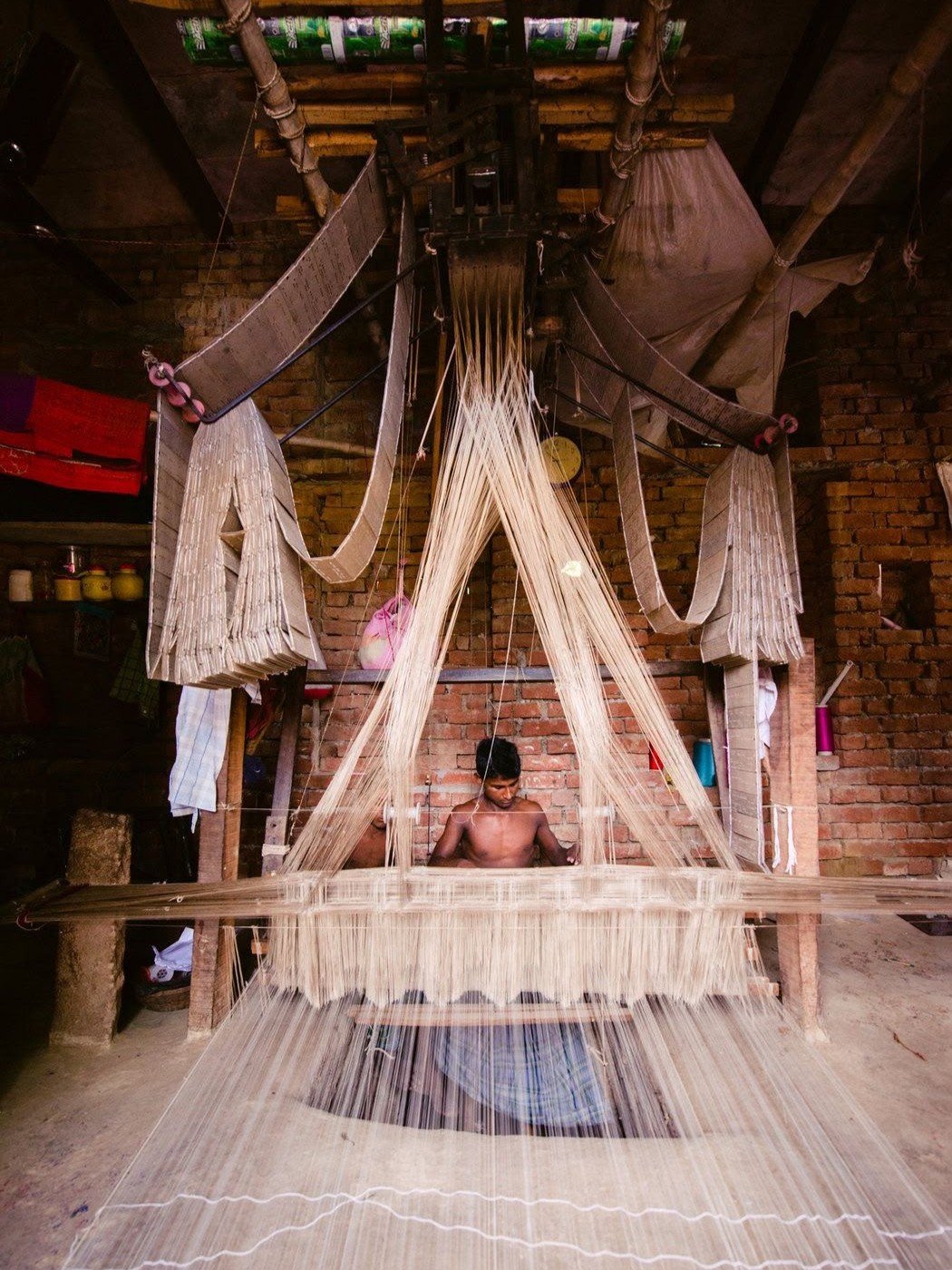
Meet the Weavers of Varanasi: The Hands Behind Every Banarasi Saree
The hands, heritage and human stories behind one of India’s most treasured textiles
When you see a Banarasi saree, the first things you may notice are the silk, the zari, the intricate border, the pallu and the unmistakable richness of the design.
But there is something much more important behind every finished saree:
a pair of hands.
Hands that prepare threads.
Hands that read patterns.
Hands that operate the loom.
Hands that correct tiny imperfections.
Hands that may have learned the craft inside a family workshop and spent decades refining it.
The Banarasi saree is often described as a symbol of Indian luxury, bridal tradition and heritage. Yet the textile’s history cannot be separated from the people who make it.
In Varanasi, weaving remains one of the city’s best-known craft traditions. The Government of Uttar Pradesh describes silk weaving and Banarasi sarees as among Varanasi’s most renowned handicrafts, while Banaras Brocades and Sarees has registered Geographical Indication status. The official GI description highlights finely woven silk, intricate zari ornamentation, compact weaving and characteristic motifs and techniques associated with Banaras.
This is the story behind the saree you see in a shop window or on an online product page.
It is the story of the weavers of Varanasi.
Who Are the People Behind a Banarasi Saree?
A Banarasi saree does not emerge from one simple step.
Its creation can involve several stages of specialised work, from yarn preparation and design development to setting the loom and weaving the final fabric.
In traditional weaving communities, skills have often been passed through families and generations. A 2024 study of Varanasi handloom weavers found that 92% of respondents identified weaving as a family occupation, illustrating how strongly inherited knowledge continues to shape the sector. The same study also found that many respondents had decades of weaving experience.
This is important because weaving knowledge is not only written in manuals.
Much of it is learned through practice.
A young person growing up around a loom may first observe. Then assist. Later, they may learn individual processes before eventually taking responsibility for a complete section of weaving.
Over years, the movement of the hand becomes almost instinctive.
The weaver learns to understand tension, alignment, rhythm, pattern, thread behaviour and the subtle differences that can influence the finished cloth.
That experience is part of what gives handmade textiles their character.
Varanasi: A City Where Weaving Is Part of Everyday Life
Banarasi weaving is not confined to a museum or a historical display.
It has developed within neighbourhoods, homes, workshops and weaving clusters across the Varanasi region.
Government handloom documentation identifies Varanasi as a major handloom cluster. The Varanasi Mega Handloom Cluster, announced in 2008–09, covers the entire Varanasi district and has received interventions involving loom upgradation, raw-material supply, credit support, training, marketing and common facilities.
This cluster-level approach reflects an important reality:
The Banarasi saree is part of an ecosystem, not just an individual artisan’s product.
Within that ecosystem are weavers, designers, yarn suppliers, dyers, traders, master weavers, cooperatives, exporters, retailers and institutions that provide technical or financial support.
A saree may ultimately reach a customer thousands of kilometres away, but its production can begin inside a modest weaving room in Varanasi.
What Does a Banarasi Weaver Actually Do?
A traditional Banarasi loom may look complicated to a visitor seeing it for the first time.
For the weaver, however, every component has a purpose.
The official GI description of Banaras brocades and sarees notes the use of conventional Banaras handloom jacquard systems and traditional attachments such as jala, pagia and naka for creating motifs.
Historically documented Banaras weaving also includes techniques such as Kadhua, Cutwork and Fekwa, along with products such as Butidar, Tanchoi and Jangla styles. Government handloom literature describing the Cholapur cluster in Varanasi records pit looms fitted with jacquard systems and identifies several of these techniques among the area’s weaving practices.
The technical process can therefore involve much more than simply “putting thread through a loom.”
A skilled weaver must coordinate:
warp and weft + pattern + tension + timing + zari + fabric structure
and maintain consistency across the length of the saree.
That is why the finished design can look so effortless even though the process behind it is highly demanding.
The Art of Reading a Design
One of the most fascinating aspects of Banarasi weaving is the relationship between design and weaving.
The motifs seen on a saree do not simply appear after the fabric has been made.
They must be planned and translated into a form the loom can execute.
Traditional Banarasi designs can include floral and foliate patterns, kalga, bel, jali structures, meena work, paisleys and other decorative elements. The Varanasi district’s official GI description specifically highlights these characteristics.
For the weaver, this means the finished saree is simultaneously:
textile + geometry + craftsmanship + timing
A small error in the pattern can affect the visual continuity of the design.
The weaver therefore needs concentration for long periods.
This is one reason the word “craftsmanship” is so important when talking about Banarasi sarees.
The craft is not simply visible in the finished motif.
It is present in every decision made while that motif is being woven.
Why Banarasi Sarees Can Take So Much Time
Not every Banarasi saree takes the same amount of time to weave.
The duration depends on the fabric, design complexity, zari density, weaving technique, pattern repeat and other production factors.
A simple design and a highly intricate brocade are not equivalent projects.
The more complex the design, the greater the concentration and labour involved.
This is especially visible in intricate forms of weaving where decorative motifs must be integrated carefully into the fabric rather than simply printed onto its surface.
The result is one of the reasons Banarasi textiles have long been associated with ceremonial clothing and heirloom wardrobes.
When a customer sees a detailed Banarasi pallu, they are seeing the final expression of a much longer process.
The Loom Is More Than a Tool
For a weaving family, the loom may be both workplace and source of livelihood.
Government documentation on Varanasi’s handloom clusters notes substantial investment in loom upgradation and technical support. In the Varanasi Mega Handloom Cluster, more than 45,000 handloom parts were distributed, while a raw-material bank supplied 18.5 lakh kilograms of yarn worth about ₹307.62 crore through March 2023.
These figures demonstrate the scale of the handloom ecosystem, but they also reveal something else:
the loom cannot function independently of the larger supply chain around it.
Good yarn must be available.
Tools must work.
Designs must remain commercially relevant.
Weavers need access to finance.
And finished products must reach customers who understand their value.
The Skill You Cannot See in a Photograph
When we buy a saree online, we see an image.
We do not see:
- How many hours the weaver sat at the loom.
- How many times a thread had to be corrected.
- How much concentration was required.
- Who taught the weaver the technique.
- How many generations of knowledge influenced the design.
- How much of the final retail value actually reached the producer.
That gap between what the customer sees and what the maker experiences is one of the most important things to understand about handloom textiles.
The beauty of a Banarasi saree is visible immediately.
The labour behind it is not.
The Challenges Facing Varanasi’s Weavers
The story of Banarasi weaving should not be romanticised.
The craft has immense cultural value, but many weavers also face economic and occupational challenges.
A 2024 study focusing on Varanasi handloom weavers reported concerns including delayed payments, low income during off-seasons, difficulty obtaining credit, rising input costs and competition from powerloom production. In that study, 80% of respondents identified powerloom competition as a challenge. It also reported concerns related to long working hours and health problems associated with prolonged loom work.
Earlier studies have similarly identified financial pressure, raw-material costs, marketing difficulties, changing designs and irregular income among major concerns for Varanasi’s handloom community.
These challenges matter because a craft does not survive simply because consumers love the finished product.
It survives when the people making it can also build a sustainable livelihood from that craft.
Why Powerlooms Have Changed the Market
Technology has not simply entered the Banarasi industry from outside.
It has changed the competitive environment in which handloom weavers operate.
Powerloom production can offer speed, consistency and lower production costs for certain products.
For a handloom weaver, the comparison can be difficult.
A handmade saree may involve significantly more time and skilled labour, while a mechanically produced textile can imitate some of the visual elements of traditional designs at a different price point.
Research on Varanasi’s handloom sector has highlighted modernisation and mechanisation as important pressures on traditional weaving livelihoods.
This does not mean every machine-made textile is inferior in every respect.
It means that buyers need to understand what they are purchasing.
A handloom saree and a powerloom saree can belong to very different production systems even when photographs look surprisingly similar.
Why Young People Do Not Always Want to Become Weavers
A craft can be culturally prestigious while still being economically difficult.
This is one of the central challenges facing traditional weaving communities.
If younger generations see long working hours, uncertain earnings and limited opportunities for growth, they may understandably look toward other professions.
A 2024 study of Varanasi weavers found that most respondents had entered weaving through their family occupation, while the same research highlighted concerns regarding income, health, market access and opportunities.
This creates a difficult question:
How do you preserve a centuries-old skill when the next generation needs a financially viable future?
The answer cannot simply be “preserve tradition.”
Tradition must also evolve economically.
Government Support for Varanasi’s Weaving Community
There have been significant efforts to support the handloom sector.
The Varanasi Mega Handloom Cluster records interventions covering:
raw materials, loom parts, solar lighting, credit, marketing, design development, training and common facilities.
As of March 2023, the cluster report recorded:
- 4,000 solar lighting units distributed
- 45,253 handloom parts distributed
- 18.5 lakh kg of yarn supplied through the raw-material bank
- Loans sanctioned to 2,336 weavers under credit support
- 220 new designs introduced through the market-development initiative
- 31 training and 7 awareness programmes completed
These are cluster-level figures reported by the Development Commissioner (Handlooms), not a count of every weaver or every Banarasi saree produced in the city.
The Government of India’s Weavers’ Service Centre, Varanasi also identifies technical guidance, skill upgrading, product development, design, weaving, dyeing, printing and implementation support for handloom schemes among its functions.
The broader handloom support system also includes mechanisms such as the Weaver MUDRA / concessional credit framework.
Meet the Master Weavers
Varanasi’s weaving community includes artisans whose skills have been formally recognised through national and state-level awards.
The Development Commissioner (Handlooms) maintains official records of handloom awardees and weavers from Varanasi, including artisans recognised for specialist Banarasi skills such as Kaduwa Jangla.
The Ministry’s official weaver database also records individual Varanasi weavers working on specific Banarasi products and techniques. For example, the database lists Haji Rais Ahmad, associated with Satin Tanchoi and Banaras Brocade, and Reyazuddin Ansari, associated with Kaduwa Jangla and Butidar sarees, among other handloom products.
These names matter because they remind us that “the Banarasi weaver” is not an abstract character.
They are real people with highly specialised skills.
At the same time, it is important not to assume that every weaver has the same background, income, technique or working arrangement. Varanasi’s weaving community is diverse, and individual stories differ.
Weaving Is Often a Family Story
One of the most meaningful aspects of Banarasi weaving is its intergenerational nature.
A design may be modern.
A colour palette may change.
A buyer may discover the saree through Instagram.
But the knowledge of how to work the loom can still come from a parent, grandparent or another experienced artisan.
This is how craft knowledge survives.
Not necessarily through a single textbook, but through:
watching + practising + repeating + correcting + teaching
A saree made today can therefore contain knowledge that predates the person who is weaving it.
That is one reason handloom textiles carry a different emotional meaning from mass-produced fashion.
What Makes a Handwoven Banarasi Saree Special?
It is tempting to say that handloom means “perfect.”
But that is not quite right.
Handloom production can contain subtle irregularities that are natural to handmade textiles.
The stronger argument for handloom is not that every inch must be mechanically identical.
It is that the textile is produced through human skill and controlled manually at the loom.
The official Varanasi GI description connects Banaras Brocades and Sarees with conventional handlooms and specialised attachments used to create intricate motifs.
That human involvement can influence:
- The rhythm of the weave
- The handling of yarn
- Pattern execution
- Small variations
- Fabric character
- The overall tactile experience
For many collectors, these qualities are exactly what make a handwoven saree special.
How Buyers Can Support the Weaver
Supporting weavers does not require buying the most expensive saree in the store.
It begins with buying consciously.
Before purchasing a Banarasi saree, ask:
Is it handloom or powerloom?
Do not assume that every product using the word “Banarasi” is handmade.
What is the fabric?
Ask whether it is pure silk, a blend, or another fibre.
Where was it woven?
Understanding provenance is particularly important when buying a high-value textile.
What is the zari?
The Silk Mark system concerns silk purity, not the quality or purity of zari, so buyers should seek separate clarity about the zari used.
Who made it?
When the seller can provide meaningful information about the artisan, weaving cluster or production process, it creates a stronger connection between the buyer and the craft.
Is the price realistic for the claimed craftsmanship?
A very low price for a supposedly highly intricate handwoven silk saree should encourage questions rather than automatic excitement.
Why the Story of the Weaver Matters
Imagine wearing a Banarasi saree at a wedding.
People notice the colour.
They notice the zari.
They compliment the border.
Someone asks where you bought it.
But the most important story is rarely visible.
Somewhere in Varanasi, a skilled artisan may have spent long hours transforming threads into the cloth you are now wearing.
That person may have inherited the skill.
They may work in a family workshop.
They may have learned techniques that are no longer widely practised.
They may also be facing the same pressures affecting many traditional artisans: rising input costs, uncertain income, competition, changing consumer preferences and the need to attract the next generation to the craft.
That is why buying a handwoven Banarasi saree can mean more than purchasing clothing.
It can mean participating in the continuation of a craft.
Banarasi Sarees Are Changing — and That Is Not Necessarily a Bad Thing
Preserving the Banarasi tradition does not mean freezing it in the past.
The Varanasi handloom cluster itself has supported new designs, product development, training and market-oriented initiatives. The cluster report records 220 new designs introduced through one market-development intervention, showing that innovation is already part of the sector’s evolution.
Modern Banarasi weaving can therefore include:
- Traditional bridal sarees
- Contemporary colour palettes
- Lightweight sarees
- Dupattas
- Home textiles
- Fashion fabrics
- Designer collaborations
- New motif interpretations
The craft survives not by refusing change, but by carrying its core skills into new contexts.
The Future of the Varanasi Weaver
The future of Banarasi weaving depends on more than nostalgia.
It depends on whether the next generation can see a future in the profession.
That requires:
fairer market access
better financing
skill development
design innovation
consumer awareness
technology that supports rather than simply replaces craft
and stronger recognition of the artisan’s contribution
The Development Commissioner (Handlooms) continues to operate support systems for training, credit, marketing, cluster development and technological assistance, while the Varanasi Weavers’ Service Centre explicitly describes its role as supporting technical and skill development in the sector.
But consumers also have a role.
When buyers ask informed questions, value genuine craftsmanship and purchase from transparent sellers, they help create demand for the kind of textile economy in which skilled weaving remains worth preserving.
Every Banarasi Saree Has Two Stories
The first story is the one everyone sees:
silk, colour, zari, motifs, border and beauty.
The second story is the one hidden inside the fabric:
time, skill, family knowledge, concentration, labour and human hands.
The second story is what we want to remember.
Because a Banarasi saree is not beautiful only because it looks beautiful.
It is beautiful because an extraordinary amount of knowledge has been transformed into something you can wear.
The Government of Uttar Pradesh recognises Banarasi sarees as one of Varanasi’s defining crafts, and the GI framework formally protects the identity of Banaras Brocades and Sarees.
But the true living heritage of Banaras is not the GI certificate, the loom, the zari or the finished saree by themselves.
It is the weaver.
The person sitting at the loom.
The person checking the pattern.
The person correcting the thread.
The person teaching the next generation.
The person whose hands turn an idea into fabric.
And when you wear a Banarasi saree, you carry a small part of that story with you.
How You Can Help Keep the Tradition Alive
The next time you shop for a Banarasi saree, take a moment to look beyond the photograph.
Ask about its fabric.
Ask about its weaving.
Ask whether it is handloom.
Ask where it was made.
Ask what makes that particular saree special.
And most importantly, remember the person behind it.
Because when we value the craft, we also create value for the craftsperson.
Every Banarasi saree has a weaver behind it.
Every weaver has a story behind the skill.
And every story deserves to be remembered.
Final Thoughts
The magic of Varanasi’s Banarasi saree tradition is not only found in its centuries-old motifs or shimmering zari.
It lives in workshops, homes and weaving clusters.
It lives in family knowledge.
It lives in the patience required to make something slowly in a world increasingly built around speed.
And it lives in the hands of artisans who continue to adapt an old craft to a changing market.
So the next time you see a Banarasi saree, don’t see only a saree.
See the weaver.
Because behind every beautiful Banarasi is a human hand—and behind that hand is a story of skill, patience, heritage and hope.
Frequently Asked Questions
Who makes Banarasi sarees?
Banarasi sarees are made by skilled textile artisans and weaving communities in and around Varanasi. The production ecosystem can involve weavers and other specialised workers connected with yarn, design, weaving and finishing.
Are all Banarasi sarees handwoven?
No. Buyers should verify whether a particular saree is handloom or powerloom rather than assuming that every saree labelled Banarasi is handwoven. Research on the Varanasi handloom sector specifically discusses competition from powerloom production.
What makes a Banarasi saree special?
Traditional Banaras brocades are known for finely woven silk, intricate zari ornamentation, compact weaving and characteristic motifs and techniques.
Is Banarasi weaving a family tradition?
Often, yes. A 2024 study of Varanasi handloom weavers found that the majority of respondents had entered weaving through family occupation, reflecting the importance of intergenerational skill transmission.
Why are authentic handwoven Banarasi sarees expensive?
The price reflects several factors, including silk, zari, design complexity, weaving time, skill and production costs. Highly intricate weaving requires significant labour and specialised expertise.
How can I support Banarasi weavers?
Buy from transparent sellers, ask whether the saree is handloom or powerloom, understand the fabric composition and weaving origin, and value craftsmanship rather than choosing only by the lowest price.
SEO Information for The Banarasi Style
Primary Keyword:
Weavers of Varanasi
Secondary Keywords:
Banarasi saree weavers, Varanasi handloom weavers, Banarasi saree weaving, Banarasi artisans, Banarasi handloom, Varanasi silk weaving, Banarasi saree craftsmanship, Banarasi weavers history, Banarasi saree artisans
Long-Tail Keywords:
- Meet the weavers of Varanasi
- Who makes Banarasi sarees
- Banarasi saree weaving process
- Varanasi Banarasi handloom weavers
- Story behind Banarasi saree
- Life of Banarasi saree weavers
- How Banarasi sarees are woven
- Traditional Banarasi weaving techniques
- Banarasi handloom vs powerloom
- How to support Banarasi weavers
- Banarasi saree artisan stories
- History of Banarasi weaving in Varanasi
SEO Title:
Meet the Weavers of Varanasi: The Hands Behind Every Banarasi Saree
Meta Description:
Discover the skilled weavers behind every Banarasi saree—explore Varanasi’s handloom heritage, weaving techniques, artisan families, challenges and the future of Banarasi craftsmanship.
Recommended URL Slug:
/meet-the-weavers-of-varanasi-banarsi-saree-artisans/
Suggested Featured Image Alt Text:
Banarasi saree weaver working on a traditional handloom in Varanasi
Research Sources
- District Varanasi, Government of Uttar Pradesh — Banaras Brocades and Sarees GI / craft description.
- District Varanasi, Government of Uttar Pradesh — Handicrafts and silk-weaving overview.
- Development Commissioner (Handlooms), Government of India — Varanasi Mega Handloom Cluster report.
- Weavers’ Service Centre, Varanasi — official Citizen’s Charter and technical-support role.
- Development Commissioner (Handlooms) — official weaver database for Uttar Pradesh/Varanasi.
- Development Commissioner (Handlooms) — national handloom awardee records.
- Paul, Biswas & Bhattacharya (2024) — study of opportunities and challenges faced by Varanasi handloom weavers.
- Naik, Bhardwaj & Mishra — post-COVID assessment of challenges in Varanasi’s handloom industry.
- Dwivedi, Kesarwani & Singh — study of problems of handloom weavers in Varanasi district.
- Government of India handloom publication documenting Banaras weaving clusters and techniques.