Khaddi Georgette vs Katan vs Munga Silk: Which Banarasi Saree Is Right for You?
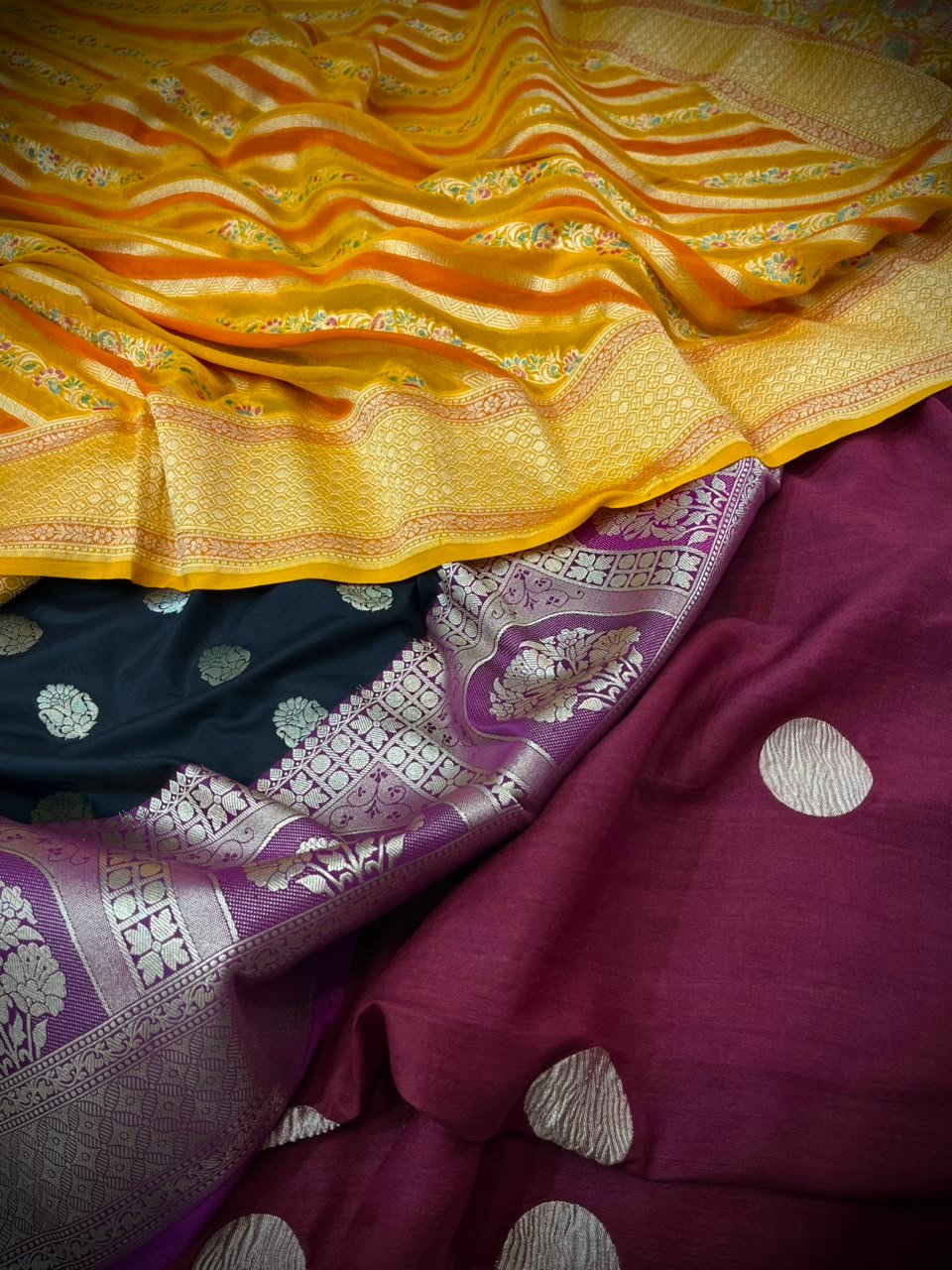
A Banarasi saree is never just about the design. The fabric underneath the zari can completely change the way a saree looks, feels, drapes and behaves when you wear it.
Among the choices available today, Khaddi Georgette, Katan Silk and Munga Silk are frequently searched for by saree lovers who want something beautiful, traditional and distinctly luxurious. But these terms can be confusing because they do not all describe exactly the same thing.
Katan and Georgette are commonly encountered as Banaras fabric categories, while Muga/Munga is a specific silk associated with Assam and is a registered Geographical Indication. Muga can also be used in woven sarees and contemporary Banarasi-style products, but the terminology should be checked carefully product by product.
So, which one should you choose?
Khaddi Georgette for lightweight fluidity? Katan for classic Banarasi grandeur? Or Munga for distinctive natural lustre and heritage character?
This complete guide will help you decide.
Khaddi Georgette vs Katan vs Munga Silk: Quick Comparison
| Feature | Khaddi Georgette | Katan Silk | Munga / Muga Silk |
|---|---|---|---|
| What it describes | A lightweight Georgette-based Banarasi fabric | A traditional silk fabric/category used in Banaras weaving | A distinctive wild silk originating in Assam |
| Texture | Fine, slightly crinkled/crepe-like | Smooth and refined | Naturally lustrous with distinctive silk character |
| Drape | Soft, fluid and close to the body | More structured and substantial | Depends on construction; generally elegant with a characteristic silk body |
| Visual effect | Graceful and lightweight | Rich, classic and regal | Natural golden/lustrous character |
| Best for | Long functions, festive wear, destination weddings | Bridal, formal and ceremonial wear | Heritage-inspired and distinctive occasion wear |
| Main attraction | Easy drape and lightness | Traditional Banarasi luxury | Natural lustre, durability and unique origin |
| Buyer priority | Comfort + movement | Grandeur + tradition | Uniqueness + silk character |
Important: Fabric weight, drape and appearance also depend on yarn quality, weaving structure, zari density, motif density and finishing. Two sarees carrying the same broad fabric name can therefore feel noticeably different.
First, What Exactly Is a Banarasi Saree?
Before comparing the fabrics, it helps to understand what “Banarasi” actually means.
Banaras Brocades and Sarees are a registered Geographical Indication associated with Uttar Pradesh. Government sources describe Banaras brocades as finely woven silk textiles decorated with intricate zari designs, including floral and foliate motifs, kalga, bel, jala, meena work and other detailed ornamentation. Traditional Banaras looms have used technologies and attachments such as jacquard, jala, pagia and naka for creating motifs.
The important point is that Banarasi is a weaving tradition rather than one single uniform fabric.
Government documentation on Banaras textiles records different fabric constructions and notes the use of silk yarns in varieties including Katan, Georgette, Organza and others. Historical documentation from the Textiles Committee also records Banarasi sarees using Katan silk in the weft and examples where twisted threads create a Georgette-like feel.
That is why two sarees can both legitimately have a Banarasi identity while feeling completely different in your hands.
1. Khaddi Georgette Banarasi Saree
What Is Khaddi Georgette?
Georgette is a lightweight fabric associated with highly twisted yarns and a characteristic crepe-like texture. Textile references describe the fabric as light and drapey, with the twist of the yarn contributing to its distinctive surface.
In the Banaras context, Khaddi Georgette refers to the lightweight, textured Georgette family used for Banarasi weaving, where traditional motifs, borders, zari and pallu designs are incorporated into a much more fluid fabric base.
Government textile documentation of Banaras sarees specifically records the use of twisted threads to create a “georgette feel,” while contemporary Banaras textile sources describe Georgette as one of the principal fabric varieties used in the region.
What Does Khaddi Georgette Feel Like?
This is where Khaddi Georgette stands apart from a heavier silk Banarasi.
It generally feels:
Light + Fluid + Textured + Easy to Carry
The slightly crinkled surface is part of its character. Instead of creating a rigid silhouette, the fabric tends to fall naturally, making it particularly appealing to women who prefer movement and an effortless drape.
Why Do People Love Khaddi Georgette Banarasi Sarees?
The biggest advantage is wearability.
A beautifully woven Khaddi Georgette Banarasi can offer the traditional visual language of Banaras—zari, butis, floral motifs, intricate borders and a statement pallu—without the same substantial feel associated with some heavily woven silk sarees.
That makes it attractive for:
- Wedding guests
- Daytime celebrations
- Festive functions
- Destination weddings
- Receptions
- Family gatherings
- Puja ceremonies
- Long-duration events
- Women who prefer lightweight sarees
Is Khaddi Georgette Good for Beginners?
It can be.
Because of its fluid nature, many wearers find Georgette-based sarees comparatively easy to manage. However, the exact drape still depends on the weave, zari density and finishing of the individual saree.
Who Should Buy Khaddi Georgette?
Choose Khaddi Georgette when comfort, movement and easy draping matter as much as traditional beauty.
It is particularly suitable for someone who loves Banarasi aesthetics but does not want every saree in their wardrobe to feel heavy or highly structured.
2. Katan Silk Banarasi Saree
What Is Katan Silk?
Katan is a traditional silk category strongly associated with Banaras weaving.
Historical documentation from the Textiles Committee records Banarasi sarees using Katan silk in the weft, and contemporary textile references describe Katan as a tightly constructed silk fabric with a smooth surface and substantial silk character.
Katan is especially associated with the traditional side of Banarasi craftsmanship.
When most people imagine a grand, classic Banarasi silk saree with a rich body, detailed zari and a formal silhouette, Katan is often close to that image.
What Does Katan Silk Feel Like?
Compared with Khaddi Georgette, Katan generally offers a:
Smoother + Richer + More Structured + More Traditional
experience.
The precise feel varies by weave and construction, but Katan is usually chosen by customers who want the saree to have greater body rather than an extremely soft, floaty drape.
Why Is Katan Popular for Bridal Sarees?
There is a reason Katan continues to occupy an important place in traditional Banarasi wardrobes.
Its richer silk character pairs beautifully with intricate brocade and zari work. Government descriptions of Banaras brocades highlight their detailed metallic ornamentation, compact weaving and elaborate floral and foliate motifs.
For a bride, that combination can create exactly the kind of:
Regal + Traditional + Ceremonial + Timeless
look that many families associate with a classic Banarasi bridal saree.
Best Occasions for Katan Silk
Katan is particularly suitable for:
- Bridal ceremonies
- Wedding functions
- Reception looks
- Engagement ceremonies
- Traditional festivals
- Important family occasions
- Formal evening events
- Heirloom-style purchases
Who Should Choose Katan?
Choose Katan if you want the classic Banarasi experience rather than the lightest possible saree.
It is ideal for someone who values traditional silk character, a more defined drape and a rich ceremonial appearance.
3. Munga / Muga Silk: A Different Kind of Luxury
This is where the comparison requires a little more care.
What Is Muga Silk?
Muga Silk, also commonly spelled Munga in retail contexts, is a distinctive silk native to Assam. The Geographical Indication Registry lists “Muga Silk of Assam” as a registered GI, with the registration covering Assam.
Government sources describe Muga as a wild silk associated with the silkworm Antheraea assamensis. It is particularly recognized for its natural yellowish-golden colour, lustre and durability.
The Assam government describes Muga as the “golden thread” of Assam and notes its naturally golden yarn, longevity and strength.
Is Munga the Same as Katan?
No.
This distinction is important.
Katan refers to a Banaras silk fabric/category, while Muga/Munga refers to the type and origin of silk fibre.
That means comparing “Katan vs Munga” is not always a perfect apples-to-apples technical comparison.
A Katan Banarasi and a Muga-based Banarasi-style saree can differ both in their silk type and construction.
For buyers, this means the product description should ideally tell you:
- What silk is used?
- Is the saree handwoven?
- Where was it woven?
- What is the weave construction?
- Is it pure silk?
- What type of zari is used?
- Does it carry appropriate certification?
What Makes Muga Silk Special?
The first thing you notice is its distinctive natural lustre.
Unlike a fabric that depends entirely on heavy metallic work to look luxurious, Muga itself has a characteristic visual quality.
Government sources describe Muga as:
Durable + Naturally Lustrous + Golden-Tinted + Distinctive
and the official GI documentation highlights its durability and shimmering, glossy texture.
Is Muga Silk Good for Special Occasions?
Absolutely.
It is particularly attractive for women who want a saree with a strong sense of heritage but also something that feels different from the most commonly encountered silk sarees.
Muga silk has a particularly strong cultural connection with Assam, where the weaving tradition is deeply rooted in the state’s textile heritage.
So, when you see a Munga/Muga Silk Banarasi saree, look beyond the name and understand the exact construction of that particular product.
Khaddi Georgette vs Katan: Which One Should You Choose?
This is the most straightforward comparison of the three.
Choose Khaddi Georgette if You Want:
Lightness
You dislike heavy sarees or simply want something that does not feel cumbersome during long functions.
Fluid drape
You prefer soft pleats and natural movement.
Versatility
You want one saree that can work for festivals, family events, weddings and parties.
Contemporary elegance
You want the heritage of Banaras without necessarily looking overly traditional.
Choose Katan if You Want:
Traditional grandeur
You want a saree that feels unmistakably ceremonial.
A richer silk presence
You like a more substantial fabric with classic silk character.
A bridal look
You want to build a traditional bridal or wedding wardrobe.
Heirloom appeal
You are looking for a saree that feels like something you could pass down through the family.
Katan vs Munga Silk: Which Looks More Luxurious?
This is not a simple winner-takes-all comparison.
Luxury can come from different things.
Katan Luxury
Katan’s appeal is often about:
Silk richness + structure + zari + traditional Banarasi design
Muga Luxury
Muga’s appeal is more about:
Natural lustre + distinctive silk character + heritage + durability
Muga silk is especially unique because its natural golden character is intrinsic to the fibre itself. The Government of Assam and the official GI documentation both emphasize its distinctive natural colour and lustre.
So:
For classic Banarasi grandeur → Katan
For distinctive natural silk character → Muga
Khaddi Georgette vs Munga Silk: Which Is Better for Everyday Comfort?
Again, there is no universal winner.
If your priority is simply:
“I want something light, fluid and easy to carry for hours.”
then Khaddi Georgette is usually the more natural choice.
If your priority is:
“I want a distinctive silk with natural lustre and heritage character.”
then Muga becomes more interesting.
The important thing is not to assume that all sarees labelled “Munga” will have identical weight or drape. Construction matters enormously.
Which Banarasi Saree Is Best for a Bride?
For Classic Bridal Grandeur: Katan
Katan is the strongest choice when your vision is:
- Traditional
- Rich
- Regal
- Structured
- Zari-heavy
- Ceremonial
A heavily worked Katan Banarasi can create an unmistakably bridal appearance.
For a Lighter Bridal Function: Khaddi Georgette
If the saree is for a reception, engagement, mehendi, destination wedding or another event where comfort matters, a finely woven Khaddi Georgette can be a beautiful alternative.
For Something Distinctive: Muga
A Muga-based saree can make sense for someone who values individuality and wants a less conventional silk story.
Which Banarasi Saree Is Best for Summer Weddings?
For a warm-weather wedding, the practical question is not just “Which fabric is most luxurious?”
It is:
“Which saree will I still enjoy wearing after four or five hours?”
Khaddi Georgette’s lightweight and fluid nature makes it particularly attractive for daytime functions and extended wear.
But remember that zari density also affects comfort. A densely brocaded saree can feel substantially different from a lightly decorated saree made from the same base fabric.
Which Saree Is Best for First-Time Banarasi Buyers?
For someone buying their first Banarasi saree, Khaddi Georgette is often a comfortable starting point.
It combines recognizable Banarasi elements with a lighter, easier-to-manage fabric.
But if your first Banarasi is specifically for your wedding, do not automatically choose the lightest fabric.
Your first saree should reflect the occasion.
First everyday/festive Banarasi → Khaddi Georgette
First bridal Banarasi → Katan
First distinctive heritage silk → Muga
Does More Weight Mean a Better Banarasi Saree?
No.
This is one of the biggest misconceptions buyers have.
A heavier saree is not automatically:
- More authentic
- More expensive to produce
- Better woven
- More luxurious
- More valuable
The Government of India describes Banaras brocades as often relatively heavy because of their intricate zari ornamentation, but that does not mean every authentic Banarasi must be heavy.
A lightweight saree can be highly sophisticated because of:
- Fine silk yarn
- Skilled weaving
- Detailed motifs
- High-quality zari
- Precise pattern development
- Excellent finishing
The real question is:
How well has the fabric, yarn and design been brought together?
How to Choose an Authentic Silk Banarasi Saree
When buying online, don’t rely only on photographs.
Silk can be difficult to authenticate by appearance and touch alone. The Silk Mark Organisation of India explicitly states that it is difficult to identify silk simply by feel and recommends the Silk Mark label as assurance for products made with 100% pure silk.
Check the Fabric Composition
Ask whether the saree is:
100% silk, silk blend, artificial silk or synthetic.
The word “silk” in a product title alone is not enough.
Check for Silk Mark Where Applicable
The Silk Mark label is intended to assure consumers that the product contains 100% pure silk.
Ask About the Weaving Location
For a Banarasi product, understand where it was actually woven.
Banaras Brocades and Sarees have GI protection, so geographical origin matters.
Understand the Zari
Silk Mark assures silk purity, not the quality or purity of zari. The Silk Mark Organisation specifically notes that its certification does not guarantee zari quality.
So always ask about:
- Zari material
- Zari type
- Finish
- Coverage
- Whether it is tested or certified
Look at the Back of the Saree
A close-up of the back can reveal much more about workmanship than a heavily edited front photograph.
Look at:
- Extra threads
- Zari floats
- Motif construction
- Neatness
- Selvage
- Weave consistency
Handloom vs Powerloom: Why It Matters
Another important buying question is:
“Is this saree actually handwoven?”
The Banaras textile tradition has evolved over time. Government craft documentation notes that traditional pit looms and jalalooms have increasingly been replaced by jacquard-based systems for precision and efficiency, while the craft and motif traditions continue.
A modern jacquard setup does not automatically mean “bad”—the important distinction is whether the saree is genuinely produced as represented by the seller.
For a premium purchase, ask for clear details rather than assuming:
Banarasi = handloom.
Which One Should You Buy?
Here is the simplest answer.
Buy Khaddi Georgette when:
You want:
Lightweight comfort, easy movement and a graceful flow.
Best occasions:
Day functions, festive gatherings, wedding guest looks, destination weddings and long celebrations.
Your style:
Elegant, contemporary and effortless.
Buy Katan Silk when:
You want:
Traditional silk richness, structure and a regal Banarasi appearance.
Best occasions:
Wedding ceremonies, bridal wear, receptions, engagements and formal celebrations.
Your style:
Classic, luxurious and timeless.
Buy Munga/Muga Silk when:
You want:
Distinctive natural lustre, silk heritage and a less conventional luxury story.
Best occasions:
Special celebrations, traditional functions, weddings and heritage-inspired dressing.
Your style:
Distinctive, elegant and culturally rooted.
The Biggest Mistake: Choosing Only by Price
Two sarees can have completely different prices even when their photographs look similar.
The final value of a Banarasi saree can be influenced by:
Silk quality + yarn quality + weave + zari + motif complexity + handwork + weaving time + finishing + provenance
A government-supported study of Banaras textiles documents the complexity of the weaving ecosystem, including designers, yarn preparation, pattern development and weaving processes.
So when comparing two sarees, don’t simply ask:
“Why is this one ₹10,000 more?”
Ask:
“What is actually different in the silk, weaving, zari, design and workmanship?”
That is the question that leads to a smarter purchase.
Khaddi Georgette vs Katan vs Munga Silk: Final Verdict
There is no single fabric that is “the best.”
There is only the fabric that is best for you.
Khaddi Georgette
Best for lightweight comfort, graceful movement and easy everyday-to-occasion wear.
Katan Silk
Best for classic Banarasi richness, bridal dressing and traditional heirloom appeal.
Munga / Muga Silk
Best for distinctive natural lustre, durability and a silk heritage rooted in Assam.
And remember one important thing:
Muga is not simply another synonym for Katan or Georgette. Muga is a specific silk with Assam’s own GI identity, while Katan and Georgette are fabric categories encountered in Banaras weaving. When a saree is marketed as a “Munga Silk Banarasi,” check the exact silk composition, weaving location and construction rather than relying on the name alone.
Ultimately, the right Banarasi saree is the one that matches your occasion, comfort, personal style and the kind of legacy you want your wardrobe to carry.
A lightweight Khaddi Georgette may become the saree you reach for again and again.
A grand Katan may become the saree you wear on your most important day.
And a distinctive Muga silk may become the piece everyone remembers.
That is the beauty of Banarasi textiles: there is no single way to wear tradition.
Frequently Asked Questions
Is Khaddi Georgette better than Katan Silk?
Neither is universally better. Khaddi Georgette is generally chosen for a lighter, more fluid drape, while Katan is preferred when the wearer wants a richer and more structured traditional silk appearance.
Is Katan Silk good for bridal wear?
Yes. Katan has a strong association with traditional Banaras silk weaving and works particularly well with elaborate zari and brocade designs suitable for bridal and ceremonial dressing.
Is Munga Silk the same as Muga Silk?
“Muga” is the official name used in the GI registration for the Assam silk. “Munga” is commonly encountered as a spelling/retail variant. The officially registered GI is Muga Silk of Assam.
Is Munga Silk a Banarasi fabric?
Not in the same technical sense as Banaras fabric categories such as Katan or Georgette. Muga is an Assam-origin silk. It can, however, be used in woven sarees and Banarasi-style products, so the exact product construction and origin should be checked.
Which Banarasi saree is easiest to carry?
Khaddi Georgette is generally the natural choice when your priority is lightweight handling and fluid drape. The actual weight still depends on zari and motif density.
Which is better for a wedding guest: Khaddi Georgette or Katan?
For a long wedding function where comfort matters, Khaddi Georgette is often more practical. For a more formal, structured and traditional appearance, Katan can be the better choice.
How do I know if a silk saree is pure silk?
Appearance and touch alone are not reliable enough. The Silk Mark Organisation of India recommends Silk Mark-labelled products as an assurance of 100% pure silk, and silk can also be tested at designated testing centres.
Does Silk Mark guarantee zari quality?
No. Silk Mark is about the purity of the silk, not the quality or purity of zari.
Explore the Beauty of Banarasi Craftsmanship
From the flowing elegance of Khaddi Georgette to the timeless richness of Katan Silk and the distinctive golden character of Muga Silk, every textile tells a different story.
At The Banarasi Style, we believe choosing a saree should be about more than finding a beautiful colour.
It should be about understanding the fabric, weave, craftsmanship and character behind it.
Explore our Banarasi saree collection and find the saree that feels right for your story.
The Banarasi Style — Timeless Weaves. Indian Heritage. Your Style.